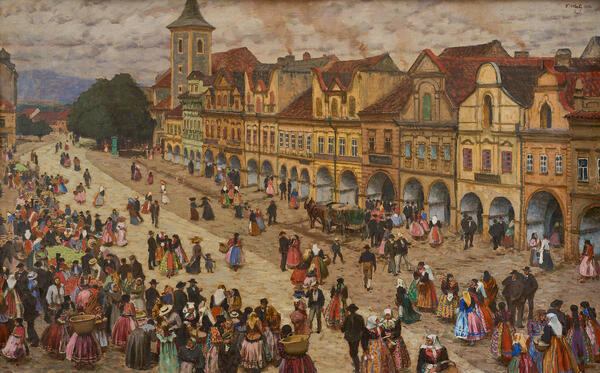


The Astrakhan Art Gallery houses two paintings by the Czech artist Vaclav Maly. They have a common theme — life of the Czech province in the late 19th — early 20th century. “Sunday in Taus” (“Sunday in Domažlice”) and “Peasants (Bohemia)” are oil-on-canvas paintings. They came to the gallery from the collection of the Austrian merchant Otto Yakovlevich Wiblinger.
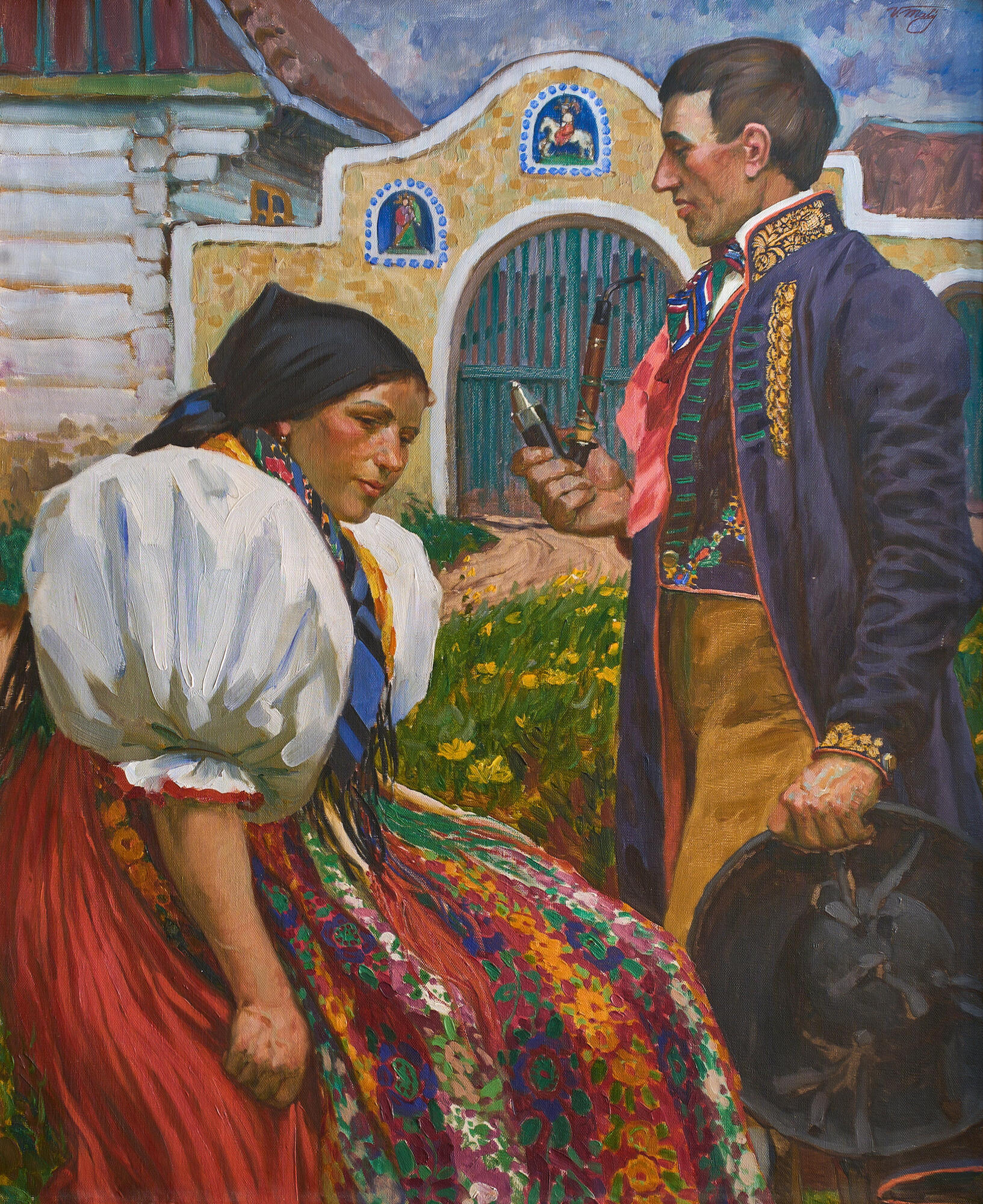
The bright, multicolored canvas by the Czech artist Vaclav Maly is distinguished by the artist’s special attention to detail. A characteristic feature of the Chod regional dress (an ethnic group in the Western Czech Republic) is a dark headscarf (dark blue for brides or black for married women) with embroidery at the ends and a long fringe around the edges. In order for the scarf to take the correct shape, the hair on the top of the head is fixed with a special comb, which allows not only to hide all the strands of hair under the headdress, but also to carefully tie a fairly heavy kerchief. One end is placed over the right shoulder, and the other lies on the neck so that the luxurious embroidery in the form of large flowers is visible.
Even today, if a woman wears a dark blue scarf, it is a sign that she is already a betrothed bride. Married women wear black shawls decorated with embroidery that is not as ornate.
The Chods used the blue color mainly in men’s clothing. This color symbolized a man’s willingness to protect a woman. If a Chod man gave a young woman a blue handkerchief, it was a gesture indicating that he was ready to protect his chosen bride. Therefore, such a gift was made immediately before the matchmaking process. Having accepted the gift, the maiden thereby agreed to marry the man. In this case, the matchmakers could start their work. By refusing the gift, she declined the offer.
It can be assumed that the couple depicted in Maly’s painting has already set a wedding day, as the peasant woman’s shawl is dark blue.
According to popular beliefs, the blue color helped to preserve peace and harmony in the family, so it was used not only for accessories, but also for decorating house facades. Above the gates of the peasant house depicted by Maly, one can notice tiles with religious images. One of them shows St. George the Victorious in a traditional scarlet cloak, piercing a serpent with a spear, and the other features an angel.