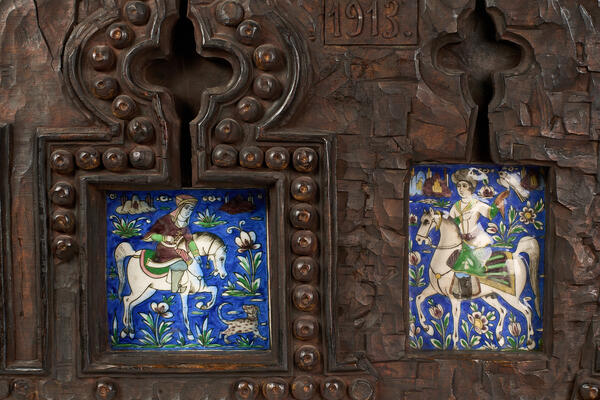
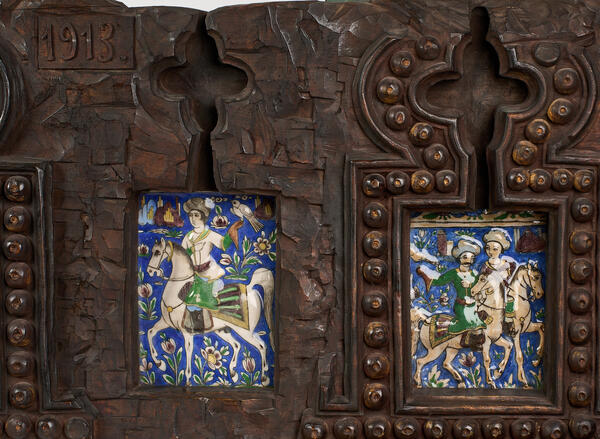
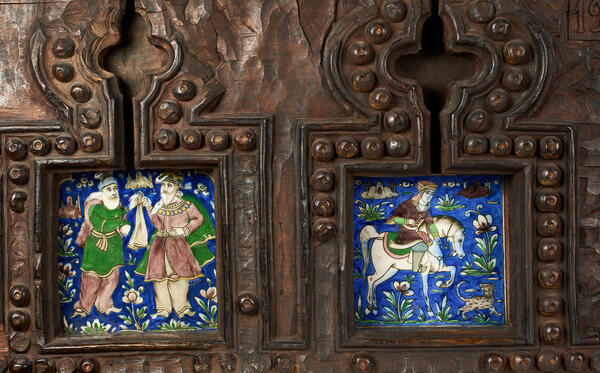
The Austrian businessman and passionate collector Otto Yakovlevich Wiblinger showed a special interest in decorative and applied art. By 1914, his Astrakhan house had a rich collection of Asian and Eastern art. For some items in his collection, Wiblinger commissioned special carved cabinets, stylized stands and frames, which were executed masterfully and with great taste.
In 1918, Wiblinger’s rich and diverse collection marked the beginning of the Astrakhan Art Gallery and its collection of foreign decorative and applied art. The Hall of Asian and Eastern Art displays a composition of four ceramic tiles made in the majolica technique.
In the Arab East, majolica with a shiny glaze with a characteristic metallic sheen called luster (glaze with the addition of lead gave a silvery sheen, glaze with the inclusion of copper — a golden-reddish sheen) became widespread after the ban on luxury. Household items were no longer decorated with precious stones and metals, instead, these materials were replaced by lead glaze. It is characterized by brightness, brilliance and unsurpassed decorative properties — vibrant and deep color of the pigment.
The tiles on display were acquired by Otto Wiblinger shortly before his departure from Russia. It is likely that the collector commissioned a frame for this decorative composition. The frame vaguely resembles a carved kiot (case) for Orthodox icons. It is similar to works made in the style of Expressionism. The wood is rather roughly chiseled. It was made by an unknown artist and dated 1913.
The composition of the tiles includes scenes that
reveal different sides of the man’s world in the East: a scene with merchants
coming to an agreement, and three plots from aristocratic life — hunting with
dogs and falconry. These ceramic tiles could serve as decorations for rooms in
the men’s half of the house (palace), or they could be displayed on the gates
of the house. The images are realistic; the artist meticulously painted the
details of the characters’ clothes and poses of the dogs. He used elements of
landscape painting as well.