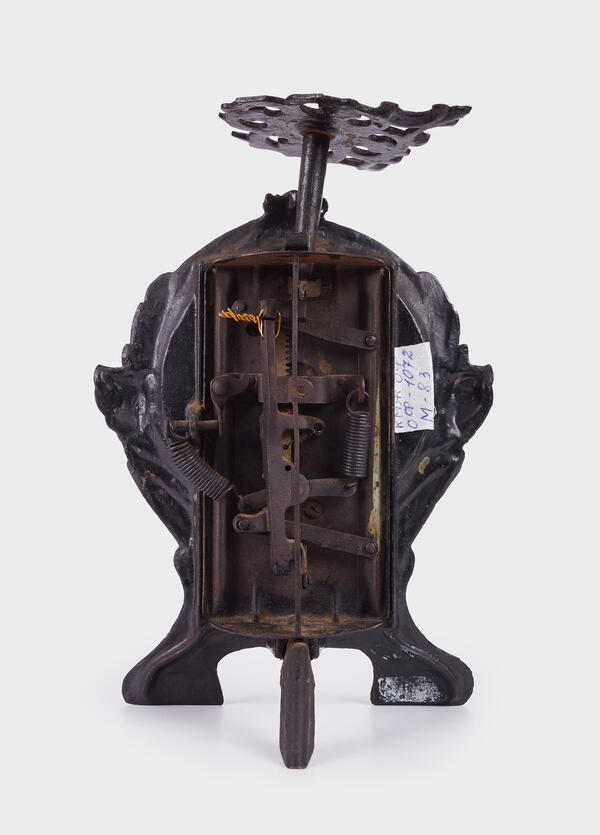
The Zheleznodorozhny Local Lore Museum presents scales belonging to the category of dial spring scales. Spring scales were invented in 1698 by the German scientist Christoph Weigel; they consisted of a slowly compressing spring and a pointer and worked without moving weights. The pointer showed the value as soon as the load was placed on the scales.
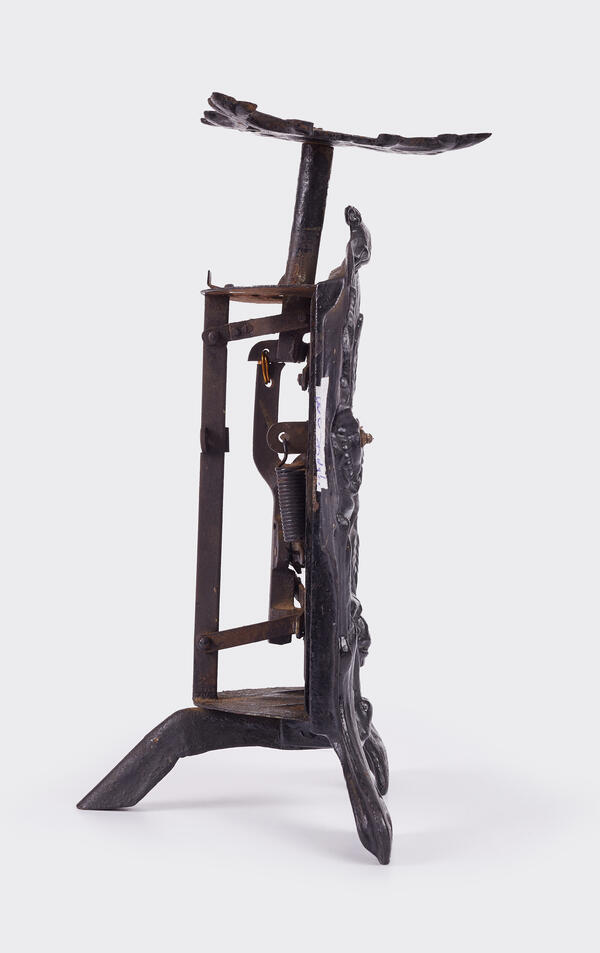
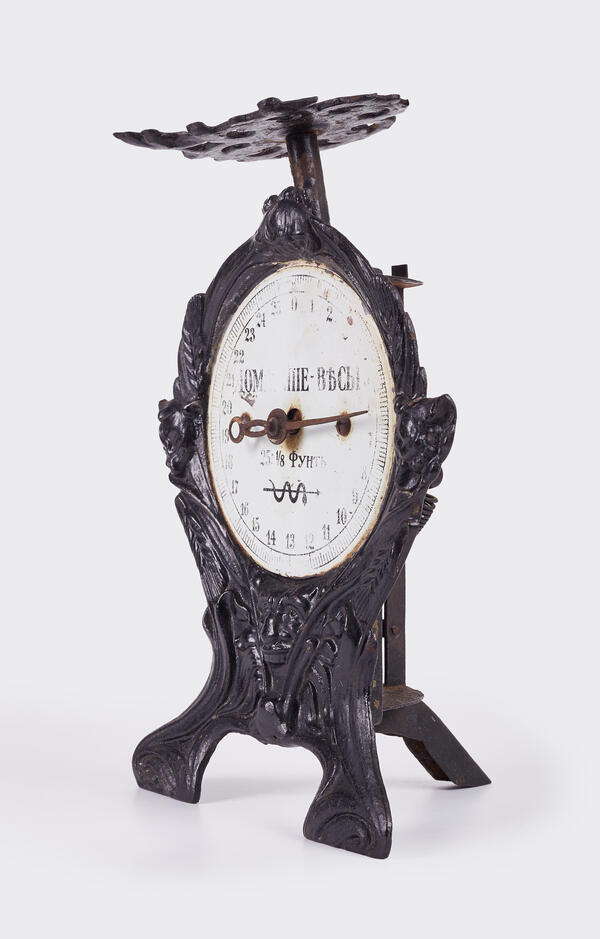
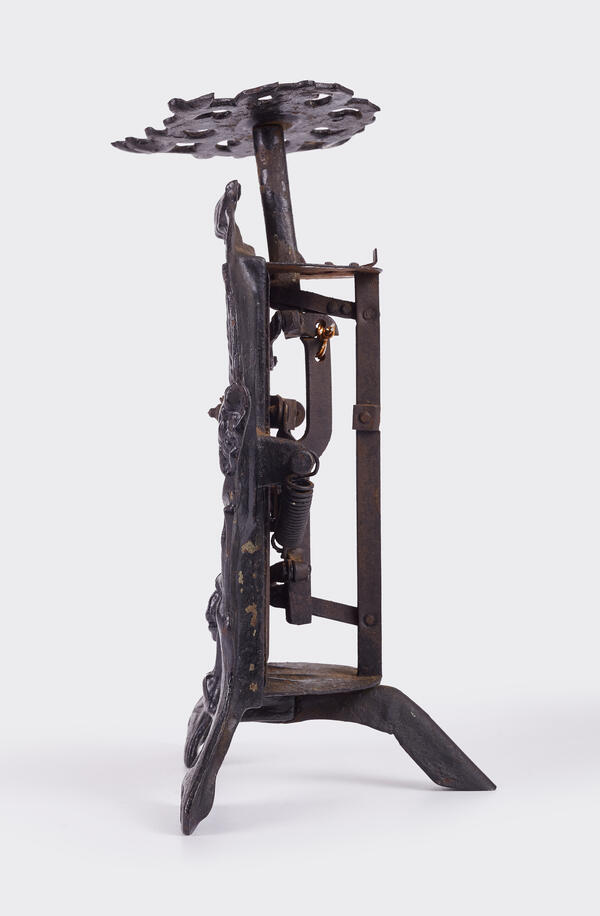
The round metal dial of the scales also indicates their purpose — for domestic use. The base rests on three legs. An openwork base for a scale pan is attached to a cylindrical rod. The scales measure in pounds, and the load capacity is 25 pounds. The front part of the case is a cast-iron bas-relief made in the Art Nouveau style, which indicates the period of creation — the turn of the 20th century. The scales are decorated with smooth and curved lines characteristic of this style, the most common motif of Art Nouveau (a flower, in this case a poppy), and an element of floral pattern — a grain ear. At the bottom of the scales is a mask of a fantastic character — a decorative element that found its way into household items from the architecture of the early 18th century.
The scales were produced by the Krups company, as evidenced by the manufacturer’s mark with the image of a snake with an arrow, located on the dial. The company was founded in 1846 by Robert Krups, who created an industrial enterprise in the city of Wald (Germany) based on the forge of his uncle Josua Cortz. The company specialized in making spring scales. The scales from the museum’s collection were produced specifically for Russia. Today, Krups is a German brand producing coffee makers and coffee machines.
Due to excessive errors, spring scales were used
for weighing goods only at home: merchants did not use them and preferred more
reliable balance scales. In the mid-19th century, spring scales
began to be used in situations that did not require high accuracy in Western
Europe, Asia, America and the Russian Empire. Even though the demand for spring
scales in many countries began to decline by the beginning of the 20th century, they were still used in everyday life for a whole century.