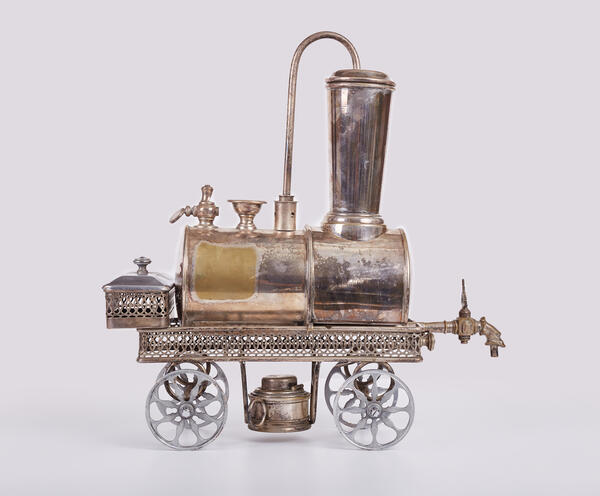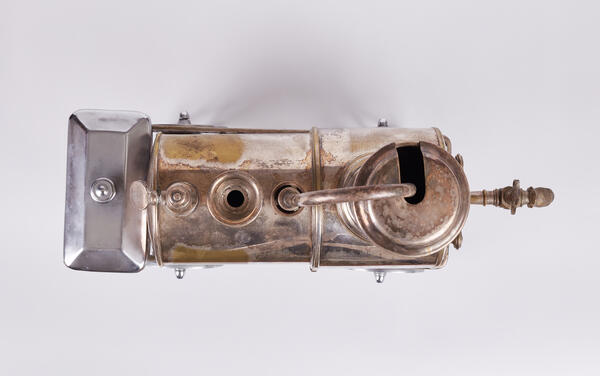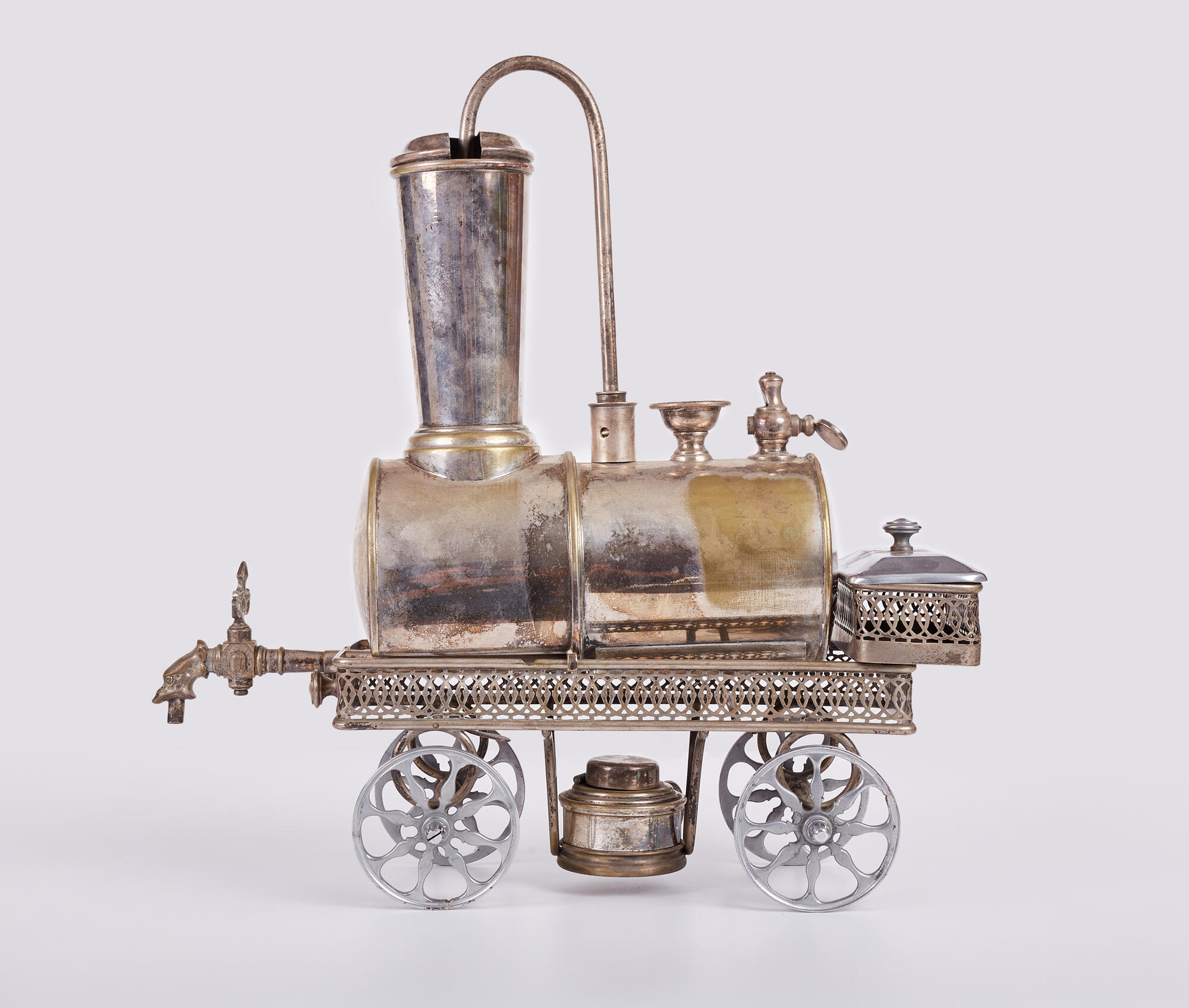


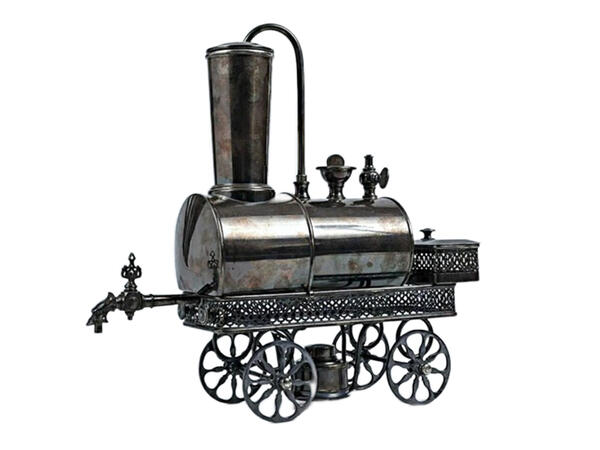
The samovar collection of the Zheleznodorozhny Local Lore Museum is adorned with a very unusual bouillotte samovar, shaped like a steam locomotive.
The bouillotte can be considered “the younger sister” of the samovar. Structurally, it is the same as the samovar and includes a horizontal four-wheeled cart, a container for sugar, a cylindrical body, a kindling pipe, a tap and a blower. The water in the samovar is heated using an alcohol lamp, after which the locomotive pulls forward, its body tilts, and a whistle sounds. When the body returns to its original position, the cap closes the wick of the alcohol lamp, the fire goes out, and the whistling stops.
The presented “steam locomotive” was manufactured in the 19th century by the famous Warsaw company Norblin & Co. The factory, renowned for its elegant and high-quality samovars of unusual shape, was founded by the industrialist Wincent Norblin (1805–1872). In 1870, items made at the Norblin & Co manufactory were presented at the All-Russian Industrial Exhibition in Saint Petersburg, where they were awarded a silver medal for their high quality, and the factory was given the right to mark all the products with the double-headed eagle — the coat of arms of the Russian Empire. It was determined that the silver was applied to a metal base using the electroplating method, as evidenced by the inscription on the stamping — GALW, from the Polish word galwanizacja (meaning “galvanization”).
In the 1870s, the Norblin company fully switched to galvanic processing of products. By the end of the 19th century, a new, more advanced technology of applying silver had practically replaced the previously existing methods of silver plating. In 1872, Ludwik Norblin bought the business of the Buch Brothers. In 1893, Ludwik Norblin, the Buch brothers and Teodor Werner organized the joint stock company Norblin, Buch Brothers and T. Werner. The factory survived the First World War but shut down in 1939.
In
Russia, bouillottes were produced in Tula, Moscow and Saint Petersburg, but after
the revolution they were abolished, since they were considered a luxury item,
and samovars became increasingly popular. The nobles who supported the European
lifestyle continued to use bouillottes for a long time.