

The Shors belong to the indigenous Turkic-speaking peoples of Southern Siberia, who have lived in the Kemerovo region, the Republic of Khakassia, and the Altai Territory. Historically, there were two ethnic groups: the Aba, who were farmers and cattle breeders and inhabited the forest-steppe, and the mountain-taiga Shors, who mainly practiced fishing, gathering, hunting, and various crafts, including weaving, dressing leather and carving horns.
The tallgrass, which sometimes is as tall as a rider on horseback, does not supply enough nutrients; there are mosquitoes, midges, horse flies, and gadflies galore; the summers are short — all this did not contribute to the development of cattle breeding, so the Shors used to keep only small numbers of cows and sheep. However, short, hardy horse breeds were commonly used for riding, and horsehair was suitable for many household needs.
The historian and archaeologist Dmitry Evgenyevich Kichigin claims that horsehair is one of the three most common natural materials used by the peoples of the Cis-Baikal region, along with wild nettle (or hemp) and tendons. Horsehair was used for sewing together and making nets, seines, lassos, reins, crossbow strings, as well as for fastening birch bark objects. According to the scientist, horsehair began to be used in the Cis-Baikal region no later than the end of the Bronze Age, and “the possibility of obtaining horsehair from a wild horse at an even earlier time” cannot be ruled out.
The Siberian ethnographer Vatslav Leopoldovich Seroshevsky noted that products made from this material are durable, “light, strong, dry quickly, and do not decay much.” The specific strength and stiffness of horsehair can be compared to those of steel wire with the same diameter.
To make ropes, horses’ manes and tails are cut. Dmitry Kichigin cites Viktor Butanov and Vyacheslav Darzh and describes two methods of weaving that different indigenous peoples have. The Tuvans have a simple practice of knotting a thread from several hairs, folding it in half and twisting a thin cord. The Khakass first twist strands of hair into rings, moisten and connect their ends; then women twist the threads in their palms, and the men make lassos.
Such ropes were used not only in everyday life, but also in shamanic rituals — they served as amulets and helped summon and capture evil spirits.
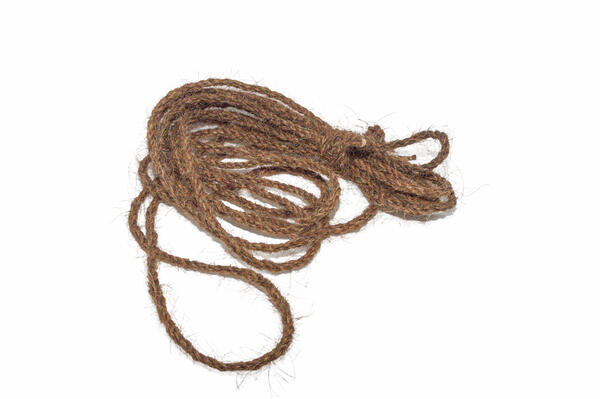
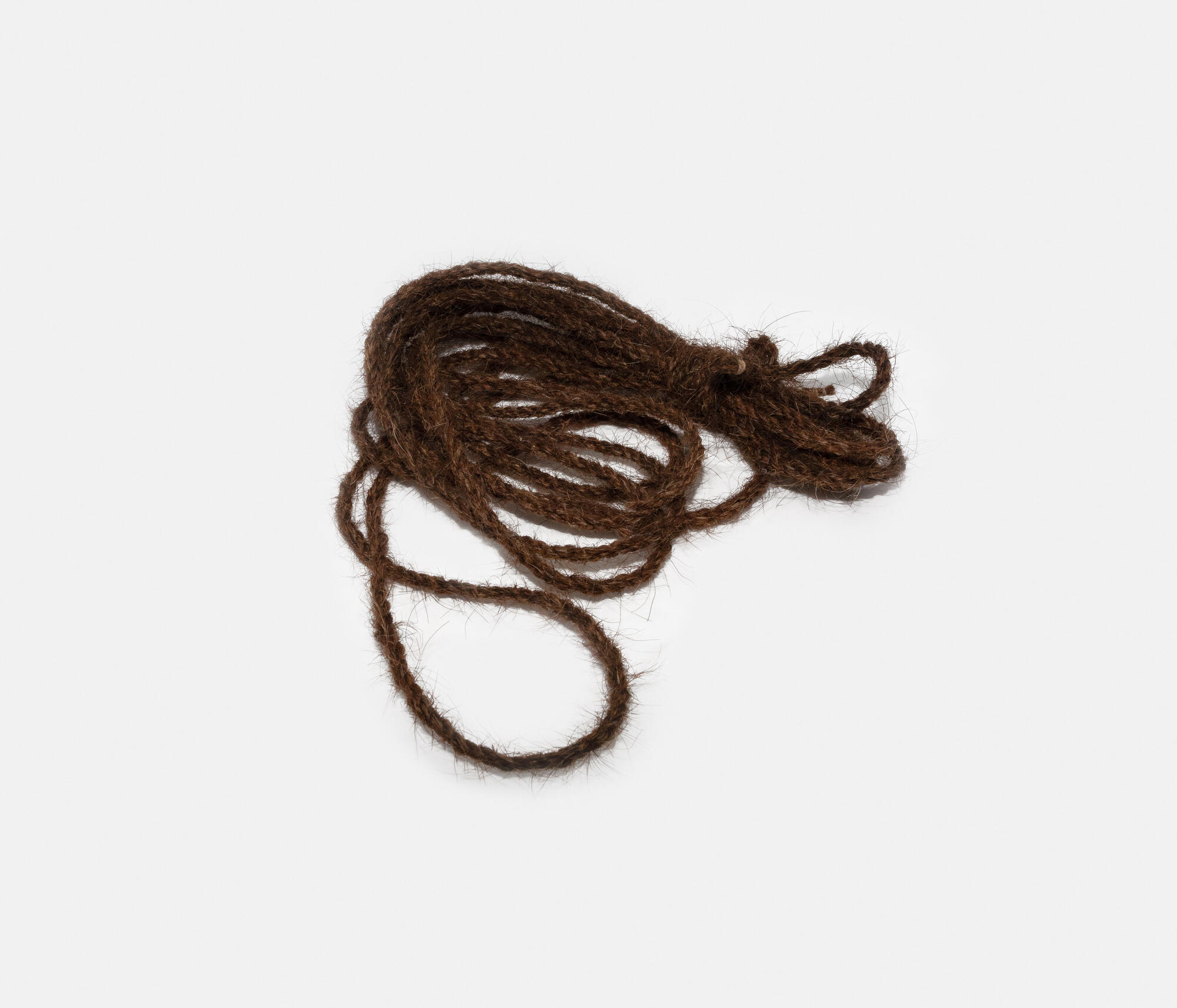
The horsehair rope that is on display at the museum
is made from two thinner horsehair ropes that are mostly light yellow and gray,
with some parts being black. The ends of the ropes are woven together.