Font
Color
Graphics
Изображение точки

To see AR mode in action:

1. Install ARTEFACT app for iOS or Android;

2. Find the exhibition «The Indigenous People: Lifeways and Trades»

3. Push the «Augmented reality» button and point your phone's camera at the exhibit;

Скрыть точки интересаПоказать точки интереса
Показать в высоком качестве

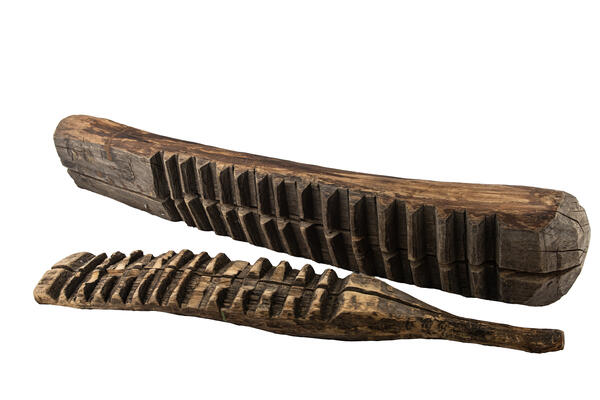
Grater rollers

Creation period
the early 20th century
Place of сreation
Gornaya Shoria, the Russian Empire
Dimensions
big — 87x17x9 cm, small — 69x11x4 cm
Technique
wood, carving
0
Open in app
#2

In the pine nut industry, every third year was considered the most productive. The Shors started collecting pine nuts from mid-August, when the cones were so ripe that they fell to the ground. Harvesting lasted until late autumn, usually until the first snow.

Each large family (“seok”, “seyok”) harvested nuts in its own area, which was called “pagla” (literally “place for climbing”).

After there was no resin left in the cones, they were peeled on ushpe rollers to extract the nuts. The Siberian researcher Sergey Porfiryevich Shvetsov described this process as follows:
#8

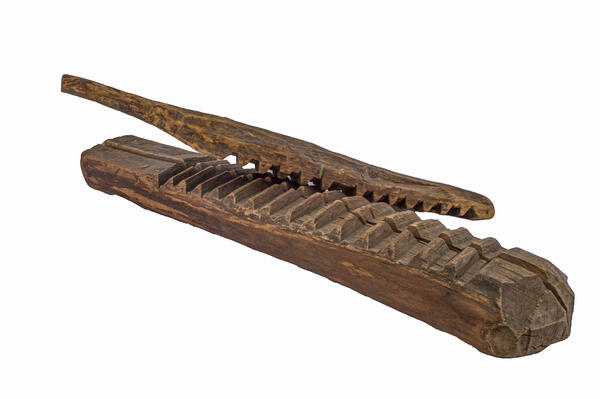
When cleaning a nut, a worker sits on the smooth end of the bottom board, throws nut cones onto the notches, which he rubs with the teeth of another board, holding the latter with both hands.

#9

The exhibition features a pair of wooden grater rollers with transverse, triangular ribs. The longer lower one with 15 ribs was the base; a whole cone was placed on it. The upper roller was used for grinding.

An ushpe should not be confused with another type of grater called paspak.

The textbook of the Shor language, edited by the linguist Elektron Fyodorovich Chispiyakov, offers the following definitions:

#6

An ushpe is a roller with notches for breaking cedar cones, ” “a paspak is a grain grater, a stone grater.

#7

Using a paspak began after the cones had been peeled off. In addition, the paspak was used to grind grain into flour. According to ethnographers, three ancient Shor devices with the same purpose have survived to this day: a paspak (also suitable for grinding salt), a manual stone mill called “terben” with two millstones, and a “sak” — a wooden mortar with a pestle, carved from cedar, less often birch or aspen. Flour-milling work was done by women, while peeling cedar cones was, as a rule, the responsibility of men.

Back in 1859, the missionary Vasily Ivanovich Verbitsky noted:

#4

Their common vice [of the wealthy Mrassu Shors] is extortion: without high interest they will not lend to the poor.

#5

Pine nuts, like furs, were the only way (besides labor) for hunters to pay for purchased goods, and according to historians, local creditors took advantage of it.

#10
Grater rollers
#3
read morehide
00:00
00:00
1x

Grater rollers

Creation period
the early 20th century
Place of сreation
Gornaya Shoria, the Russian Empire
Dimensions
big — 87x17x9 cm, small — 69x11x4 cm
Technique
wood, carving
0
Point your smartphone camera to open in the app
Share
VkontakteOdnoklassnikiTelegram
Share on my website
Copy linkCopied
Copy
Open in app
To see AR mode in action:
  1. Install ARTEFACT app for 
  2. iOS or Android;
  3. Find and download the «Paintings in Details» exhibition
  4. Push the «Augmented reality» button and point your phone's camera at the painting;
  5. Watch what happens on your phone screen whilst you flip through the pictures.
 
We use Cookies
Cookies on the Artefact Website. We use cookies to ensure that we give you the best experience on our website. If you continue without changing your settings, we'll assume that you are happy to receive all cookies on the Artefact website. However, if you would like to, you can change your cookie settings at any time.
Learn more about useHide
Content is available only in Russian

X

Нашли опечатку?...

%title%%type%