A float is one of the oldest and most popular fishing devices. In its working vertical position, its lower end goes under the water, while its surface part is used for observation. During the fishing process, the float performs two functions: holding a hook with bait or a fishing net at a given depth and signaling a bite. Additionally, it helps to cast the bait to the desired distance.
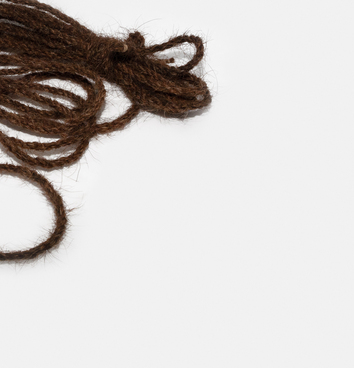
The Shors often used seines and nets made of horsehair, hemp, or nettle. For weaving, they used rulers to measure the size of the mesh cells and a needle to wind the threads.
The Shors used nets to surround an area in large bodies of water, stepped into the water or went in boats to stir up the water and scare the fish. The fish began to move in all directions and, as a result, got caught in the nets.
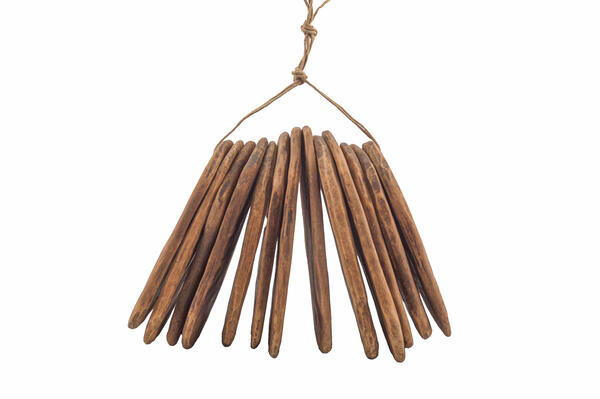
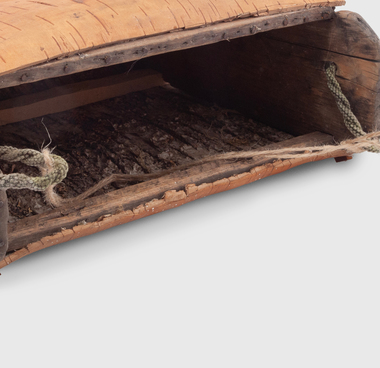
The floats came in different sizes depending on the size of the nets. For “engme” nets, the Shors made wooden or birch bark “beacons”, which were secured at the top edge.
The combined “kamnyk achi” net, which was nine meters long and one meter wide, had cells of different sizes to catch different types of fish — both large and relatively small ones. The upper part of the product, starting from the floats, had large cells so that the biggest fish could pass through. Below there were smaller cells to catch, for example, a large grayling. Next were rows of even smaller cells for a smaller grayling, and at the very bottom were the smallest ones for small fish.
Weights made of beaten river pebbles were attached to the lower edge of the net. They were tied with cedar root to a bowstring — a rope stretched along the entire net.
There was another type of net designed for night fishing — without sinkers. In this case, a net was suspended across the river downstream, and the fishermen sailed along it in boats, attaching the upper end of the net to a long pole. As soon as the fish got in the trap, the pole began to shake, like a float, catching the vibrations, and the fishermen came to take the caught fish out of the water.
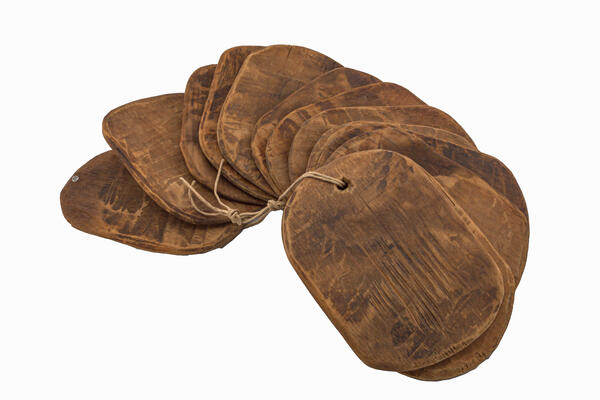
The museum displays a set of floats — oval wooden
boards — for the seine called “tab”, “tyukod”, or “balber”.