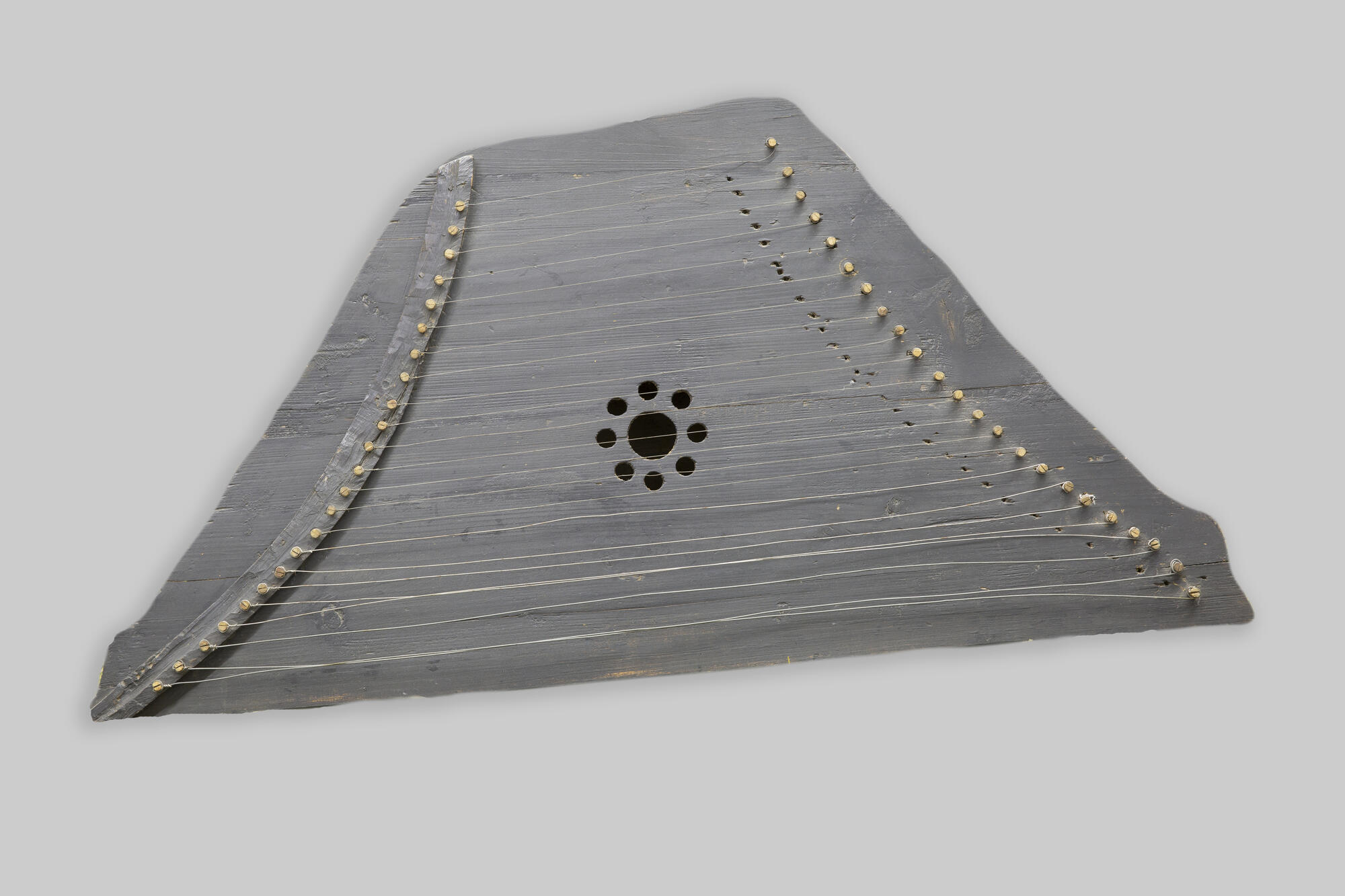


The krez is a stringed plucked musical instrument of the Udmurts. The krez is similar in construction to other stringed plucked instruments such as the Russian gUsli or the Karelian kantele. Translated from the Udmurt language, ‘krez’ means ‘song, melody.’ Krezes were typically manufactured by musicians who played it—krezchi. To be played, the instrument is placed on the musician’s knees with its semicircle towards them; the melody is played with the right hand, and the bass is played with the left. The krez produces clear and light sounds.
The musical instrument presented in the exhibition was made in the early 20th century by Kuzma Bashenin, a resident of the Stary Senteg village. The instrument has 23 strings.
Manufacturing process for the krez included soaking the material in hot water several times and drying it for up to three years to make the sound crisper. The boards cut for the krez were rubbed with boiled hemp oil. The wood turned yellow and could no longer absorb water. Dark hue of the instrument was typically a result of prolonged storage or use near the open flames within the ancestral sanctuary.
The strings were made from horsehair; later, strings of fishing line and metal were used. Spruce, pine, birch, and aspen were used to manufacture select parts. According to an Udmurt legend, InmAr, the head of the pantheon who resided in heaven, chose the tree from which the krez should be made by striking it with a lightning bolt.
The legends of the Udmurts have even preserved the origin of the first krez: “Once upon a time, a wise old Spruce lived in a dense forest. They called her Mudor-Kyz—the Forest Mother. They said that the Forest began with her; perhaps, the whole world began with her. The Spruce propped up the heavens and kept it from falling onto the earth. The sun rested on its branches. In its roots, there was a spring from which the mighty river of White Kama began. People came from far away to pay their respects to Mudor-Kyz. But eventually the Sun”s evil stepmother, Lightning, has set fire to the Spruce. Mudor-Kyz perished in that fire. But then a man came and revived her — he made a krez from her trunk and imbued the instrument with his own human soul. So people got Bajym Krez - the Great Zither. When they were played, the Sun leaned closer to the earth to hear them. When they sang “Invu Utchan Gur” - “Melody of Heavenly Dew”, the sky cried and its tears fell as rain… “.
A krez could have a variable number of stings and could be larger or smaller, depending on its purpose. Bajym, or Great Krez, is the largest kind, with over 20 strings. The krez was an iconic musical instrument used during public prayers and ceremonies.
Smaller krezes were played during holidays and festivities. They were roughly identical in construction: the semicircular top with strings and a resonator box body. Several resonating strings were typically installed within the body.
The musical instrument presented in the exhibition was made in the early 20th century by Kuzma Bashenin, a resident of the Stary Senteg village. The instrument has 23 strings.
Manufacturing process for the krez included soaking the material in hot water several times and drying it for up to three years to make the sound crisper. The boards cut for the krez were rubbed with boiled hemp oil. The wood turned yellow and could no longer absorb water. Dark hue of the instrument was typically a result of prolonged storage or use near the open flames within the ancestral sanctuary.
The strings were made from horsehair; later, strings of fishing line and metal were used. Spruce, pine, birch, and aspen were used to manufacture select parts. According to an Udmurt legend, InmAr, the head of the pantheon who resided in heaven, chose the tree from which the krez should be made by striking it with a lightning bolt.
The legends of the Udmurts have even preserved the origin of the first krez: “Once upon a time, a wise old Spruce lived in a dense forest. They called her Mudor-Kyz—the Forest Mother. They said that the Forest began with her; perhaps, the whole world began with her. The Spruce propped up the heavens and kept it from falling onto the earth. The sun rested on its branches. In its roots, there was a spring from which the mighty river of White Kama began. People came from far away to pay their respects to Mudor-Kyz. But eventually the Sun”s evil stepmother, Lightning, has set fire to the Spruce. Mudor-Kyz perished in that fire. But then a man came and revived her — he made a krez from her trunk and imbued the instrument with his own human soul. So people got Bajym Krez - the Great Zither. When they were played, the Sun leaned closer to the earth to hear them. When they sang “Invu Utchan Gur” - “Melody of Heavenly Dew”, the sky cried and its tears fell as rain… “.
A krez could have a variable number of stings and could be larger or smaller, depending on its purpose. Bajym, or Great Krez, is the largest kind, with over 20 strings. The krez was an iconic musical instrument used during public prayers and ceremonies.
Smaller krezes were played during holidays and festivities. They were roughly identical in construction: the semicircular top with strings and a resonator box body. Several resonating strings were typically installed within the body.