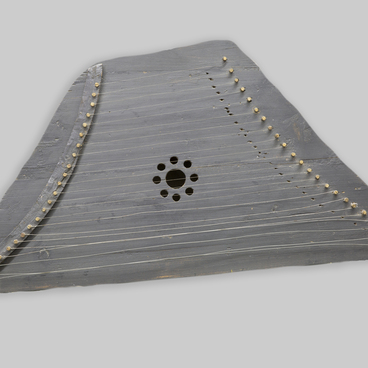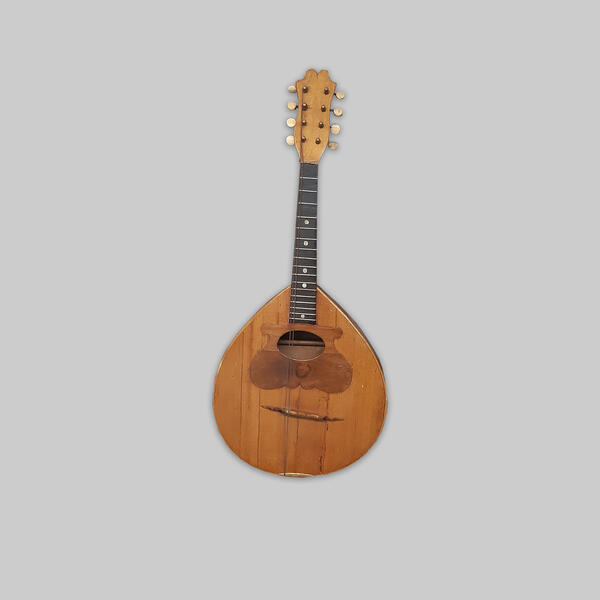
The exhibition showcases a mandolin made by P. F. Balakin, a gunsmith at the Izhevsk arms factory. Creating a mandolin is a complex, time-consuming, and meticulous work. A craftsman starts with making the bottom of the instrument. It is the most difficult stage. The bottom consists of several previously curved wooden strips, staves. Maple, nut-tree, or cypress are often used for this detail. The case of the exposed mandolin has an almond shape. Similar mandolins make a soft and strong sound.
A mandolin is a stringed musical instrument in the lute family of the Italian origin, which produces sounds by plucking. A mandolin is smaller than a lute, has a shorter finger board, and a smaller number of strings. A player plucks strings with a plectrum, fingers, or a bird’s feather. Tremolo technique is used to play a mandolin. As metal strings produce a short sound, a rapid reiteration of a single note produces a longer effect. The musical instrument was popular in Russia in the first half of the 20th century. In Russia, it was sometimes called “an onion.”
Many people associated the mandolin with Italian folk music. Indeed, the present-day instrument appeared in Italy in the late 18th century. Although its prototype was an Italian soprano lute of the late 17th century. The oldest of the existing mandolins dates back to 1744.
As the instrument was acquiring popularity in Europe, it gained different names. The modern version of a mandolin with steel strings, also called the Genoese mandolin, was first mentioned in works of the famous Italian musicians, like Gervasio Vinaccia, who travelled across Europe and taught people to play musical instruments. According to these historical notes, the modern mandolin was invented by members of Vinaccia family in Naples.
The mandolin became very popular in the late 19th – early 20th centuries. Dozens of thousands of instruments were made. The mandolin was imported to Russia in the first half of the 18th century. It became popular very quickly.
A mandolin is a stringed musical instrument in the lute family of the Italian origin, which produces sounds by plucking. A mandolin is smaller than a lute, has a shorter finger board, and a smaller number of strings. A player plucks strings with a plectrum, fingers, or a bird’s feather. Tremolo technique is used to play a mandolin. As metal strings produce a short sound, a rapid reiteration of a single note produces a longer effect. The musical instrument was popular in Russia in the first half of the 20th century. In Russia, it was sometimes called “an onion.”
Many people associated the mandolin with Italian folk music. Indeed, the present-day instrument appeared in Italy in the late 18th century. Although its prototype was an Italian soprano lute of the late 17th century. The oldest of the existing mandolins dates back to 1744.
As the instrument was acquiring popularity in Europe, it gained different names. The modern version of a mandolin with steel strings, also called the Genoese mandolin, was first mentioned in works of the famous Italian musicians, like Gervasio Vinaccia, who travelled across Europe and taught people to play musical instruments. According to these historical notes, the modern mandolin was invented by members of Vinaccia family in Naples.
The mandolin became very popular in the late 19th – early 20th centuries. Dozens of thousands of instruments were made. The mandolin was imported to Russia in the first half of the 18th century. It became popular very quickly.