

The painting ‘Barnabas of Vetluga’ was created by Tatyana Noskova, a teacher and a painter of the Chkalov Youth Club in Nizhny Novgorod. Despite the fact that at this time she was rather young, she turned to a highly spiritual plot, closely associated with the Nizhny Novgorod region.
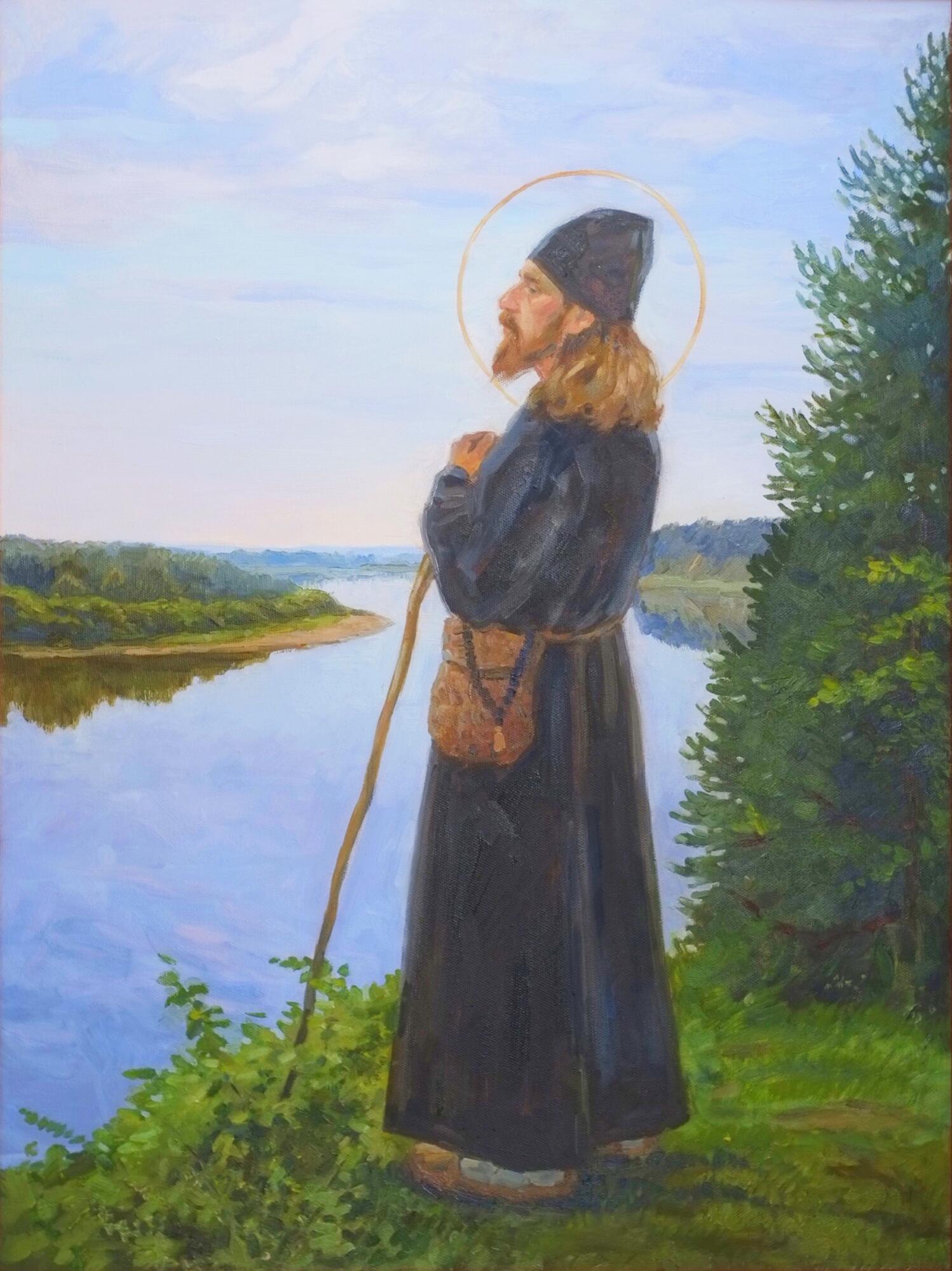
The painting depicts Barnabas of Vetluga, a young monk and priest, standing on Red Mountain, the steep bank of the taiga river Vetluga. According to the legend, he came to Povetluzhje in 1417. The time was very difficult: the region was ravaged by the Tatar-Mongol invasion, and the situation was aggravated by internal strife and constant raids by pagan Mari tribes. According to legends, the missionary activity of Barnabas and his sincere sermons helped to convert many Mari to Orthodoxy, and he also helped to alleviate internal strife. After his death, his followers built a monastery here, and then, the village of Varnavina monastery appeared nearby.
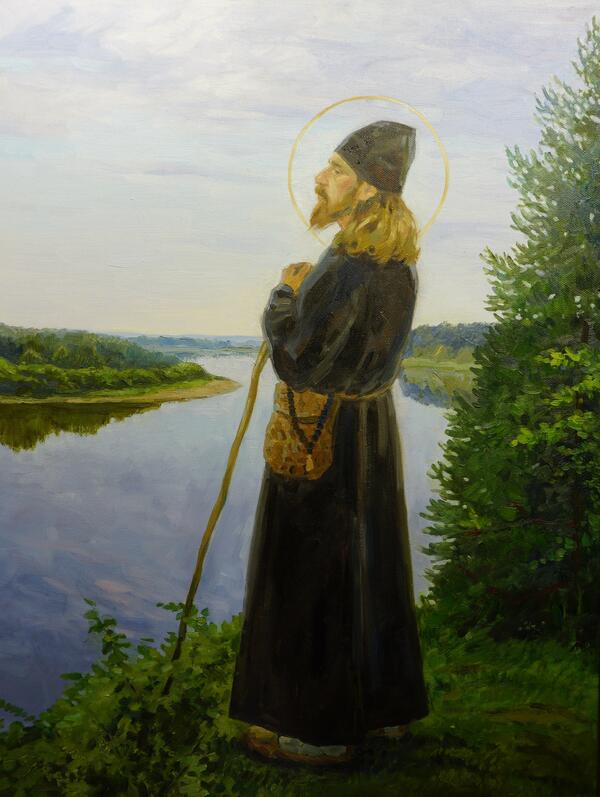
Noskova painted the monk Barnabas, dressed for the road: wearing a casual black headdress (skouphos), an inner cassock, and bast shoes. On his belt, there is a small purse with a monk’s rosary placed on top of it. The holy monk leans on a staff, he has his eyes closed, apparently at this moment he is saying a prayer. The painter probably shows the very moment when Barnabas came to the territories of Povetluzhje from Veliky Ustyug. He made this journey after his hometown was devastated by the pagan tribes, having decided to preach Orthodoxy to the pagans, in order to make them warm up towards Christians. According to one version, the monk decided to settle on Krasnaya Gora because this place reminded him of the steep high bank above the Sukhona River in the city of Great Ustyug.
Around the head of the Holy Reverend Barnabas, the painter painted a halo — a conventional designation of radiance around the heads of Christ, of the Mother of God and of other saints, which symbolize their holiness. The halo can come in different shapes: round, triangular, hexagonal and in the form of a golden ring that outlines the head. It was the last option that Noskova chose. Such depiction of a halo is characteristic of the Catholic tradition, but in this case it doesn’t matter: it is a artistic portrait of an Orthodox saint, and not his canonical sacred image.
The painting depicts Barnabas of Vetluga, a young monk and priest, standing on Red Mountain, the steep bank of the taiga river Vetluga. According to the legend, he came to Povetluzhje in 1417. The time was very difficult: the region was ravaged by the Tatar-Mongol invasion, and the situation was aggravated by internal strife and constant raids by pagan Mari tribes. According to legends, the missionary activity of Barnabas and his sincere sermons helped to convert many Mari to Orthodoxy, and he also helped to alleviate internal strife. After his death, his followers built a monastery here, and then, the village of Varnavina monastery appeared nearby.
Noskova painted the monk Barnabas, dressed for the road: wearing a casual black headdress (skouphos), an inner cassock, and bast shoes. On his belt, there is a small purse with a monk’s rosary placed on top of it. The holy monk leans on a staff, he has his eyes closed, apparently at this moment he is saying a prayer. The painter probably shows the very moment when Barnabas came to the territories of Povetluzhje from Veliky Ustyug. He made this journey after his hometown was devastated by the pagan tribes, having decided to preach Orthodoxy to the pagans, in order to make them warm up towards Christians. According to one version, the monk decided to settle on Krasnaya Gora because this place reminded him of the steep high bank above the Sukhona River in the city of Great Ustyug.
Around the head of the Holy Reverend Barnabas, the painter painted a halo — a conventional designation of radiance around the heads of Christ, of the Mother of God and of other saints, which symbolize their holiness. The halo can come in different shapes: round, triangular, hexagonal and in the form of a golden ring that outlines the head. It was the last option that Noskova chose. Such depiction of a halo is characteristic of the Catholic tradition, but in this case it doesn’t matter: it is a artistic portrait of an Orthodox saint, and not his canonical sacred image.