The author of the vibrant landscape ‘Autumn. Stubs’, Valery Krylatov was born in 1960 in the village of Krasnye Polyany near Kirov, but his formation as a painter took place in the Nizhny Novgorod lands. Having graduated from the prestigious Repin Institute in St. Petersburg (formerly the Academy of Arts), he returned to Nizhny Novgorod that he knew since his youth, where he soon became a teacher at a local school of arts. It was here that he developed not only a brilliant pedagogical career, but also finally found his personal artistic language.
In 1993, Krylatov was admitted to the Union of Artists of Russia and he had a personal exhibition arranged for him in the building of the Nizhny Novgorod Fair. During the exhibition, in particular, he showed the multi-figured painting ‘We can’t forget!..’ dedicated to the victims of Stalin’s repressions. In 2012, he became a laureate of the Kostroma exhibition and competition ‘Portrait of the Motherland in the Works of Teachers and Artists’ and a laureate of the Nizhny Novgorod Prize in the field of fine arts. Since the 1990s, the painter often visited France, where he painted sketches, landscapes of Paris, Marseille and Normandy, as well as portraits. There he repeatedly had his personal exhibitions.
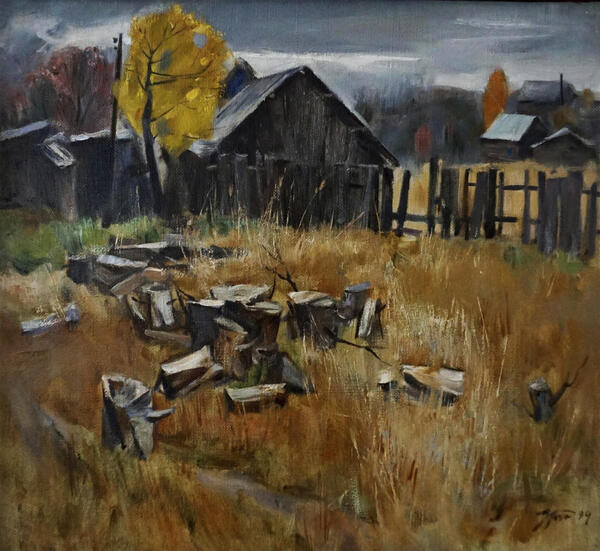
In his landscape works, Krylatov aspires to reveal the discreet beauty of Russian nature. This is the goal he wanted to achieve with the painting ‘Autumn. Stubs’. It is entitled so due to the image of blockheads in the foreground. Within the space of the canvas, the painter shows a gloomy autumn, but at the same time it looks very colorful, thoughtful and even philosophical. This is how he set an original contrast: on the one hand, Russian nature is shown here through a riot of colors, and, on the other hand, its discreetness and silent charm are preserved.
It is important to note that in the painting ‘Autumn. Stubs’, the painter perfectly shows a simple, even a mundane plot. The ability to notice and to show the charm of the most low-key features of the surrounding world is characteristic for Krylatov’s art. This point of view is expressed, among other things, by Elizaveta Surganova, an employee of the Nizhny Novgorod Art Museum, noting that Krylatov’s painting has a subtle lyricism, and that he can show the ‘quiet joy of being’. Krylatov himself emphasized that the main goal in his art and life is not to become insensitive and cold-hearted.
In 1993, Krylatov was admitted to the Union of Artists of Russia and he had a personal exhibition arranged for him in the building of the Nizhny Novgorod Fair. During the exhibition, in particular, he showed the multi-figured painting ‘We can’t forget!..’ dedicated to the victims of Stalin’s repressions. In 2012, he became a laureate of the Kostroma exhibition and competition ‘Portrait of the Motherland in the Works of Teachers and Artists’ and a laureate of the Nizhny Novgorod Prize in the field of fine arts. Since the 1990s, the painter often visited France, where he painted sketches, landscapes of Paris, Marseille and Normandy, as well as portraits. There he repeatedly had his personal exhibitions.
In his landscape works, Krylatov aspires to reveal the discreet beauty of Russian nature. This is the goal he wanted to achieve with the painting ‘Autumn. Stubs’. It is entitled so due to the image of blockheads in the foreground. Within the space of the canvas, the painter shows a gloomy autumn, but at the same time it looks very colorful, thoughtful and even philosophical. This is how he set an original contrast: on the one hand, Russian nature is shown here through a riot of colors, and, on the other hand, its discreetness and silent charm are preserved.
It is important to note that in the painting ‘Autumn. Stubs’, the painter perfectly shows a simple, even a mundane plot. The ability to notice and to show the charm of the most low-key features of the surrounding world is characteristic for Krylatov’s art. This point of view is expressed, among other things, by Elizaveta Surganova, an employee of the Nizhny Novgorod Art Museum, noting that Krylatov’s painting has a subtle lyricism, and that he can show the ‘quiet joy of being’. Krylatov himself emphasized that the main goal in his art and life is not to become insensitive and cold-hearted.