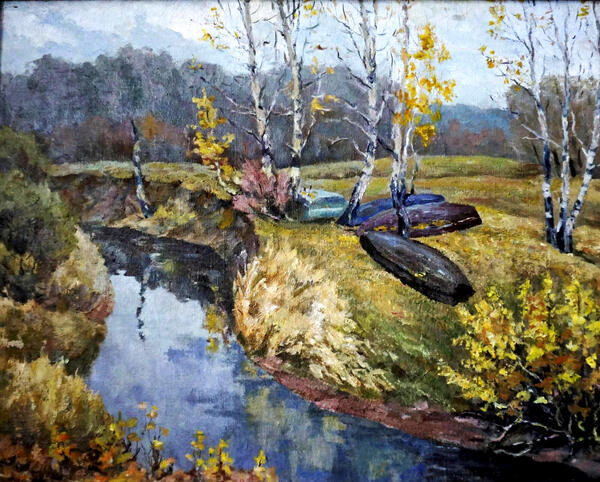
Valery Smirnov, a self-taught painter, was born in 1950. Coming from a family of peasants, he could have inherited the talent for painting from his father, a school teacher, who, in his free time, copied famous paintings. Otherwise, the art of Smirnov can’t be fully explained: he completed his first painting at almost 40 years old, and the landscape “Boats” was painted by him in 1995, at the age of 45.
In this picture, he depicted Popovka, a small river, which flows in the Shudsky rural soviet of the Varnavinsky district. Boats lie on its riverbank, their dark and contrasting colors standing out even against the already vivid background: the painter managed to fully convey the charm of the late colorful autumn in the village. Smirnov gave his lyrical landscape the title “Boats”, which was not accidental: almost any inhabitant of the rural Varnavinsky district has seen a boat in one way or another.
Many forest rivers flow here, and the main one is the large Vetluga River. For almost all of the year fishermen take to the Vetluga River for difficult but necessary fishing. Their main transport is wooden dugout boats, which are depicted in this landscape painting. A dugout can also be called a single-line, a monoxil, a komyaga, a komelnik, or a dubovka. This is a flat-bottomed rowing boat, sometimes with a removable mast, made of a single tree trunk. Such boats usually have no keel (the lower horizontal beam that gives the stability to the vessel).
Dugout boats are often made from thick and short trunks of large trees. The boat’s sides are put into the desired shape during a complex process. First, the boat is soaked, which causes it to expand. After that, it is heated over a fire, and at this moment, until the boat hasn’t returned to its original volume, the sides are pressed with thin springy struts, which adjusts their bend.
The oldest dugout, as of today, was discovered in the territory of the modern Netherlands. Experts believe that it was created between the eighth and seventh millennia BC. The earliest archaeological evidences of the use of dugout vessels in Ancient Russia have been found in Staraya Ladoga: scientists discovered a dugout bench, dating back to the middle of the 8th century.
In this picture, he depicted Popovka, a small river, which flows in the Shudsky rural soviet of the Varnavinsky district. Boats lie on its riverbank, their dark and contrasting colors standing out even against the already vivid background: the painter managed to fully convey the charm of the late colorful autumn in the village. Smirnov gave his lyrical landscape the title “Boats”, which was not accidental: almost any inhabitant of the rural Varnavinsky district has seen a boat in one way or another.
Many forest rivers flow here, and the main one is the large Vetluga River. For almost all of the year fishermen take to the Vetluga River for difficult but necessary fishing. Their main transport is wooden dugout boats, which are depicted in this landscape painting. A dugout can also be called a single-line, a monoxil, a komyaga, a komelnik, or a dubovka. This is a flat-bottomed rowing boat, sometimes with a removable mast, made of a single tree trunk. Such boats usually have no keel (the lower horizontal beam that gives the stability to the vessel).
Dugout boats are often made from thick and short trunks of large trees. The boat’s sides are put into the desired shape during a complex process. First, the boat is soaked, which causes it to expand. After that, it is heated over a fire, and at this moment, until the boat hasn’t returned to its original volume, the sides are pressed with thin springy struts, which adjusts their bend.
The oldest dugout, as of today, was discovered in the territory of the modern Netherlands. Experts believe that it was created between the eighth and seventh millennia BC. The earliest archaeological evidences of the use of dugout vessels in Ancient Russia have been found in Staraya Ladoga: scientists discovered a dugout bench, dating back to the middle of the 8th century.