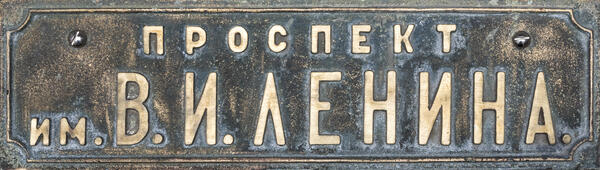
In 2016, this brass plate was specially dismantled for the museum exposition from one of the houses on the V. I. Lenin Avenue. There are almost no such plaques left now, they were replaced by plastic signs. However, for the residents of the city, it was the shiny brass plaques on the houses of the main street that became a symbol of the construction and prosperity of Severodvinsk.
About 20 years after the start of the construction of the city, the future Lenin Avenue was called ‘Arkticheskaya Street’ and was located on the outskirts of the city. After the end of the Great Patriotic War, the city’s population began to increase sharply. The city began to build up in a western direction. The former suburb street was rapidly changing its appearance. On both sides of the Arkticheskaya Street, multi-storey residential buildings were built, richly decorated with stucco decorations. Public buildings were erected on the street - the “Rodina” cinema, the House of an Engineer and Technical Worker, a library, shops on the first floors of the buildings. At the intersection with Lomonosov Street, in 1958, a monument to the great scientist was erected.
During the period of active development, a railway line was laid in the center of the street for the supply of building materials. In 1957, the track was removed and the street was asphalted. In the southern part of the Arkticheskaya Street, youth workers’ dormitories were built, and every morning a work stream was sent down the street towards the plant. In the evenings, the young workers liked to stroll around the Arctic, they called their place of walks ‘Brod’. In the mid-1950s, young trees grew green along the newly built houses. Each newcomer was obliged to work ‘on greening’ for 20 hours and plant several dozen ‘roots’.
In November 1957, for the 40th anniversary of the Great October Revolution, Arkticheskaya Street was renamed into V.I. Lenin Avenue. On May 1, 1958, a festive demonstration took place on Lenin Avenue for the first time. The final chord in the improvement of the city’s main avenue was the installation of shiny brass plaques on the houses. Unfortunately, over the years, the plaques have faded, and then most of them were lost.
About 20 years after the start of the construction of the city, the future Lenin Avenue was called ‘Arkticheskaya Street’ and was located on the outskirts of the city. After the end of the Great Patriotic War, the city’s population began to increase sharply. The city began to build up in a western direction. The former suburb street was rapidly changing its appearance. On both sides of the Arkticheskaya Street, multi-storey residential buildings were built, richly decorated with stucco decorations. Public buildings were erected on the street - the “Rodina” cinema, the House of an Engineer and Technical Worker, a library, shops on the first floors of the buildings. At the intersection with Lomonosov Street, in 1958, a monument to the great scientist was erected.
During the period of active development, a railway line was laid in the center of the street for the supply of building materials. In 1957, the track was removed and the street was asphalted. In the southern part of the Arkticheskaya Street, youth workers’ dormitories were built, and every morning a work stream was sent down the street towards the plant. In the evenings, the young workers liked to stroll around the Arctic, they called their place of walks ‘Brod’. In the mid-1950s, young trees grew green along the newly built houses. Each newcomer was obliged to work ‘on greening’ for 20 hours and plant several dozen ‘roots’.
In November 1957, for the 40th anniversary of the Great October Revolution, Arkticheskaya Street was renamed into V.I. Lenin Avenue. On May 1, 1958, a festive demonstration took place on Lenin Avenue for the first time. The final chord in the improvement of the city’s main avenue was the installation of shiny brass plaques on the houses. Unfortunately, over the years, the plaques have faded, and then most of them were lost.