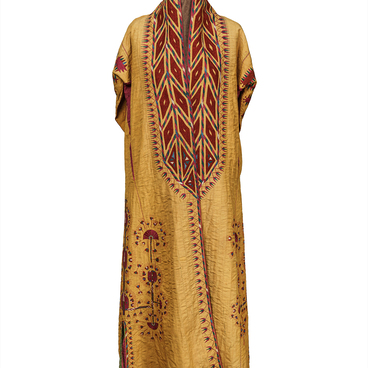
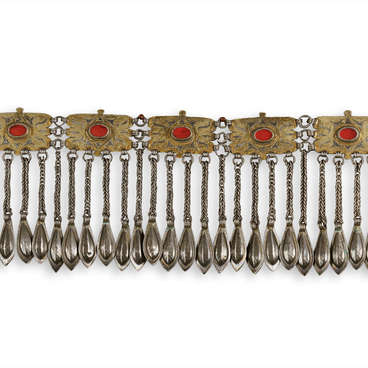
The art of jewelry making has long been developed among the peoples of Central Asia and Kazakhstan. Some jewelry pieces of these peoples once served as amulets, but later evolved to have purely aesthetic functions.
In Central Asia, jewelry was an integral part of the national dress and accompanied a woman throughout her life. Girls wore earrings in the first days after birth, because people believed that earrings protect the wearer. Particularly numerous and diverse were accessories made for girls aged 9 to 12, when they were already considered brides. The most difficult to manufacture was the set of wedding jewelry, which women wore until the birth of the first child. After the age of 30 to 35, the number of jewelry pieces tended to decrease, and by the age of 40 to 45, women typically wore simpler earrings and rings.
Turkmen jewelry, as a rule, is impressive, massive, with many pendants, abundantly covered with patterns and inlaid with semiprecious stones, like carnelian and turquoise.
According to researchers, accessories such as the tumar amulet were associated with various symbols. In each case, the choice of shape for the tumar — rectangular, triangular, round, cylindrical or prismatic — was thought out and dictated by its sacred properties.
In the view of ancient cultures, any form carried comprehensive representations linked to the geometric symbolism of the universe. The circle symbolized the celestial bodies — the sun and moon and their patronage; the square represented the earth and the cardinal points. The triangle — the most common and mysterious shape that has been used since ancient times — was associated with protection from evil eyes. Many cultures associated the triangle with the idea of divine creative power, ascent, and proximity to the higher world and, consequently, its protection.
The tumar is a massive triangle with a hollow
silver tube, with a piece of paper with a prayer or salt inside. Usually, several
tumars of different sizes were worn: large ones were worn on a chain in front
on the stomach as a central accessory or sometimes were worn over the shoulder
or placed on the chest; small ones were hung on a necklace, attached to the
back of the left shoulder or sewn to the dress in the chest area on both sides
of the slit of the collar (especially often on the dress of young nursing
women).