Jewelry is an integral part of the outfit. It has always been an indicator of the wearer’s ethnicity and social and marital status.
Jewelry served both aesthetic and symbolic purposes. Therefore, in most Turkmen tribes, girls aged 9 to 12 and older wore “sinsile” or “sunsule” headbands.
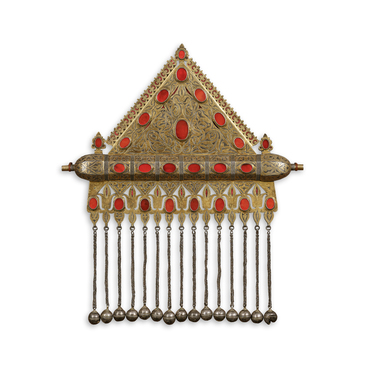
Sunsule is a diadem made by a Turkmen craftsman. It is a traditional distinguishing sign of a bride-to-be.
The decoration is called “sinsile”, “sumsule”, “change”, “ildirgich”, or “manlaylik”. This variety of names reflects the fact that every tribe has their own preferred style of this headband and that there have always been various design features that distinguish one type of sunsule from another. For instance, manlaylik or sunsule (sinsile, sumsule) is rather a common term for this type of jewelry. The word “ildirgich” denotes a variety of sinsile with abundant ornamentation and the obligatory inclusion of a large number of “eyes” made of dark cherry carnelian, a favorite ornamental stone of the Turkmen people, which is called “hakyk” in the East.
“Sunsule” literally means “chain”, because this decoration always incorporates chains, with simple stamped plates strung between them. The decoration usually consists of one or two, less often a larger number of rows.
The sunsule was attached to a skullcap or fixed on the forehead, like a headband. Most Turkmen jewelry had “shelpe” pendants and “duvme” bells, which make a melodious noise when moving.
Sunsule pieces were silver or silver with gilding and were usually decorated with oval carnelian inserts. Turkmens believed in the good magical properties of silver and carnelian. Silver, according to ancient beliefs, had healing and protective properties, and carnelian brought health, prosperity, peace, joy and abundance, and protected its owner from the evil eye and other misfortunes.
The sunsule was worn by girls, as well as young women before the birth of children. Women between the ages of 35 to 40 used it as an ornament fastened to clothing.
And yet the most beautiful and sophisticated in
composition and execution were the wedding sunsule. Only the most important
representatives of the family could afford such jewelry made of silver with
gilding.