The catalog of the
Historical and Ethnographic Museum “Russian Heritage”, which was compiled by
Ivan Fyodorovich Barshchevsky and published in 1909, features an entry about
this exhibit,


Reverse


1 / 2
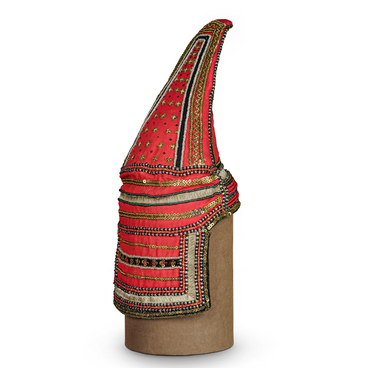
Sary-chyrpy — women’s robe worn over the head
Creation period
the 19th century
Place of сreation
Turkmenistan
Dimensions
144x47 cm
Technique
silk, wool, canvas; printing on textiles, tambour embroidery
Collection
Exhibition
1
Open in app#1
#2
Sart robe from [the town of] Merv, yellow paper cloth with embroidery with colored silk threads, lined with printed calico.
#3
Such robes were worn over the head and shoulders for ceremonial occasions.
Often, several craftswomen worked on one robe for two to three months. A seamstress made the robe itself from several pieces of homespun silk fabric, and an embroideress applied a pattern to the cut panels. Then it was necessary to carefully sew the prepared pieces together so that the pattern aligned and the overall ornamental composition was cohesive. Lastly, an ornate collar was sewn to the finished garment. The hem of the chyrpy robe was decorated with a fringe of red and black silk threads.
The pattern on the chyrpy robe opens the world of mysterious symbols. This is either an ornament of broken lines with buds, or a special kind of pattern for each panel of the robe: large stylized pointed tulips decorate the back; branches and stems with flowers curl along the shoulders and hem; bright petals, buds and leaves run along the sleeves, and a small geometric pattern is embellished on the cuffs. In addition to the floral ornament, there are also zoomorphic motifs: horns, eyes, or claws of animals. Large triangles, circles and rhombuses are also used in the ornament.
The color of the robe indicated the age of the wearer. Dark green or black sary-chyrpy robes were worn by a young woman under 40 years of age. It was believed that dark tones protected and hid the wearer from the evil eye. Turkmen women over the age of 40 wore yellow robes over their headdresses. A white robe was made for older women, as this color symbolizes wisdom, purity and chastity, as well as the afterlife.
Women carefully kept their sary-chyrpy robes in the family, passing them on to their daughters.
#4
Ministry of Culture of the Russian Federation
read morehide
00:00
00:00
1x
Sary-chyrpy — women’s robe worn over the head
Creation period
the 19th century
Place of сreation
Turkmenistan
Dimensions
144x47 cm
Technique
silk, wool, canvas; printing on textiles, tambour embroidery
Collection
Exhibition
1
 Point your smartphone camera to open in the app
Open in app
Share