Font
Color
Graphics
Изображение точки

To see AR mode in action:

1. Install ARTEFACT app for iOS or Android;

2. Find the exhibition «The Indigenous People: Lifeways and Trades»

3. Push the «Augmented reality» button and point your phone's camera at the exhibit;

Скрыть точки интересаПоказать точки интереса
Показать в высоком качестве

Box, saw, sieve, floats, fishgig, hammer

0
Open in app
#1

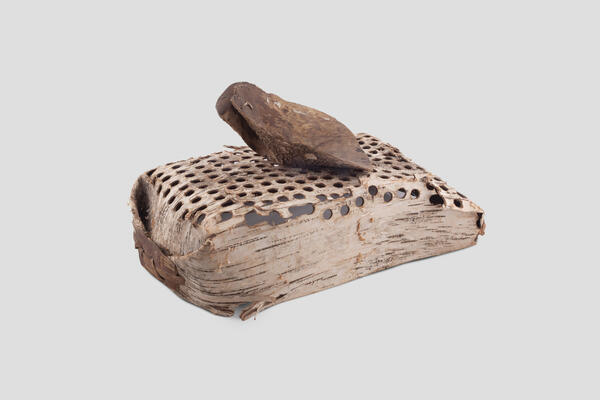
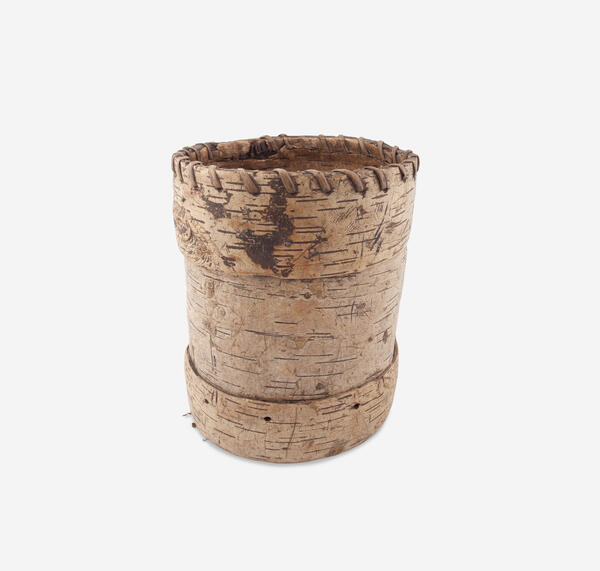
Birch bark box

#2

Having visited Siberia in the 18thcentury, the Swedish born engineer, traveler and Russian diplomat Lorenz (Lavrenty) Lang, wrote in his travel diary that all the utensils of the Tomsk Shors consisted of an iron cauldron and birch bark vessels. Vasily Vasilyevich Radlov also noted the importance of birch bark utensils in Shor communities.

Birch bark is the top thin layer that is pinkish cream in color. This material was harvested at the end of May — beginning of June, when birch trees were full of sap and the birch bark layer could be separated as easily as possible. With a certain skill and accuracy, it was removed without damaging the next layer, so that after a few years the trunk restored its bark.

The Shors also harvested bird cherry bark called “sarga”: using a knife, people cut it in “straps” from branches and then pulled through a special recess in the handle of the knife to straighten it. The sarga bark was rolled and stored, and immediately before use it was steamed with boiling water to restore the necessary flexibility.

Birch bark was used to make small cups, impressively sized kuspak vessels, which could contain from 9 to 12 buckets of liquid, and ulan boxes for storing grain with a capacity of up to 25 poods. Small items were joined with a braided seam. When making large containers and vessels, the Shors used ugum threads made from split cedar root (this seam was called kostan), horsehair or bird cherry bark.

The presented tozek vessel with a lid is made from kyuchen birch bark taken off like a “stocking” from a cut down tree. Such containers were used as thermoses: even in hot weather, the drink in them remained cold. A solid layer of bark ensures the vessel’s waterproof.

The front side of the vessel was wrapped in a “shirt” (a piece of birch bark cut on one side), which was fastened with a “lock” or sewn together. The workpiece was treated with steam and a wooden bottom was hammered between the walls. The dried bark covered it so tightly that no additional fastening was required.

If the artist wanted, he could decorate the tozek with a geometric or zoomorphic ornament, using the technique of embossing or slotted carving with a background.
#4
Name: Birch bark box
№: 27747029
Date of creation: the early 20th century
Place of creation: Gornaya Shoria, the Russian Empire
Technique: birch bark, wood; weaving, sewing
Dimensions: 24,5×19×22,5 cm
#5
Hand saw
#7

Back in the middle of the 19thcentury, the ethnographer Vasily Vasilyevich Radlov described Shor houses as“almost empty inside, since [Shors] do not have the habit of possessing anything other than the clothes they wear on their bodies.”The main types of “home” production were the processing of birch bark and wood.

At the same time, the Shors considered birch to be a sacred tree, a tree of happiness. This

special attitude was associated with religious beliefs: birch wood was used to create objects for religious purposes. According to the Shors, in the distant past, each clan had its own type of tree from which it traced its origin. Representatives of the clan treated their tree with great respect. They never cut it down, and if such a need arose, they invited a person from another family. Arriving at the hunting site, the Shors first chose a mighty (sacred) cedar or fir.

Russian settlers in Siberia brought many crafts that had been unknown to the indigenous population, including those related to wood processing, carpentry and making sleighs, wheels, and carts. The Siberians, including the Shors, mastered new work technologies necessary for the manufacture of spindles, distaffs, and other household items.

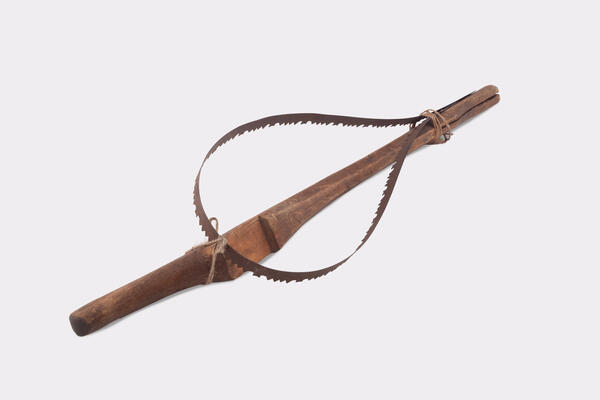
The tools that were new for the Shors included a two-handed bow saw charbek (cherbek) for sawing wood along the grain.

The “bow” instrument received its name for its similarity with the weapon of the same name: the same principle of elasticity and the presence of a bowstring made of flax or hemp rope.

A bow saw can be used to make cuts in both dry and wet wood. The tool consists of three solid racks (a horizontal center and two vertical side ones), which are not only carefully processed, but often varnished. Racks are made from hardwood, such as oak, ash or hornbeam. In the lower part of the vertical posts, identical symmetrical through holes are made for attaching both handles.

Between the middle post and the bowstring there is an auxiliary bar — a latch, the rotation of which ensures the tension of the bowstring and, consequently, the iron part between the handles.

The remarkable thing about a bow saw is that its blade never jams at the cut site, although sawing can be hard in difficult areas.

#6
Name: Hand saw
№: 37392794
Date of creation: the early 20th century
Place of creation: Gornaya Shoria, the Russian Empire
Technique: wood, iron
Dimensions: 70×120×3,5 cm
#8
Sieve
#10

The Shors compensated for the shortage of agricultural products by foraging, including pine nut harvesting. In the first half of the 19thcentury, this activity was turned into a business — the surpluses were sold to Russian merchants. Previously, nuts were collected in smaller quantities and exclusively for local consumption.

Ethnographic texts mention a delicious Shor dish called “toktsok” — balls made from a mixture of crushed pine nuts with shells, honey and talkan flour. Nuts were of great importance to hunters in the summer and autumn.

In commercial cedar forests, each family had its own plot. The Siberian educator of the 19thcentury, Alexander Vasilyevich Adrianov, wrote:

#11

The right of every Shor to harvest nuts or hunt animals is always strictly limited to a certain place; the entire habitat of the Tubalars [including the Shors] is divided into sections of the ‘taiga’, and each is ruled by one or another clan (soyok).

#12

In the taiga camp, the Shors built temporary pole or permanent log houses and barns to store fishing equipment. Sometimes such tools were made right on the spot.

Cones were collected on the ground after gusty winds, pulled from tree crowns or knocked down by using special mallets to tap bare inaccessible trunks.

The cones were put away for some time to get rid of the resin. Then they were ground on a wooden notched grater, the nuts were extracted and winnowed by tossing in a “sargash” birch bark box. According to the “Essays” of Leonid Pavlovich Potapov, “an adult worker could hardly winnow about 1.5 centners” of grain or nuts per day.

To sift the crushed nuts from the chaff, a birch bark sieve with large cells was used. During the work, the peeled nuts fell onto the linen that was spread beneath, and the scales and large pieces of dirt remained in the sieve and were thrown away.

The presented sieve is made from a single piece of birch bark with the outer layer facing out. The sides of this low, slightly elongated rectangular box were made slightly raised and stitched along the top edge with straight stitches. The corners were bent into a triangle, pressed with rectangular strips of birch bark, and additionally reinforced with a horizontal bird cherry rod.

#9
Name: Sieve
№: 37392794
Date of creation: the early 20th century
Place of creation: Gornaya Shoria, the Russian Empire
Technique: birch bark; weaving, stitching
Dimensions: 50×30,5×13,5 cm
#13
Floats
#15

A float is one of the oldest and most popular fishing devices. In its working vertical position, its lower end goes under the water, while its surface part is used for observation. During the fishing process, the float performs two functions: holding a hook with bait or a fishing net at a given depth and signaling a bite. Additionally, it helps to cast the bait to the desired distance.

The Shors often used seines and nets made of horsehair, hemp, or nettle. For weaving, they used rulers to measure the size of the mesh cells and a needle to wind the threads.

The Shors used nets to surround an area in large bodies of water, stepped into the water or went in boats to stir up the water and scare the fish. The fish began to move in all directions and, as a result, got caught in the nets.

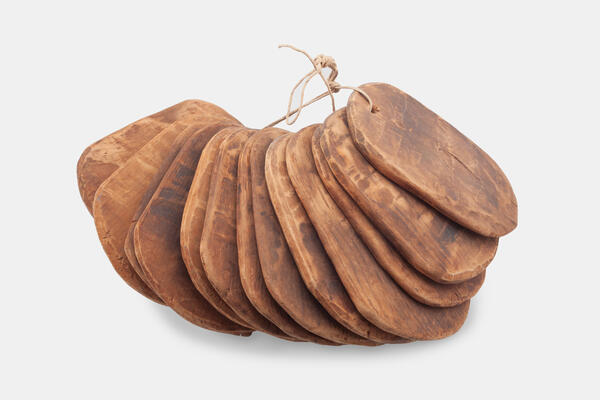
The floats came in different sizes depending on the size of the nets. For “engme” nets, the Shors made wooden or birch bark “beacons”, which were secured at the top edge.

The combined “kamnyk achi” net, which was nine meters long and one meter wide, had cells of different sizes to catch different types of fish — both large and relatively small ones. The upper part of the product, starting from the floats, had large cells so that the biggest fish could pass through. Below there were smaller cells to catch, for example, a large grayling. Next were rows of even smaller cells for a smaller grayling, and at the very bottom were the smallest ones for small fish.

Weights made of beaten river pebbles were attached to the lower edge of the net. They were tied with cedar root to a bowstring — a rope stretched along the entire net.

There was another type of net designed for night fishing — without sinkers. In this case, a net was suspended across the river downstream, and the fishermen sailed along it in boats, attaching the upper end of the net to a long pole. As soon as the fish got in the trap, the pole began to shake, like a float, catching the vibrations, and the fishermen came to take the caught fish out of the water.

The museum displays a set of floats — oval wooden boards — for the seine called “tab”, “tyukod”, or “balber”.

#14
Name: Floats
Date of creation: the mid-20th century
Place of creation: Gornaya Shoria, Kemerovo Oblast, the USSR
Technique: wood, carving
Dimensions: 16,5×12×0,7 cm, boards: 16.5–18×12–13×0.7–1 cm
#16
Fishgig
#18

Fishing, though not as popular as hunting, was still widespread in the Shor culture. It can be confirmed by the variety of Shor fishing techniques and the developed terminology regarding the subject. Fishing is also mentioned in local legends: Shor warriors set up fences for fish and drive poles into the riverbed using massive wooden mallets.

Vasily Vasilyevich (Friedrich Wilhelm) Radlov wrote that“with the arrival of winter, difficult times begin; those who did not sell enough fish during summer to buy enough flour must endure poverty and hunger.”At the same time, as the 19th-century ethnographer notes, fishing cannot be considered a profitable business:“the income [from it] is barely enough to feed and clothe the person.”

The Soviet researcher Leonid Pavlovich Potapov classified fishing as an auxiliary activity of “consumer nature” that had value as part of the diet, especially for hunters who spent long months away from home.

Catching small fish resembled gathering; women and children performed this task in shallow water. Catching pike, grayling, taimen, burbot, and orfe suitable for sale required more serious skills and special equipment. Leonid Potapov wrote that on the rivers Kondoma and Mrassa“they beat fish… with an iron spear azbrga”, also known as a “shoshkha”. This method “requires a great deal of experience and dexterity.”

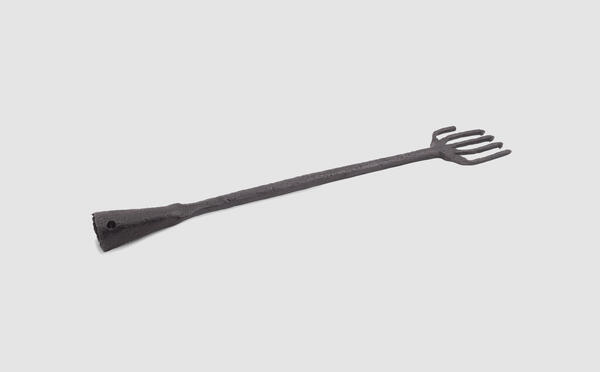
A fishgig is a specialized striking weapon with several (in the presented example, five) prongs on a big shaft that can be two to two and a half meters long. This device is used for both day and night fishing. Night fishing required special care and concentration. By the light of a fire on the bow of the boat, the fisherman noticed a large fish down in water, got within striking distance and hit it with a fishgig just below the gills. At the same time, there remained a risk that the wounded fish could drag the fishgig underwater.

In addition to the fishgig, the Shors used wooden arrows, traps, nets and “kendyr” nets. Women and children wove nets and sold them in Kuznetsk for two kopecks per fathom. The durable and cheap products were in great demand.

#17
Name: Fishgig
Date of creation: the early 20th century
Place of creation: Kuznetsk, the Russian Empire
Technique: metal, forging
Dimensions: 51×7,5×1,5 cm

№: 36866731

#19
Hammer
#21

The Russians called the Shors “Kuznetsk people” or “Kuznetsk Tatars”. Until the 19thcentury, iron smelting and processing was the main occupation of these people, especially of those living in the north.

The historian Valery Makarovich Kimeyev wrote that traditional metalworking was the most “successful craft… mastered by the ancestors of the Shors — the Aba and Biryusinians” in the 17thand 18thcenturies. The archaeologists, including Yuri Viktorovich Shirin, attribute the traces “of bloomery iron and the remains of hundreds of iron smelting furnaces” to this period.

The Kuznetsk people used iron products (“armor and iron arrows, and cauldrons”) to trade them for the felt and livestock provided by the nomads. The Shors also sold ironware to Russian merchants and used it to pay “yasak” — “30–40 pieces of iron ore (about 1 pood)… for one sable.”

However, according to archaeological finds, this craft was in decline at the end of the 18thcentury. Kimeyev attributes this to several reasons: competition with South Siberian Russian craftsmen, increased demand for furs and the Yenisei Kyrgyz and Teleuts, who were especially interested in Shor weapons, leaving the “political arena.” At the turn of the 19thcentury, the Russian influence made traditional Shor blacksmithing almost completely disappear.

Local blacksmiths continued to forge parts of agricultural tools, such as plows, knives, forks, shovels, hammers, sickles, axes, and scythes.

Before sharpening, the scythe blade is first hammered. If the scythe is sharpened without this preliminary preparation, especially if sharpening machines are used, then it gets dull faster.

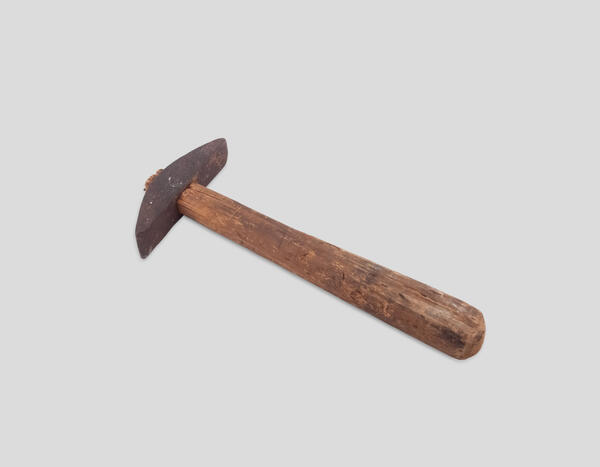
For high-quality work, the craftsmen used a forged double-sided hammer for scythes and an anvil or a pinning jig that was hammered into a stump block.

The entire blade of the scythe was hammered from the heel to the toe at least twice. No section of the blade was struck two times in a row. Later (it could be also done during the work process), the blade was adjusted using an iron rod and sharpened with fine-grained whetstone. After this treatment, the sharpened scythe could be used for mowing for 3–4 or even 7–8 hours.

#20
Name: Hammer
Date of creation: the early 20th century
Place of creation: the Russian Empire
Technique: wood, iron
Dimensions: 28×3×2,5 cm

№: 36728001

#3
read morehide

Box, saw, sieve, floats, fishgig, hammer

0
Point your smartphone camera to open in the app
Share
VkontakteOdnoklassnikiTelegram
Share on my website
Copy linkCopied
Copy
Open in app
To see AR mode in action:
  1. Install ARTEFACT app for 
  2. iOS or Android;
  3. Find and download the «Paintings in Details» exhibition
  4. Push the «Augmented reality» button and point your phone's camera at the painting;
  5. Watch what happens on your phone screen whilst you flip through the pictures.
 
We use Cookies
Cookies on the Artefact Website. We use cookies to ensure that we give you the best experience on our website. If you continue without changing your settings, we'll assume that you are happy to receive all cookies on the Artefact website. However, if you would like to, you can change your cookie settings at any time.
Learn more about useHide
Content is available only in Russian

X

Нашли опечатку?...

%title%%type%