The Shors and nomadic herders viewed the horse in a completely different way. Leonid Pavlovich Potapov described this difference in his “Essays”: “Catching a horse, saddling was such a nuisance. It was better to walk a kilometer or two, unlike a southern Altaian, who, if he had a horse, would ride a horse even for half a kilometer, considering it indecent to walk.”
This affected both the degree of development of horse breeding in general and the production of horse equipment, including saddles. The “Essays” specify that the horse saddles of the Shors were “simple pieces of wood, often without a soft cushion and with one girth made of rope, saddled almost on the bare back of the horse.”
A high quality balanced saddle distributes the rider’s weight evenly on the horse’s back and makes it easier for the horse to move, otherwise the animal could be physically harmed.
As a rule, the saddle was assembled on an “archak” tree. It was made entirely of wood, the low curved front and rear parts of the saddle followed the shape of the horse’s back. In composite wooden saddles, the front and rear parts of the saddle were attached to the saddle tree with leather straps. The upper part of the saddle could be made more comfortable by padding it with a layer of felt and covering it with leather on top. A felt padding was also placed under the saddle, which was pulled up to the horse’s croup using a girth made of kendyr threads. The shock-absorbing saddle pad, which modern riders place under their saddle cloth to protect the horse’s back from mechanical damage, was not used.
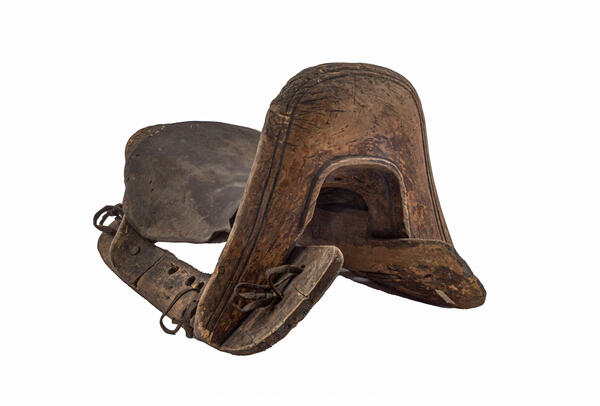
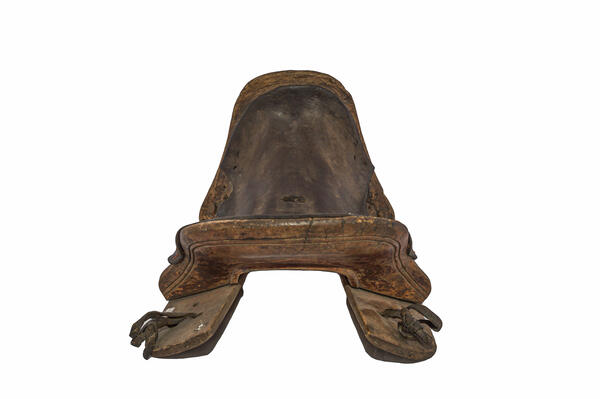
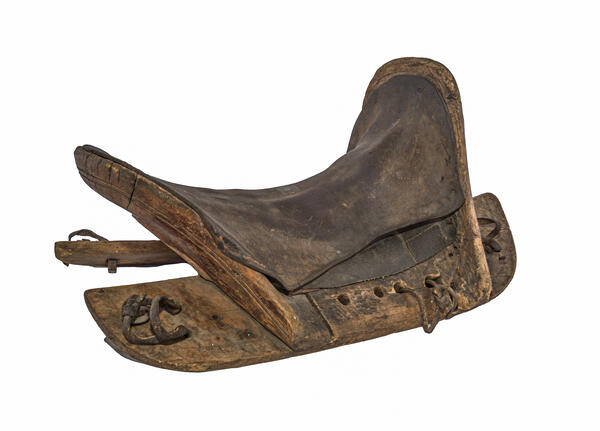
The saddle presented in the exhibition resembles a
cavalry one. This sophisticated item was created in a later period and belongs
to a group of saddles that riders used in training and works. The rider was to
remain on horseback for a long time while grazing livestock or during multi-day
trips in unpredictable weather and road conditions. The wooden tree was
commissioned to fit the individual measurements of both the horse and the
person. For the covering, pigskin was most likely used, previously treated with
steam to fit the base. The low pommel is located above the horse’s withers
providing protection. The cantle is slightly higher and provides a comfortable
riding position.