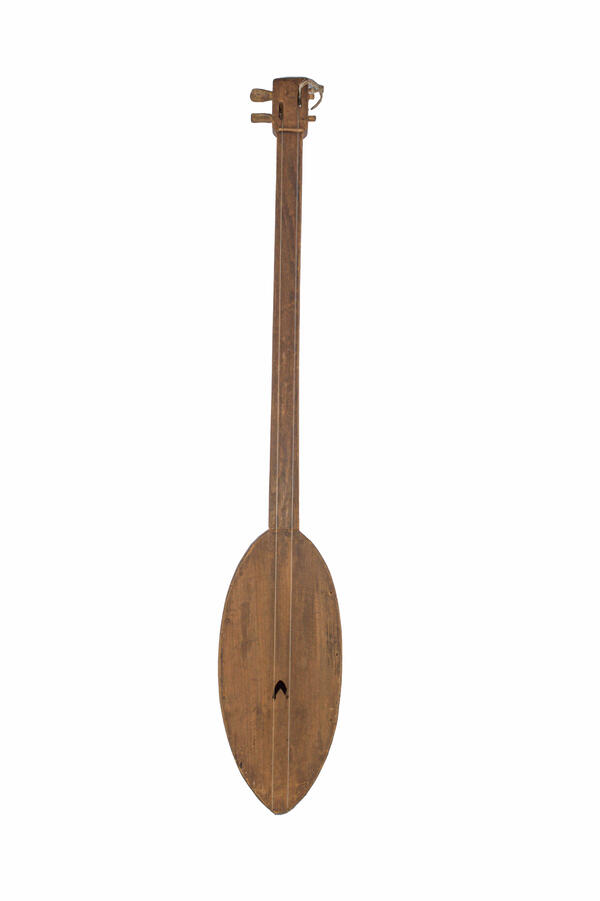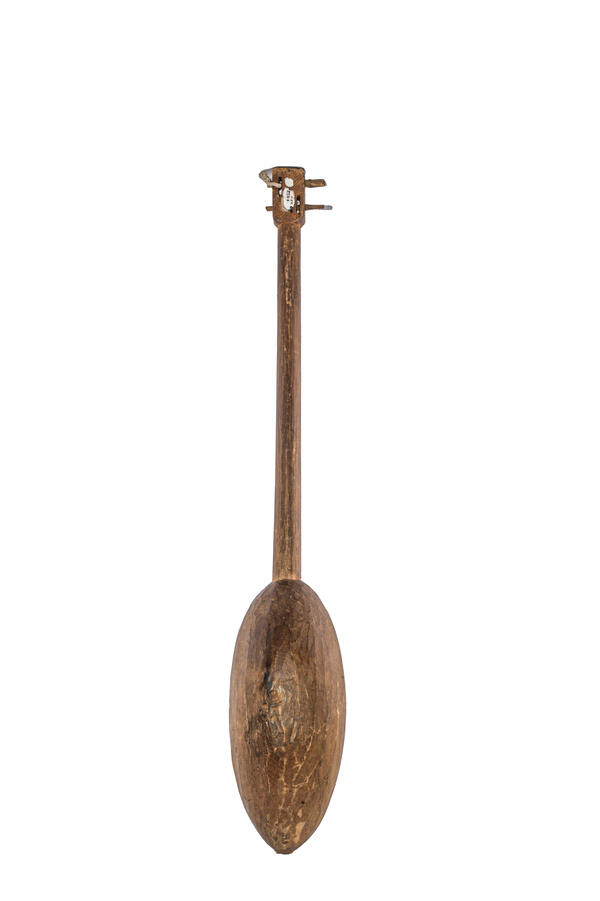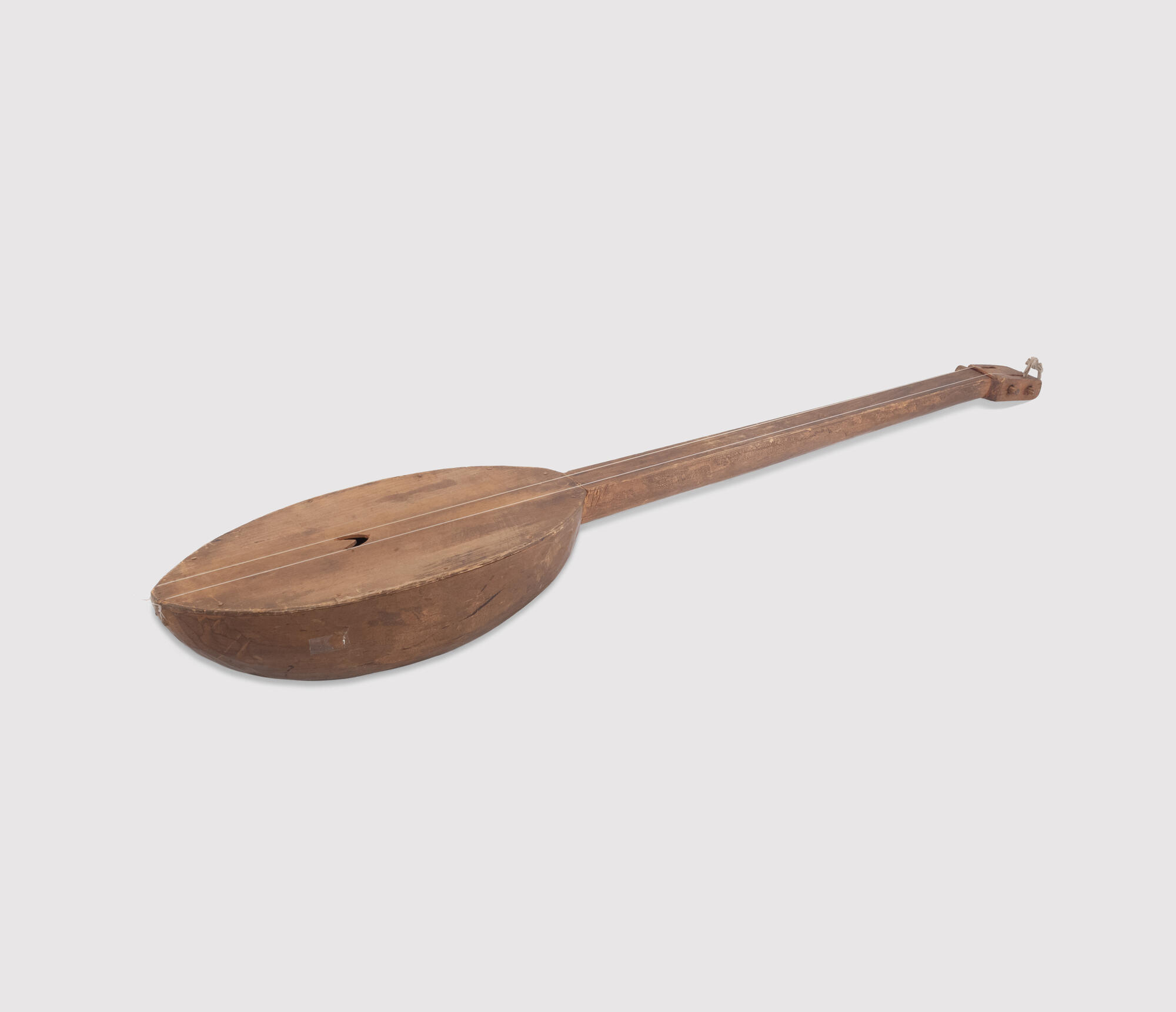


The indigenous people of the south of Western Siberia loved singing songs and telling tales to the accompaniment of a musical instrument, the kai-komus. The Shor people have singers who have the gift of unique throat singing. “Kai” is a special type of throat singing. Hence the name of the singer who has this ability is “kaichi”. Usually, the performer sat on a stool and placed the instrument on his knees. There was a basin or bucket next to the kaichi to spit and there was a towel to wipe his face. The narrator began to play slowly, “trying out” the instrument and his own voice, then moved on to the actual performance, alternating singing with prosaic retelling.
The forerunner of the kai-komus is the Kyrgyz folk three-stringed musical instrument called “komuz”. This instrument was played by nomads, and later it appeared in almost every home. The oldest description of komuz dates to 201 BC, the earliest instruments date to the 12th century.
The presented komuz has two strings; models with three strings are also known — the middle melodic string and the side drone strings that create the background. As a rule, the entire instrument — the body, neck, and head — is made from a single piece of juniper, hazel, or apricot wood. Part of the body is carved out to create a hollow space. Nowadays, a thick fishing line or a dense silk thread can be used as strings, but ancient nomads used specially processed animal intestines.
This is mentioned in the legend about the invention of komuz. Once upon a time, a young hunter saw a beautiful girl near a lake and wanted to take her as his wife but did not know how to express his feelings. Lost in thought, he noticed that there was something in the branches of the nearest apricot tree, and the wind was making wonderful sounds when touching these strings. The strings turned out to be the dried intestines of a goat, probably killed by a predator. The hunter broke off a dry branch from an apricot tree, gave it the shape of a tear, plucked the strings, and sang a love song.
The sounds of komuz are melodic, but rather quiet, so it is customary to listen to the instrument in small rooms like a yurt. Kaichi also sang in hunters’ cabins to appease and entertain the “masters of the taiga.”
The moral code and aesthetic views of the people
found expression in the legends and traditions about “Kai-eezi”. The performer
was not allowed to distort the text or confuse the lines, and listeners were
not allowed to disturb the singing with noise or use foul language during the
performance. People from the most distant uluses gathered to listen to a
kaichi.