Font
Color
Graphics
Изображение точки

To see AR mode in action:

1. Install ARTEFACT app for iOS or Android;

2. Find the exhibition «A Thousand Years of Northern Navigation»

3. Push the «Augmented reality» button and point your phone's camera at the exhibit;

Скрыть точки интересаПоказать точки интереса
Показать в высоком качестве

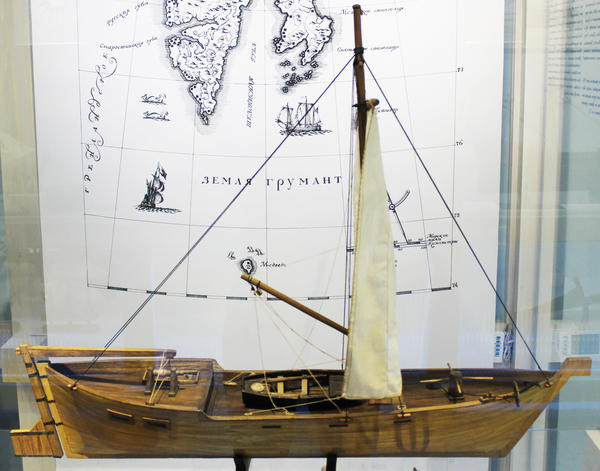
Model of Koch

Creation period
late1980s
Dimensions
78х97х40 cm
Technique
assembling
11
Open in app
#1
Unknown Author
Model of Koch
#3
In the XI century ancient Novgorodians came to the White Sea, attracted by the region’s natural riches, abundance of furs, birds, fish, pearls. Those who settled there permanently, were called “living at the sea side”, or Pomors. 

For fish harvesting they built wooden kochs, ideally adapted for sailing and rowing in Arctic environment. The universal vessels easily passed through shallow waters and brash ice, reached previously inaccessible high latitudes. On average, service life of a koch was 3-4 years. 
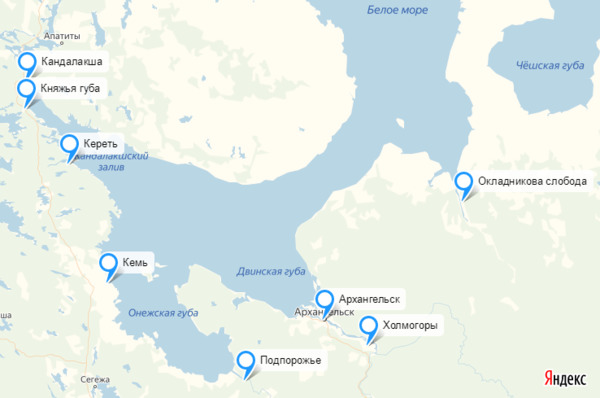
#4

Centers of the Pomor Shipbuilding at the White Sea

#6
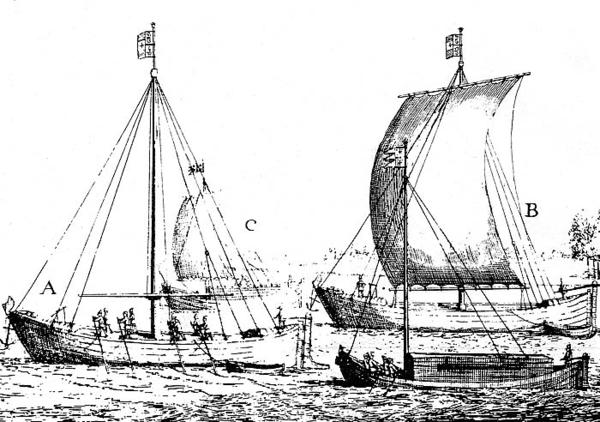
Engraving from Nicolaes Witsen book Ancient and Modern Shipbuilding and Navigation (1690)
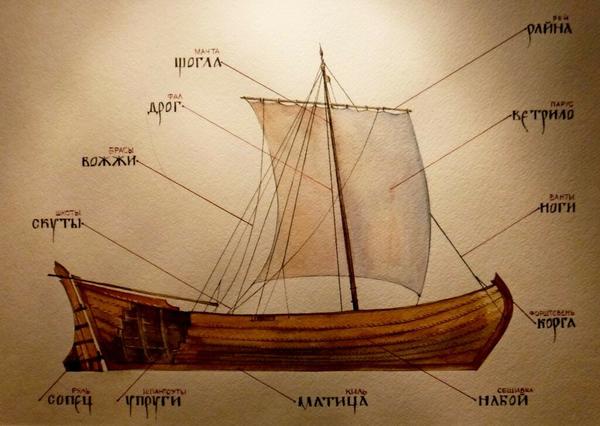
The word ‘Koch’ came from the Novgorodian lands where kotsa or kocha meant clothing. The hull of a koch at the boot-topping area was protected against ice with double shell, called shuba (fur coat), made of tough boards. 
 
It is interesting that shipwrights built kochs by intuition, with no drawings, on their vast experience only. Outline sketch of a future boat was drawn with a stick on sand. Close attention was paid to the bottom, because it experienced enormous loads, in particular when there was a need to drag the boat. 
#7

Koch

#8
Engraving from Nicolaes Witsen book Ancient and Modern Shipbuilding and Navigation (1690)
Koch was equipped with two big anchors 4,5 poods (1 pood = 2 stones) each, and several two-pood anchors. They were used not only at sea but also for pulling the boat through the icefields. A reliably ‘sewed together’ boat withstood ice impact perfectly, was maneuverable, ruggedized, and light at the same time. In an unprecedented way, one day a koch was literally dragged over the Urals in the region of Yamal Peninsula. 

Famous seafarer Willem Barentsz, ice-bound on his state-of-th-art boat, wrote in his diary: ‘Today two Russian kochs going upstream passed by us. How do they manage to sail on these walnut-shells? ’ And he put his finger right on the crux. The silhouette of rounded and flattened bottom of a koch resembles just a nut-shell half.  

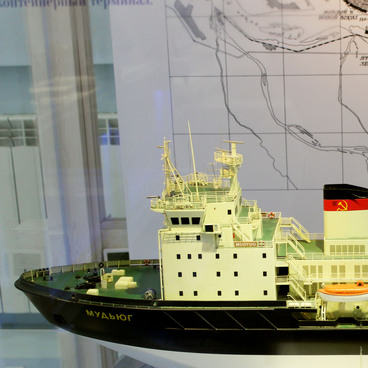
Thanks to this shape the koch hull did not break under the ice compression but was squeezed out to the surface. The Pomor experience was adopted by Norwegian shipbuilder Colin Archer, when he created his ship Fram whereon Rual Amundsen landed in Antarctic and reached the South Pole in 1911. This experience came in handy to Vice-Admiral Makarov for designing Yermak, the world’s first Arctic-class icebreaker. 

The Pomor kochs had excellent seaworthiness characteristics. They made 150-200 kilometers a day, and that significantly exceeded the capabilities of British merchant vessels and Dutch frigates; kochs navigated close to the shore in shallow-water channels inaccessible to deep-draft boats, and could enter river mouths.
#15
Photograph of a mount from Solovetsky Maritime Museum
#2
Peter the First launched a crushing blow to the Pomor traditional shipbuilding. Willing to create a merchant fleet on the model of European marine, this Tzar inhibited the Pomors from building new ships. Kochs born for severe Arctic and difficult voyages, kochs on which Semen Dezhnev and Fyodor Popov went on expeditions, fell into undeserved neglect. 
 
Separate fragments, well-preserved in permafrost and found during archeological excavations, helped to recreate the look of koch. The boat memory is reflected on the map too: there is Koch Guba (inlet) in the mouth of Yana River.
#16
read morehide
00:00
00:00
1x

Model of Koch

Creation period
late1980s
Dimensions
78х97х40 cm
Technique
assembling
11
Point your smartphone camera to open in the app
Share
VkontakteOdnoklassnikiTelegram
Share on my website
Copy linkCopied
Copy
Open in app
To see AR mode in action:
  1. Install ARTEFACT app for 
  2. iOS or Android;
  3. Find and download the «Paintings in Details» exhibition
  4. Push the «Augmented reality» button and point your phone's camera at the painting;
  5. Watch what happens on your phone screen whilst you flip through the pictures.
 
We use Cookies
Cookies on the Artefact Website. We use cookies to ensure that we give you the best experience on our website. If you continue without changing your settings, we'll assume that you are happy to receive all cookies on the Artefact website. However, if you would like to, you can change your cookie settings at any time.
Learn more about useHide
Content is available only in Russian

X

Нашли опечатку?...

%title%%type%