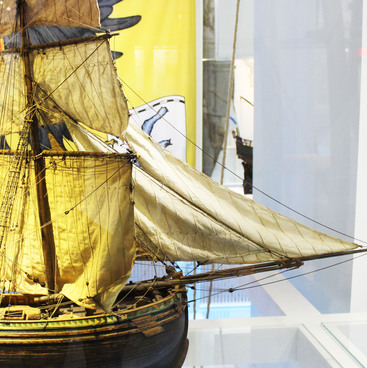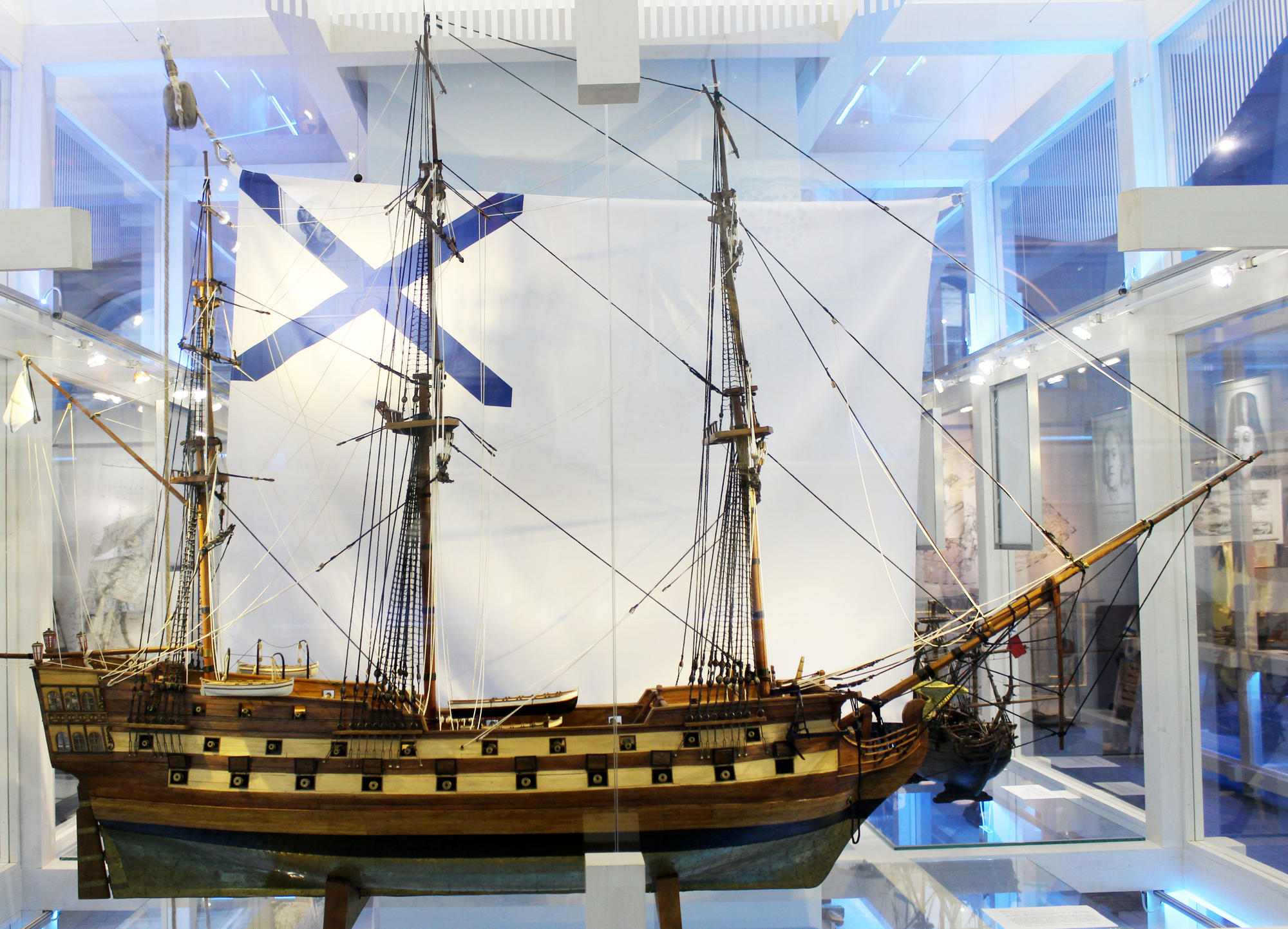


Gorod Arkhangelsk belongs to the capital ship class of combat vessels. She was launched at Solombala Wharf close to Arkhangelsk and named after the latter in 1735.
The rebirth of Solombala Wharf which deteriorated after Great Northern War was supervised by Captain-Commander Richard Cosenz, a British third-generation shipbuilder who entered into service for the Russian Empire. He headed the process of ship building in compliance with the drawings of Englishman Lambe Yames (christened Ivan Vasilyevich) and Ivan Zuyev. The ship was one of the last built during the life of this master.
She was taken under command by Alexander Polyansky, Captain of Colonel Rank. This naval grade substituted the grade of Captain 1 Rank in 1732. Officers of this rank had the right to command capital ships and small sea forces of this class.
Gorod Arkhangelsk was a part of the series of capital combat sailboats with Peter II as its lead ship built by shipwright Joseph Nye at the Saint Petersburg Admiralty Wharf in 1728. 19 similar sailboats had been built until 1768.
The length of the ship was 43.6 meters, breadth - 11.6 meters, and draft was relatively light – 5.1 meters. Gorod Arkhangelsk belonged to the lowest fourth rank with regard to the level of armaments. Small vessels which were ill-suited for fighting a battle in a line formation were included in that rank and used for reconnaissance or other nonoperational missions. The sailboat was equipped with 54 positioned on two decks artillery guns of four- to eighteen-pound caliber.
Soon after getting afloat, the ship sailed to the base of Russian Navy in the town of Kronshtadt and joined the same-name squadron. The life of Gorod Arkhangelsk ran in the Baltic Sea waters. In the company of Peter II commanded by Captain of Colonel Rank Thomas Stokes, they patrolled the area at the Cape of Stirsudden on the northern coast of the Gulf of Finland and later sailed on missions to the Beryozovye Islands and Revel.
In Russo-Swedish War of 1741-1743, Gorod Arkhangelsk fought under the command of Captain Stepan Malygin. She met the beginning of the war at the roads of Kronshtadt wherefrom she defended the capital against conquest by the enemy. In 1742, the boat patrolled the Gulf of Finland as a part of a squadron under the command of Rear Admiral Iakov Savvitch Barch but did not join battles. In the final period of Russo-Swedish War, the boat took part in fire duels at the Cape of Gangut and performed sea passages to Revel and Kronshtadt.
After the end of the war, the ship continued her service in the squadron. In 1749, she was disassembled in Kronshtadt.
The rebirth of Solombala Wharf which deteriorated after Great Northern War was supervised by Captain-Commander Richard Cosenz, a British third-generation shipbuilder who entered into service for the Russian Empire. He headed the process of ship building in compliance with the drawings of Englishman Lambe Yames (christened Ivan Vasilyevich) and Ivan Zuyev. The ship was one of the last built during the life of this master.
She was taken under command by Alexander Polyansky, Captain of Colonel Rank. This naval grade substituted the grade of Captain 1 Rank in 1732. Officers of this rank had the right to command capital ships and small sea forces of this class.
Gorod Arkhangelsk was a part of the series of capital combat sailboats with Peter II as its lead ship built by shipwright Joseph Nye at the Saint Petersburg Admiralty Wharf in 1728. 19 similar sailboats had been built until 1768.
The length of the ship was 43.6 meters, breadth - 11.6 meters, and draft was relatively light – 5.1 meters. Gorod Arkhangelsk belonged to the lowest fourth rank with regard to the level of armaments. Small vessels which were ill-suited for fighting a battle in a line formation were included in that rank and used for reconnaissance or other nonoperational missions. The sailboat was equipped with 54 positioned on two decks artillery guns of four- to eighteen-pound caliber.
Soon after getting afloat, the ship sailed to the base of Russian Navy in the town of Kronshtadt and joined the same-name squadron. The life of Gorod Arkhangelsk ran in the Baltic Sea waters. In the company of Peter II commanded by Captain of Colonel Rank Thomas Stokes, they patrolled the area at the Cape of Stirsudden on the northern coast of the Gulf of Finland and later sailed on missions to the Beryozovye Islands and Revel.
In Russo-Swedish War of 1741-1743, Gorod Arkhangelsk fought under the command of Captain Stepan Malygin. She met the beginning of the war at the roads of Kronshtadt wherefrom she defended the capital against conquest by the enemy. In 1742, the boat patrolled the Gulf of Finland as a part of a squadron under the command of Rear Admiral Iakov Savvitch Barch but did not join battles. In the final period of Russo-Swedish War, the boat took part in fire duels at the Cape of Gangut and performed sea passages to Revel and Kronshtadt.
After the end of the war, the ship continued her service in the squadron. In 1749, she was disassembled in Kronshtadt.