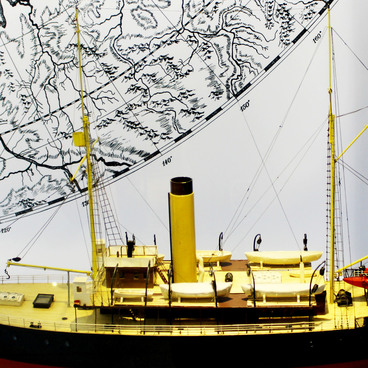
Icebreaker Mudyug was built in 1982 by Finnish company Wärtsilä on order placed by the Soviet Government. In five years engineers of Thyssen-Nordseewerke firm from Germany introduced changes in the icebreaker construction by having modernized the ship head. Until 2006 the icebreaker had cleared the way for vessels proceeding to the Port of Arkhangelsk. Today the ship is owned by the Federal State Unitary Enterprise Rosmorport in Saint Petersburg.
Diesel icebreaker Mudyug was the first vessel out of three Mudyug-type icebreakers which were build in Finnish shipyards. The icebreaker was named after the same-name island situated in the White Sea.
The first home base of the vessel was the Port of Murmansk and then she was moved to Arkhangelsk. In 1987 Icebreaker Mudyug was upgraded with substantial changes introduced in the bow construction. Such a reconstruction made it possible to increase the foredeck volume but adversely affected maneuverability of the vessel and decreased the maximum ice thickness the icebreaker could pass through. Massive arctic ice appeared to be beyond the modernized vessel capacity. For this reason Mudyug was handed over to the Sea Port of Saint Petersburg.
The principal task of the icebreaker today is to ensure safe passage of civil vessels in the Baltic Sea aquatorium and on the approaches to it.
The icebreaker assists heavy-tonnage vessels to move across the ice and is also used for towing barges and floating structures. Thanks to the fact that Mudyug is equipped with a fire-fighting system she can be a party to salvage operations and render assistance to ships in distress.
In 2019 Mudyug took part in a festival of icebreakers (LedokolFest) held on May, 4 and 5 in Saint Petersburg. Residents and guests of the Northern Capital had an opportunity to board the vessel, familiarize themselves with her history and obtain detailed information on technical characteristics of the icebreaker.
Diesel icebreaker Mudyug was the first vessel out of three Mudyug-type icebreakers which were build in Finnish shipyards. The icebreaker was named after the same-name island situated in the White Sea.
Mudyug is a double-decker with extended foredeck and six-deck superstructure, which is moved closer to the bow and consists of deckhouse and cabins of the crew. . The icebreaker has double hull and bottom, strengthened bow and flat stern. The ship length overall is 112 meters, breadth is 22 meters, and hull height is over 10 meters. The water volume displaced by the icebreaker is nearly 7000 tons; load capacity is about 3000 tons. Mudyug picks up speed up to 16,5 knots, and can be out at sea up to 25 days without rewatering and reprovisioning.
The first home base of the vessel was the Port of Murmansk and then she was moved to Arkhangelsk. In 1987 Icebreaker Mudyug was upgraded with substantial changes introduced in the bow construction. Such a reconstruction made it possible to increase the foredeck volume but adversely affected maneuverability of the vessel and decreased the maximum ice thickness the icebreaker could pass through. Massive arctic ice appeared to be beyond the modernized vessel capacity. For this reason Mudyug was handed over to the Sea Port of Saint Petersburg.
The principal task of the icebreaker today is to ensure safe passage of civil vessels in the Baltic Sea aquatorium and on the approaches to it.
The icebreaker assists heavy-tonnage vessels to move across the ice and is also used for towing barges and floating structures. Thanks to the fact that Mudyug is equipped with a fire-fighting system she can be a party to salvage operations and render assistance to ships in distress.
In 2019 Mudyug took part in a festival of icebreakers (LedokolFest) held on May, 4 and 5 in Saint Petersburg. Residents and guests of the Northern Capital had an opportunity to board the vessel, familiarize themselves with her history and obtain detailed information on technical characteristics of the icebreaker.