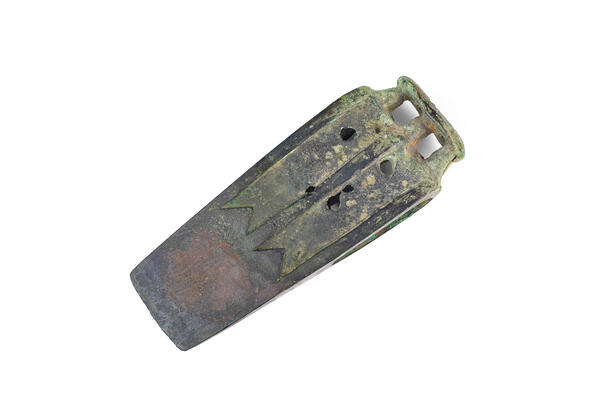
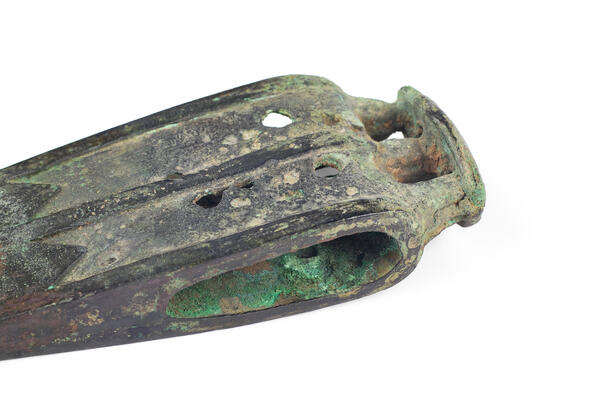
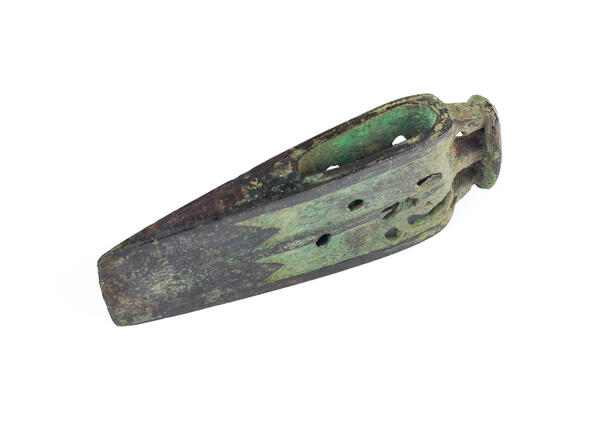
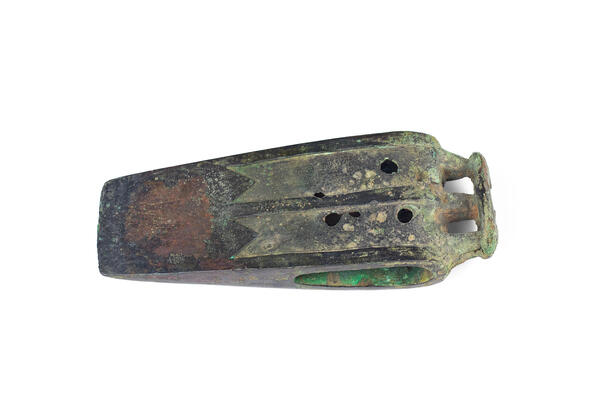
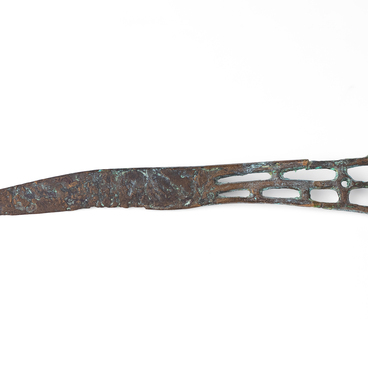
The eyed ax, the one having an ear — a hole for the handle, with a mushroom-shaped butt was made of bronze. The craftsman decorated the central part of the object with triangular festoons — protrusions. Scientists have dated this artifact to the period from the 6th to the 5th century BCE.
It was discovered during the survey of the Beya settlement in the Republic of Khakassia. In 2007, the Beya archaeological expedition of the Institute of the History of Material Culture of the Russian Academy of Sciences conducted research on many stone structures belonging to the large burial ground of the Podgornov stage of the archaeological Tagar culture of the 10th–3rd centuries BCE. Rescue excavations were carried out by a detachment led by Lyudmila Anatolyevna Sokolova.
The ancient burial ground was the final resting place for people of the Caucasian type, very tall with a well-developed and harmonious skeleton, typical for representatives of the Tagar archaeological culture. The young man buried in grave 5, despite his age, had already reached 170 centimeters, although his growth was still continuing. The young woman accompanying him was not much shorter than him.
The burial in grave 5 turned out to be the richest in goods. It was blocked by a larch log layer. A stone box made of dug-in sandstone slabs measuring two by two and a half meters was installed inside the ground pit. A man, a teenage woman and a young warrior were buried there. Later, an adult woman was also buried here, disturbing the already present skeletons.
A massive bronze eyed ax with a mushroom-shaped butt was found at the belt of the young warrior. As the researchers noted, it was of a rare type and in excellent preservation. The central part of the ax was decorated with geometric patterns. A wooden ax shaft with also wooden inserts for fastening has been preserved inside.
Since the diameter of
the inserts did not exceed the diameter of a modern match, researchers
concluded that the ax was not intended for serious work and was most likely
ceremonial. Perhaps it was made specifically for the burial. This assumption
was confirmed by the absence of traces of work on the blade, and the
preservation of traces of cleaning with an abrasive tool.