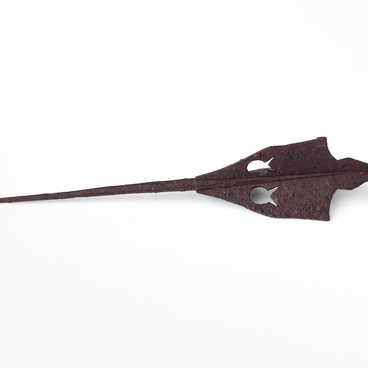
This knife with an openwork handle from the collection of the Sayanogorsk Museum was made of bronze. The craftsman decorated the edge of the handle with the image of a stylized head of a bird of prey. Russian scholars attributed this object to the late Saragashen stage of the Tagar culture, which developed from the 9th to the 3rd century BCE.
The knife was included in the funerary equipment of Tagar burial mounds, which were dated from the 4th to the 3rd century BCE. Researchers found it on the territory of a burial ground in the city of Sayanogorsk. The excavations were carried out by the Beya Archaeological expedition of the Institute of the History of Material Culture of the Russian Academy of Sciences in the period from 1992 to 1994. The group was led by Margarita Nikolaevna Pshenitsyna, a Soviet and Russian archaeologist.
The Tagar culture arose on the basis of the Karasuk culture (late 2nd — early 1st millennium BCE), more precisely, its Kamennyi Log stage or, in other words, the Lugava culture. A variety of bronze knives of the Tagar are widely represented among the objects of the Sayanogorsk Museum. Their abundance allowed the researchers to identify a group of the most common objects. Among them were straight knives, in which the handle did not separate from the blade and had one or more holes.
A special place in the collection was occupied by knives with a unique decorative pattern of handles and pommels. The bronze casting of the Tagar culture was characterized by monumentality, lack of pretentiousness, simplicity of artistic images, depiction of single animal figures, and, accordingly, the absence of their fight scenes.
The Tagar animal style
was very similar to the Scythian one. The knives of this culture traditionally
had the pommel and the place between the blade and the handle decorated with animal images. Images of the heads of a
griffin or a bird of prey, an entire figure or the head of a boar, goat, ram,
wolf, horse, tiger, lion, donkey, bird of the grouse or pheasant order have
become traditional for Tagar archaeological culture. Elk, saiga antelope, and
camel were rarely depicted — no more than fifteen images of these animals were
found in total. In the process of creating the weapon decoration, the Tagar did
not use the image of a bull, a bear and a hare.