

Even though the first electromagnetic telegraph was invented by Pavel Lvovich Schilling in St. Petersburg, the telegraph key comes from the United States. This universal device that transmits Morse code characters was created by Alfred Vail, who was a young assistant and collaborator of Samuel Morse at the time. He also made a gigantic contribution to the development of the famous alphabet, built on a combination of dots and dashes (or dits and dahs). Some claim that it was Vail who came up with a cipher for the entire alphabet after studying the letter frequency in the English language. Interestingly enough, the letter “e” turned out to be the most common one and was assigned a code — a single dit.
The Schilling telegraph was rather complicated in comparison with its American counterpart. Therefore, in 1898, Nicholas II signed a decree of the Council of Ministers on the establishment of the Joint Stock Company of Siemens & Halske Russian Electrotechnical Works. Among the military equipment were Morse telegraph machines of various modifications, as well as the sending keys.
After the nationalization, the Siemens and Halske enterprise became known as the Petrograd State Telegraph Plant. There, the production of telegraph devices with a simpler model of keys continued. During the Great Patriotic War, limited quantities of sending keys were produced by the Moscow plant “Elektropribor”.
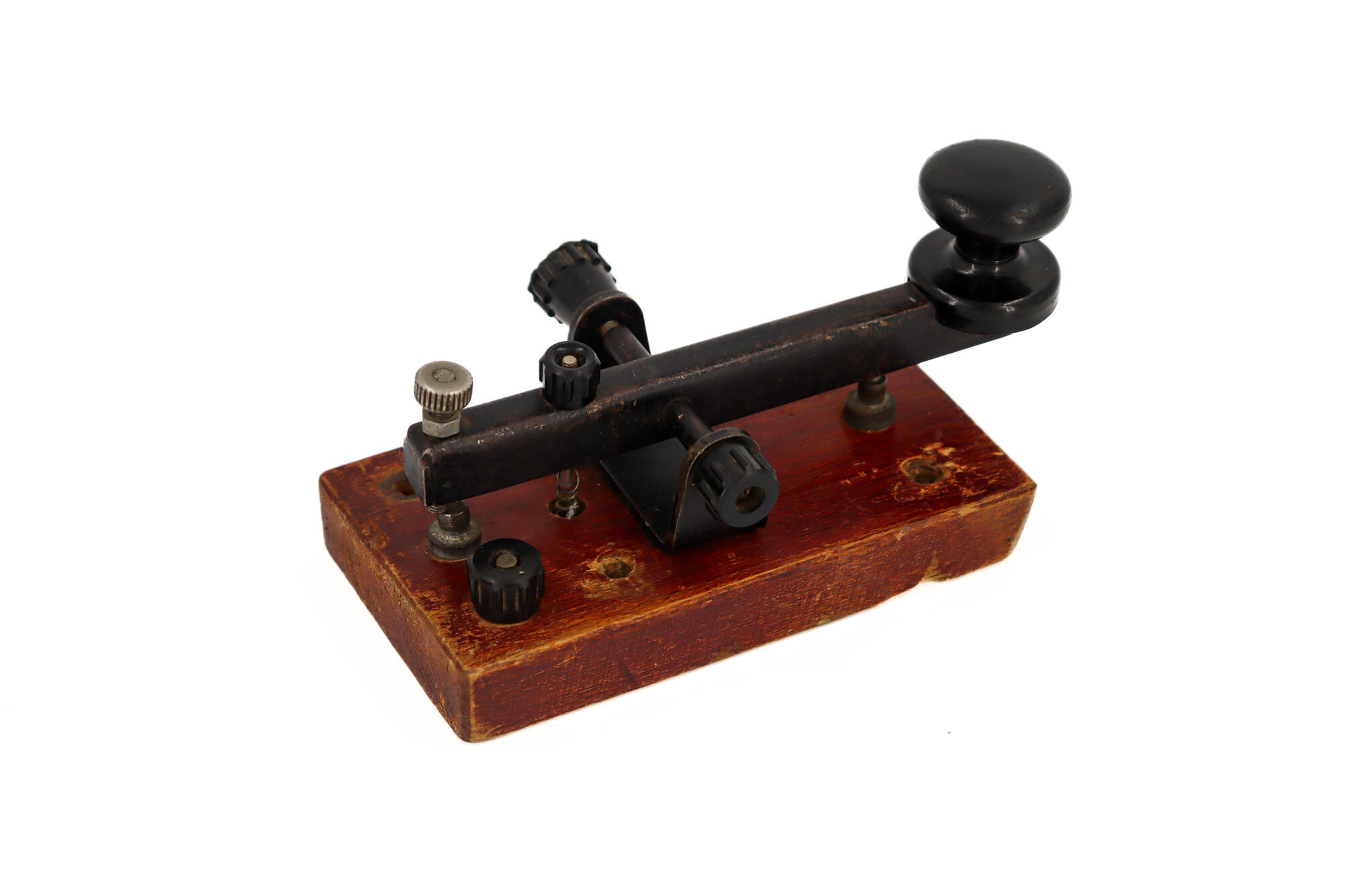
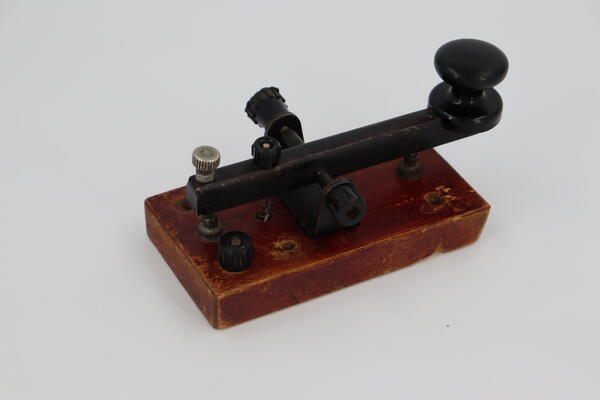
The traditional telegraph key was a vertically oriented lever with a spring extension. The instruments with a horizontal movement of the lever were less popular. By pressing the knob on the lever, the operator created a closed electric circuit, sending pulses of two different lengths: the short one meant a dot, while the long one was a dash. Their combination formed a text message.
In the heyday of the telegraph, there were several methods of working on a mechanically operated key: the operator could position the entire forearm on the table, rest on the elbow, or leave the arm hanging in the air. The key lever was pressed by the fingers or the wrist. Moreover, there were different ways of placing fingers on the knob. So, different keys were used accordingly. There were keys with a large round knob, or with a flat one, placed somewhat lower to the table. Sometimes, a bearing support was under the knob.
The ability to work with a mechanical key was considered a basic skill for a radio operator, regardless of how often it was put into practice. The transmission rate on the mechanically operated key is low. In reality, operators rarely exceed the rate of 100–120 characters per minute.
After long hours of work in a fixed position, telegraph operators could develop an injury known as telegrapher’s paralysis and suffer from motor impairment and muscle strain.
The Schilling telegraph was rather complicated in comparison with its American counterpart. Therefore, in 1898, Nicholas II signed a decree of the Council of Ministers on the establishment of the Joint Stock Company of Siemens & Halske Russian Electrotechnical Works. Among the military equipment were Morse telegraph machines of various modifications, as well as the sending keys.
After the nationalization, the Siemens and Halske enterprise became known as the Petrograd State Telegraph Plant. There, the production of telegraph devices with a simpler model of keys continued. During the Great Patriotic War, limited quantities of sending keys were produced by the Moscow plant “Elektropribor”.
The traditional telegraph key was a vertically oriented lever with a spring extension. The instruments with a horizontal movement of the lever were less popular. By pressing the knob on the lever, the operator created a closed electric circuit, sending pulses of two different lengths: the short one meant a dot, while the long one was a dash. Their combination formed a text message.
In the heyday of the telegraph, there were several methods of working on a mechanically operated key: the operator could position the entire forearm on the table, rest on the elbow, or leave the arm hanging in the air. The key lever was pressed by the fingers or the wrist. Moreover, there were different ways of placing fingers on the knob. So, different keys were used accordingly. There were keys with a large round knob, or with a flat one, placed somewhat lower to the table. Sometimes, a bearing support was under the knob.
The ability to work with a mechanical key was considered a basic skill for a radio operator, regardless of how often it was put into practice. The transmission rate on the mechanically operated key is low. In reality, operators rarely exceed the rate of 100–120 characters per minute.
After long hours of work in a fixed position, telegraph operators could develop an injury known as telegrapher’s paralysis and suffer from motor impairment and muscle strain.