The subscriber loudspeaker of the Record series — popularly known as the “dish” — has secured its place in the life of Soviet citizens since 1921, with the beginning of radio broadcasting. Wired equipment, including radio loudspeakers, began to be installed at enterprises and organizations, on squares of settlements and villages. Since 1925, radio has appeared in residential buildings. By 1937, there had already been 25 radio outlets per one thousand inhabitants.
In the second quarter of the 20th century, loudspeakers were manufactured by about a dozen factories in the Soviet Union. The subscriber loudspeaker of the Record series was the most mass-produced in the country and was made in a number of modifications: Record, Record-1, Record-3, and so on. The first device of this series was released in 1924 — 50 years after the German engineer Ernst Werner von Siemens first publicized a similar device.
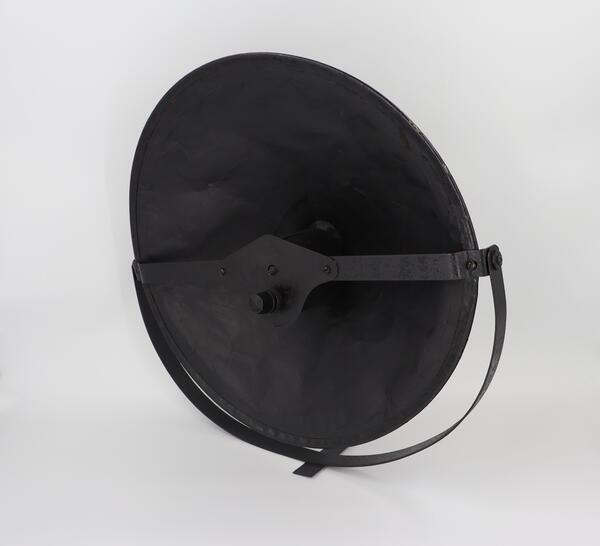
As soon as two years later, the device was described in great detail in the Soviet magazine called “Drug Radio”, published in Leningrad. Issues 2 and 3 for 1926 provided information not only about the fastening systems, but also the dimensions of the parts, and the materials of which those were made. In particular, loudspeakers of the Record series were of several types: desktop and wall-mounted, with various stands or suspensions. In terms of design, they were quite simple — it was a conical dish-type diffuser made of plain or pleated paper with a diameter of about 40 cm, mounted on metal holders. The diffuser was combined with an electromagnetic mechanism where a volume control was installed.
During the Great Patriotic War, the Record loudspeakers worked in apartments, houses, wooden huts and on street poles. It was under the radio loudspeakers that Soviet citizens gathered in the rear to hear the official news about the course of the fighting. The loudspeakers broadcast hits of famous war-time singers Lyudmila Ruslanova and Isabella Yuryeva for front-line soldiers, boosting the morale of the troops.
In addition to propaganda, entertainment and information, “black dishes” had another important function — that of civil defense. For example, during the Leningrad blockade, the city radio broadcasting network numbered about 1,500 street loudspeakers, informing the population about impending shelling and air raids.
On May 9, 1945, it was the Record loudspeakers that brought the joyful news of the end of the war to the homes of Soviet citizens. It was from such radio dishes all across the country that the voice of announcer Yuri Levitan was heard, who spoke about the “unconditional surrender of the German armed forces.”
In the second quarter of the 20th century, loudspeakers were manufactured by about a dozen factories in the Soviet Union. The subscriber loudspeaker of the Record series was the most mass-produced in the country and was made in a number of modifications: Record, Record-1, Record-3, and so on. The first device of this series was released in 1924 — 50 years after the German engineer Ernst Werner von Siemens first publicized a similar device.
As soon as two years later, the device was described in great detail in the Soviet magazine called “Drug Radio”, published in Leningrad. Issues 2 and 3 for 1926 provided information not only about the fastening systems, but also the dimensions of the parts, and the materials of which those were made. In particular, loudspeakers of the Record series were of several types: desktop and wall-mounted, with various stands or suspensions. In terms of design, they were quite simple — it was a conical dish-type diffuser made of plain or pleated paper with a diameter of about 40 cm, mounted on metal holders. The diffuser was combined with an electromagnetic mechanism where a volume control was installed.
During the Great Patriotic War, the Record loudspeakers worked in apartments, houses, wooden huts and on street poles. It was under the radio loudspeakers that Soviet citizens gathered in the rear to hear the official news about the course of the fighting. The loudspeakers broadcast hits of famous war-time singers Lyudmila Ruslanova and Isabella Yuryeva for front-line soldiers, boosting the morale of the troops.
In addition to propaganda, entertainment and information, “black dishes” had another important function — that of civil defense. For example, during the Leningrad blockade, the city radio broadcasting network numbered about 1,500 street loudspeakers, informing the population about impending shelling and air raids.
On May 9, 1945, it was the Record loudspeakers that brought the joyful news of the end of the war to the homes of Soviet citizens. It was from such radio dishes all across the country that the voice of announcer Yuri Levitan was heard, who spoke about the “unconditional surrender of the German armed forces.”