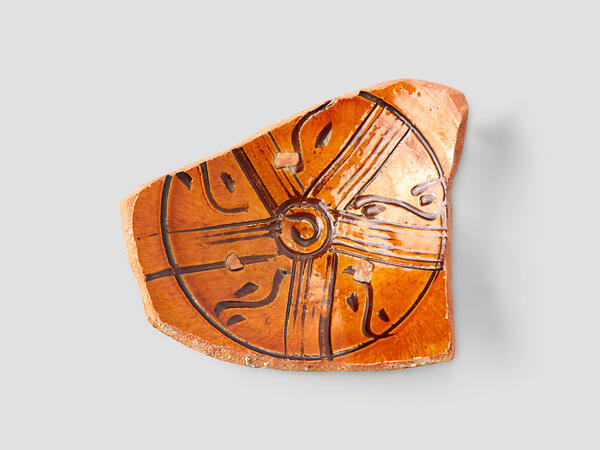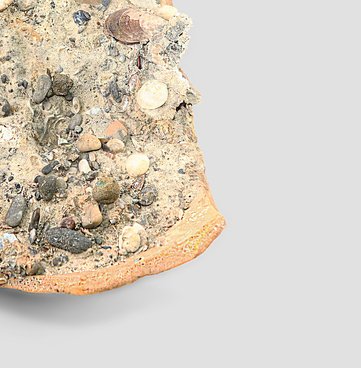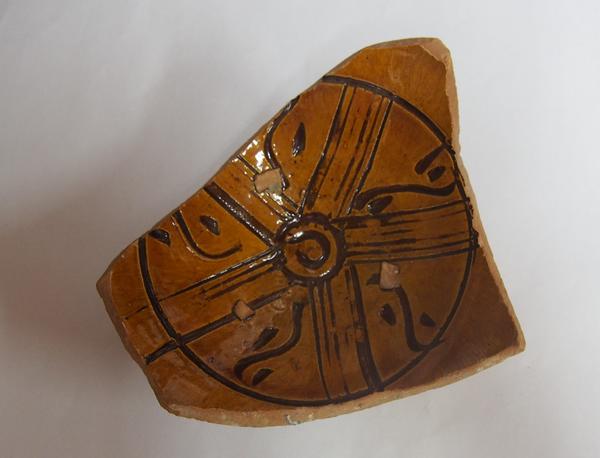
This plate was found on the seabed in Novy Svet Bay, where merchant ships and military escort ships moored when they arrived in Soldaya in the Middle Ages. The busy routes between East and West, Asia and Europe passed through here. The port, known from sources as Sudak-Limen, was located between the important trading points of the Black Sea — Trebizond on the southern coast and Tamatarcha on the Taman Peninsula.
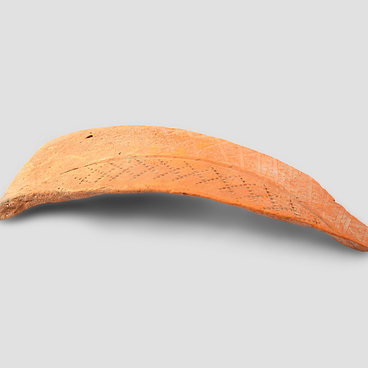
The artifact belongs to the type of cheap red-clay pottery, which was supplied in large quantities to the North–Eastern Black Sea region in the middle — third quarter of the 13th century. The presented object was mass-produced, which is evidenced by the traces left by a tripod on the bottom from the inside. Such tripod stands were only used to hold a large batch of vessels all fired at the same time.
The Mediterranean Region, which included the Black Sea, was a kind of “free economic zone” in the late Byzantine period of the 13th — mid-15th century. Despite political, religious and ethnic disagreements and feuds, trade was still active in this area, primarily because of Italian merchants.
The advent and development of glazed pottery is inextricably linked to the formation of urban culture and the development of urban crafts. Researchers believe that glazed pottery — dishes, bowls, vases with a variety of decorations — appeared around the same time when towns became a center of crafts.
In the second half of the 13th century — the first half of the 14th century, the local production of glazed tableware in the cities of Eastern Crimea became so active that imports from the Byzantine Empire were no longer necessary and were greatly reduced.
Irina Borisovna Teslenko, a Candidate of Historical Sciences and senior researcher at the Institute of Archaeology of Crimea, has analyzed the types of glazed pottery of this period and noted that some finds in Alushta resemble Byzantine items. Given this, Teslenko admits that Crimean pottery may be included “in the group of products influenced by Byzantine culture”.