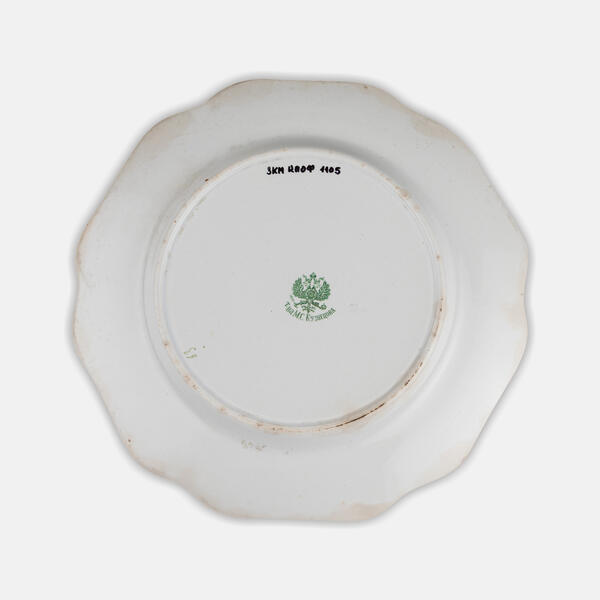
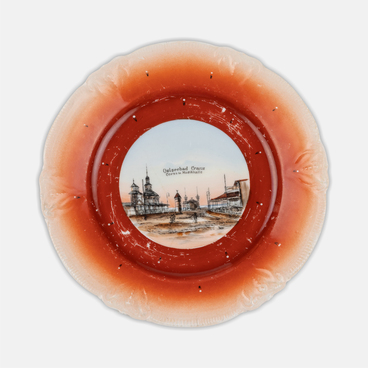
One of the most eye-catching items in the “Russians in Cranz” exhibition is the beautiful hexagonal plate. Its white relief edge is decorated with blue painted forget-me-nots. On the back of the plate, there is a brand of the Matvey Kuznetsov Partnership.
The years between the Franco-Prussian War in the second half of the 19thcentury and World War I are known as the Belle Époque (“Beautiful Epoch”). It was the last golden age of aristocracy and at the same time a period of innovations and technological progress which included the development of railroads, ocean liners, telephone, telegraph, gas, and electricity. In addition to the pursuit of fine arts, painting, music, and beauty in general, people enjoyed numerous technical innovations.
During that time, Russians started visiting East Prussia more and more often. A large number of guidebooks were produced, the most famous of which was “The Guide to Königsberg and the Nearby Seaside Resorts” of the 1912 edition, edited by M. Kantarovich. “Who among Russian travelers does not know about the Cranz seaside resort? Everybody does!” was the opening line of the guide. Up to 15,000 vacationers from the Russian Empire came to Cranz every year. The travel passports and well-developed transport network made it possible for Russian travelers to visit the German resort. Interestingly, many local residents, hotel employees, and waiters understood Russian quite well. The town’s Kurhaus (the main hotel and center of the resort’s life) was even subscribed to 10–15 Russian newspapers. These included the newspaper “Sankt-Peterburgskie Vedomosti” and the magazine “Niva”. “Niva” was positioned as an illustrated magazine of liberal politics and contemporary lifestyle.
On August 3, 1914, when Germany announced
mobilization, the number of Russian tourists decreased significantly. As a
token of those times, the Zelenogradsk Museum of Local Lore features some
interesting exhibits. These include Russian newspapers of those years,
tableware of Russian manufacturers, banknotes of the State Bank of the Russian
Empire and the Reichsbank, a postcard with a lady in a sea dress, and German
propaganda porcelain of 1914–1915. One of the most noteworthy exhibits is this
plate produced by the Kuznetsov Partnership.