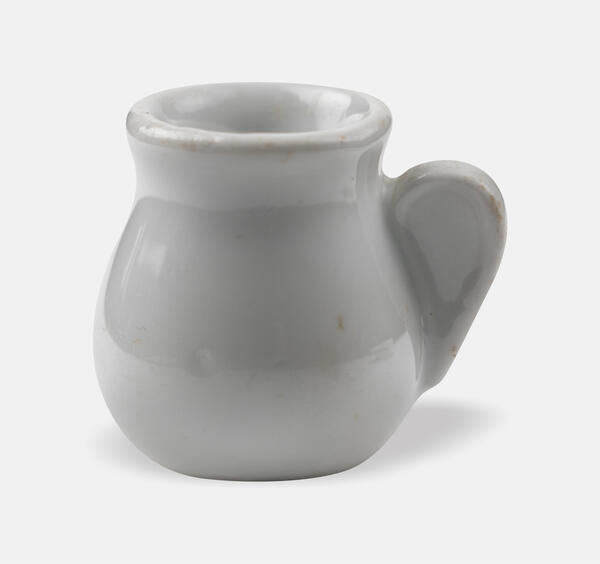
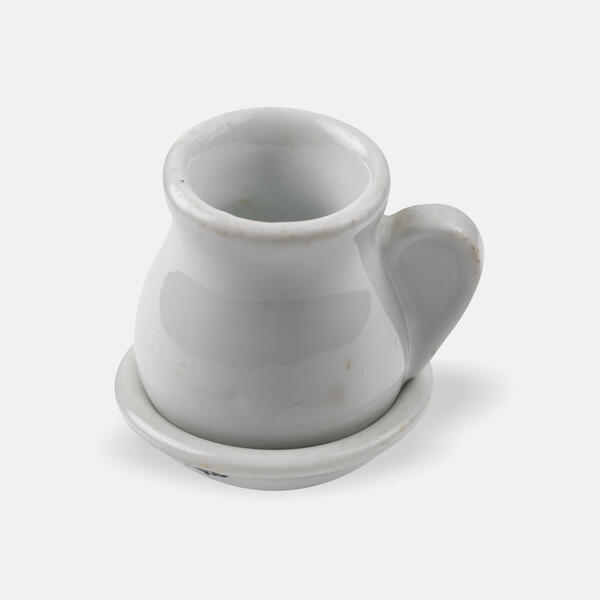
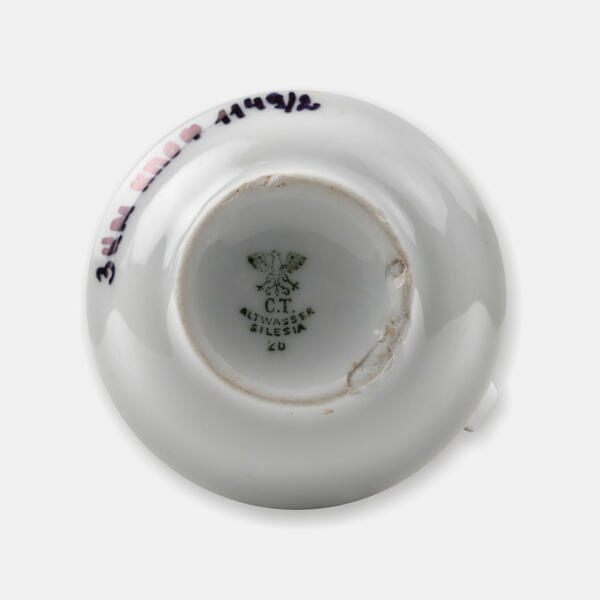
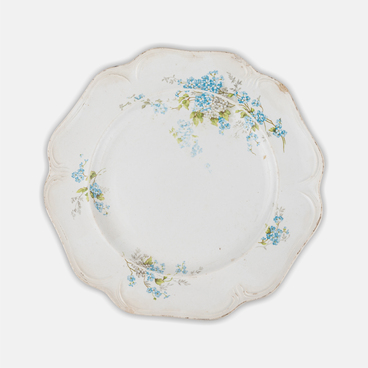
Two creamers with saucers produced by the Carl Tielsch Porcelain Manufactory were donated by Alexander Gorbovskikh, a Kaliningrad historian and long-time friend of the museum.
The history of the Carl Tielsch Porcelain Manufactory spans over 150 years. It was founded in the German town of Altwasser (later Waldenburg) in Lower Silesia in 1845 and quickly became one of the leading porcelain manufactories in Germany. Its popularity was ensured by the wide range of products. The enterprise focused on producing high-quality handmade porcelain, inviting the best artists and decorators of that time.
In 1913, the company reached the peak of its development. By mid-1914, the factory’s catalog contained 1,637 products. Although this might not seem like much, any item in that list, for example, a coffee pot, could be offered in approximately 200 versions which varied in size and décor.
The company successfully survived World War I. In
1917, the town’s authorities demanded that production be reduced to 60% for the
sake of saving resources. To compensate for the decline in production, Egmont
Tielsch suggested transforming the manufactory into a company limited by share.
In 1932, the Tielsch company was taken over by Hutschenreuther and the factory
in Altwasser became a branch of C.M. Hutschenreuther. Production continued
until 1945 with 1,200 employees. On May 8, 1945, Waldenburg was taken by the
Soviet Army and transferred to Poland. The Tielsch family fled, leaving behind
their castle in Reußendorf, and C.M. Hutschenreuther A.G. completely lost the
production in Altwasser. Under Polish management, the factory functioned until
1952, when it was nationalized entirely. During these years the last Tielsch
stamps were used with the additional inscription “Made in Poland”. In 1992, the
enterprise was transformed into a joint-stock company. The Tielsch factory
still operates today, but since 1992 it has been known as Zakłady Porcelany
Stołowej Wałbrzych S.A.