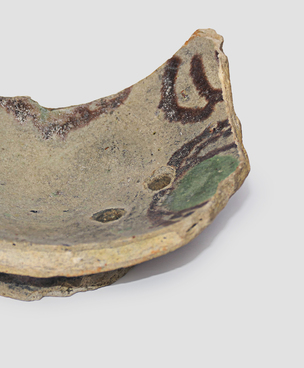
The scientific collections of the Sudak Fortress contain an impressive quantity of Byzantine ceramics, found during underwater archaeological excavations. The collection was formed as a result of many years of studying the water area in the bays of Sudak and Novy Svet. The first exhibits were donated by private individuals; in 1960–1990, the collection welcomed items found underwater by Mikhail Antonovich Frondzhulo and Igor Avenirovich Baranov. From 1999 to 2013, the main source of new finds were materials obtained by the underwater archaeological expedition led by Sergey Musiyevich Zelenko. The finds made between 2015–2016 have also significantly enriched the collection.
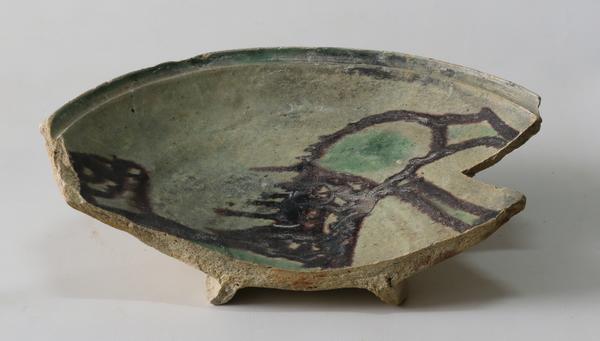
The plate on display was raised from the wreck site of an Italian merchant ship and could either belong to one of the crew members or be part of a trade shipment.
Theophilus Presbyter wrote about the process of making painted Byzantine ceramics and the list of favorite scenes to depict on them as early as the 11th century in his Schedula diversarum artium (known as “List of Various Arts”). According to his descriptions, for any vessel, Greek craftsmen “use all kinds of dyes and mix each of them separately with water, then add finely ground glass of the same color as the dye in a one to five ratio and mix it all with water again… Using this mixture, they draw circles and quadrifoils and place animals, birds, plants or anything else to their liking into them, and after the vessels are painted in this way, they put them in the kiln.”
Over time, the production process improved and started to include new dyes.
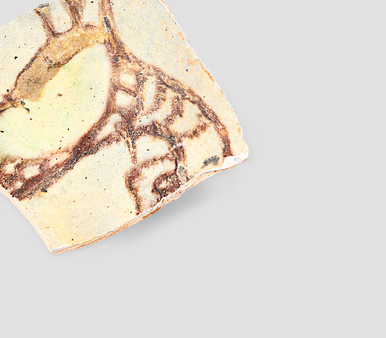
The exhibit belongs to the contour subtype of this type of ceramics: an animal’s profile is painted on a light monochrome background in brown color, and the circles in the girdles are marked with green dye. Oxides of copper salts were used to make this dye.
Part of the animal’s body is depicted with a scale pattern. This motif, consisting of scale-shaped elements, is a geometric pattern of Eastern origin.
The free manner of painting and the vague outlines make it hard to determine for sure what animal is depicted; it might be a hoofed one.