Tobacco played an important role in the life of the Shors: not only men but also women and teenagers were smokers. Since the 18th century, growing tobacco has been one of the sources of income for Kuznetsk townspeople. At the end of the 19th and beginning of the 20th centuries, smoking was considered a fashionable phenomenon in Kuznetsk, especially among women.
The 19th-century traveler and ethnographer Alexander Vasilyevich Adrianov wrote that wealthy Shors “lend money to their… relatives for the future nut harvest at 60-80 kopecks per pood <…> most often and most willingly they lend not money, but a commodity popular with foreigners like vodka, tobacco, gunpowder, etc.” Tobacco is also mentioned among the goods a hunter needs, along with bread, horse meat, salt, firearms supplies, materials for clothing and shoes, and tea.
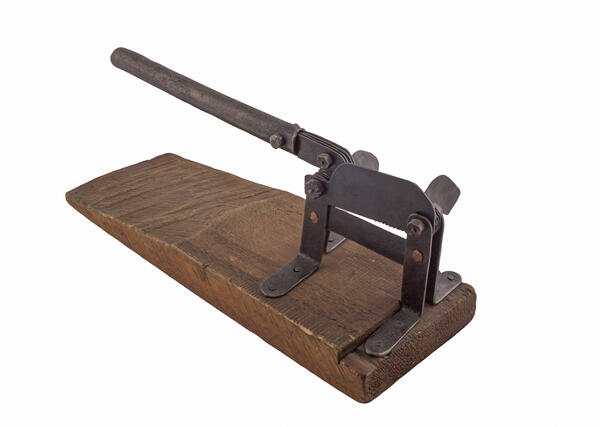
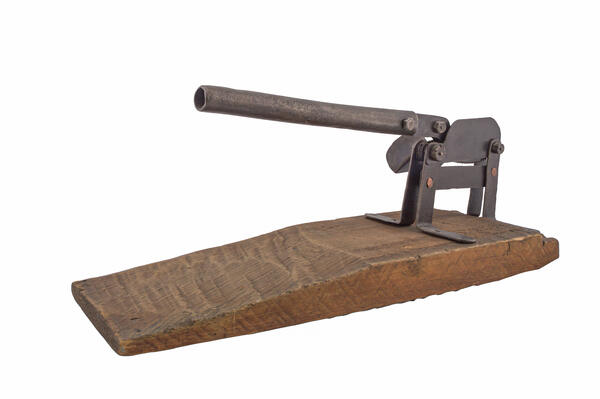
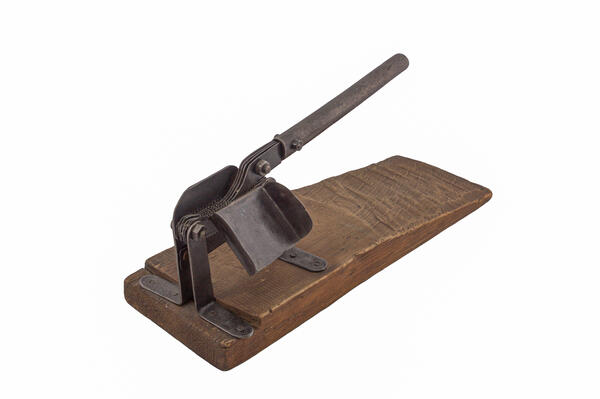
To grind tobacco leaves for smoking, there were special devices called tobacco cutters.
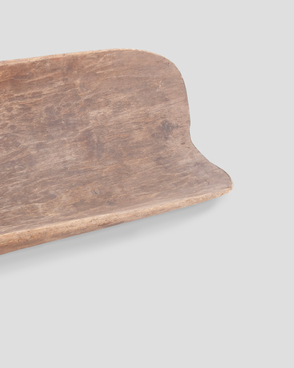
The exhibited device has several blades. It is mounted on four corner legs. Bolts, nuts, and nails fasten the corners respectively to the blades and the wooden base board. The five lower knives are immovable and have a serrated edge along their upper surface. There is a protective plate on one side of the blades, on the other there is a groove along which tobacco is placed under the cutting surfaces with the edges raised by three centimeters. Four arched movable upper blades are fixed between the lower blades, equipped with a serrated edge at the bottom. Attached to these movable knives is a handle through which the tobacco cutter is operated.
Tobacco cutters were commissioned in small private forges. In the 1920s, even factory production of tobacco (the Shors considered it too strong) appeared in Kuznetsk, however, most of the work in such factories was carried out manually.
The Shors smoked wooden pipes with crooked
mouthpieces, which were stored along with tobacco in fabric or leather pouches.
Green tobacco leaves were dried and mixed with birch bark to reduce the
bitterness when smoking. In the summer, when tobacco supplies were depleted,
the Shors used dry grass or smoked old pipes themselves, having previously
crushed them into powder.