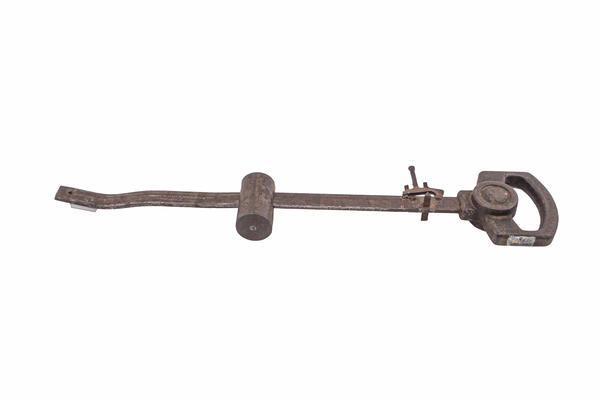
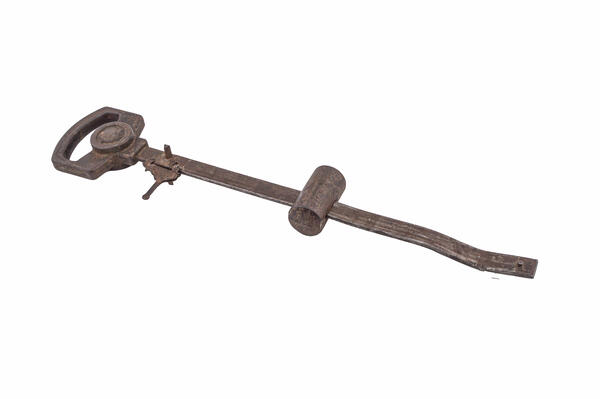
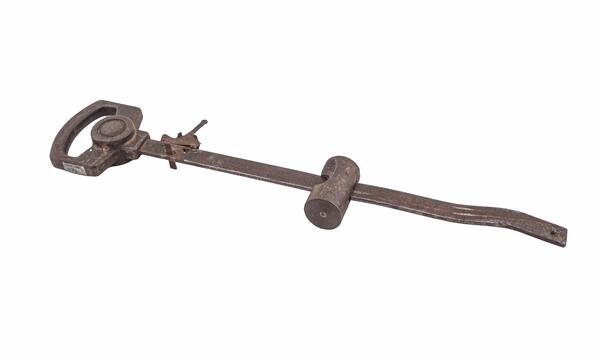
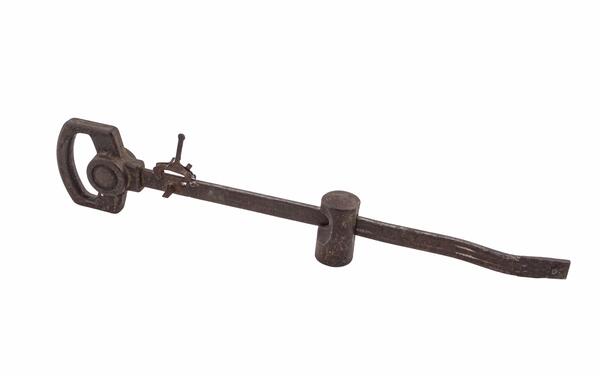
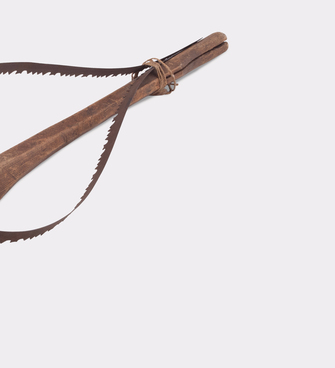
The first simplest scales with a counterweight appeared in Russia back in the 14th century and were widely used by merchants, farmers, hunters, and housewives. The merchandise to be weighed was hung on a hook, and then the device was balanced by moving the suspension cord along the beam.
Given how often cunning merchants defrauded their customers, the use of steelyards was banned in the 18th century. They were still readily available unofficially, but with the steelyards made before the 19th century determining the place and date of their manufacture can pose a problem.
The steelyard presented in the exhibition is also known as a Roman steelyard or Roman balance. The suspension cord and the plate with the object to be weighed remain immovable, while the counterweight is slid along the length of the beam until it and the object in the plate balance perfectly. The weight of the load is indicated by the position of the counterweight on the scaled beam.
In the first half of the 20th century, steelyards were furnished with scale marks displaying the weight in kilograms. There was a sliding weight to counterbalance the load and indicate its weight, as well as an immovable cylindrical cast-iron weight. The plate with the load was hung from a hook that was suspended from a rigidly fiхed loop. It was suspended four centimeters from the zero-reference point in the direction of the cast-iron weight.
In the USSR, the use of steelyards was banned again since even the properly made ones were prone to inaccuracy. Nevertheless, they were sold in hardware stores as household scales of the Tulinovsky plant.
In June 1941, an instrument engineering plant was evacuated from Vitebsk to the village of Tulinovka, Tambov Region, with the workers and engineers arriving as well. The former cloth factory buildings that were partially restored after a fire in 1933 housed the plant’s facilities, which began to supply the active army.
After the war, the Metal Products Plant enterprise began to produce loudspeakers, accessories for suitcases and other consumer products. In 1952, the plant started making weighing scales, primarily steelyards reading 10 and 20 kilograms. Over time, the range was expanded to include the pan balance, dial scales, medical scales, and others. In 1976, a new particularly precise instrument was introduced. At that time, the plant received its official name — the Tulinovsky Instrument Engineering Plant.
Equipment and materials were delivered to the plant
from Lipetsk, Khabarovsk, Tyumen, Saratov, Belarus and Ukraine, and the product
range was popular both in the Soviet Union and abroad: in Bulgaria, Mongolia,
and Vietnam.