The Shor agriculture had all the usual stages, but the archaic methods of work made it extremely difficult. The taiga forest was cut down and burned to make room for arable land; each cleared area was highly valued and was in the private use of the person who cultivated it. Fertilizers were necessary — without them, the soil became depleted after three or four years, and farmers had to move to a new place.
For a long time, crops were harvested by hand; the threshing method of roasting produced no more than 0.1 hectares of crop per person per day. Only then one could start winnowing, that is, separating grain from chaff while simultaneously removing dirt and insects.
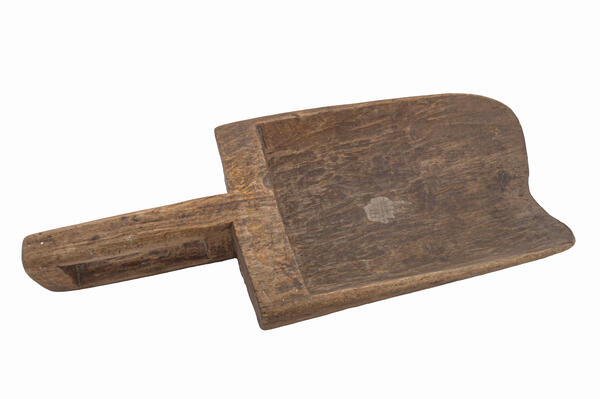
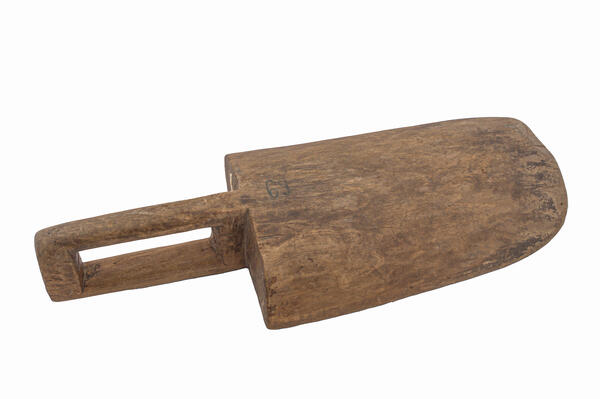
In its simplest form, the winnowing process consists of throwing grain into the air in such a way that the grain falls back, and light rubbish and chaff are blown away by the wind. Before the advent of special winnowing machines with fans, people used their own hands, wooden shovels, or scoops.
The Shors used “sargash” hand-held boxes that looked like half of a round shaman’s tambourine or a wide scoop. The sides of such winnowing tools were made from birch bark or thin cedar shingles and attached to the wooden bottom with wooden nails or leather straps.
Shor farmers put the threshed grain into cylinder birch bark vessels and left it on wooden “tastak” platforms in the field. Once winnowed, the grain was taken to barns placed on four posts to make them rodent proof. If there were no barns, grain was stored under a shed built on arable land, in huge birch bark boxes that were covered with a board and pressed down with stones. There were no locks on the grain barns since there was no theft in Shor villages.
In the 20th century, ethnographers, who
observed the life of the Shors for a long time, noted that they had a ѳdyşkelaw (literally meaning “loan”):
in the autumn, families with a good harvest would certainly share it with less
fortunate neighbors, meaning that next year it would be vice versa, should the
situation change. People would also share a big meal to celebrate the first
harvest.