The talented painter Fyodor Korney was born in 1959 in the town of Baranovichi, Belarus. Having done his military service, he trained as a textile designer at the Vitebsk State Technological Institute. In 1990, he lived with his family in the Varnavinsky district of the Nizhny Novgorod region. In Nizhny Novgorod, he held several personal exhibitions, and his works also had success on exhibitions in Poland. In 1998 he was admitted to the Union of Artists of Russia.
Korney’s creative range is wide: using watercolor and mixed techniques, he created many natural and urban landscapes, and still life paintings. His art can generally be described as a thoughtful continuation of the great traditions of Russian lyric writing, although many of his works indicate a thorough knowledge of impressionist techniques. The painter created his works, talking to the viewers sincerely, and that’s why his paintings often have a strong and very deep impact on visitors to exhibitions.
Within the landscape ‘Plyos. Zarechye’ Korney managed to preserve the best sides of the etude: freshness, spontaneity in the portrayal of a very elusive state of nature. At the same time, it is obvious that here the painter showed something more than just a kaleidoscope of quickly passing vivid impressions.
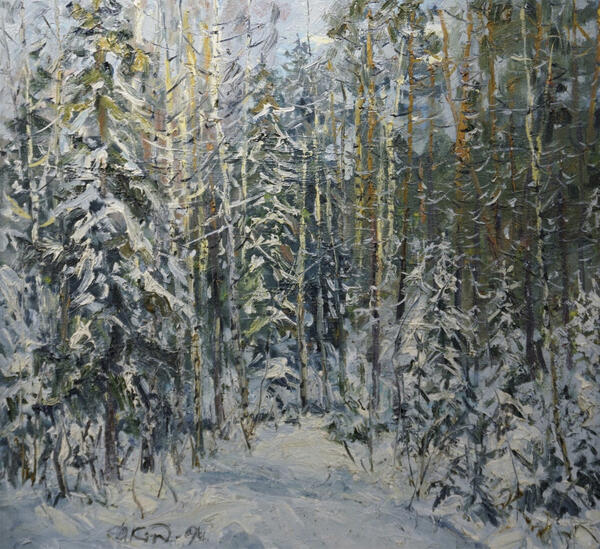
The painting was done in a pasty, with wide and large strokes. Having masterfully depicted the snow and conveyed its complex plasticity, Korney also managed to establish an amazing harmony between diverse white tones and contrasting brown and green colors. Instead of an all-encompassing delight caused by the beauty of the nature, the painting evokes very precise and intense low-key emotions.
The painting ‘Plyos. Zarechye’ masterly conveys the riddle of the winter forest. The tall spruces and pines covered with a deep layer of snow are both enchanting in their beauty and mysterious. Perhaps the painter not only reflected on the mysteries of the Russian forest, but also on the riddle of the soul of someone who grew up in these places. While the composition of the plot is simple and plain, Roots first shows us the depths of the endless forest, and from there, he takes us into the endless mysteries within ourselves.
Korney’s creative range is wide: using watercolor and mixed techniques, he created many natural and urban landscapes, and still life paintings. His art can generally be described as a thoughtful continuation of the great traditions of Russian lyric writing, although many of his works indicate a thorough knowledge of impressionist techniques. The painter created his works, talking to the viewers sincerely, and that’s why his paintings often have a strong and very deep impact on visitors to exhibitions.
Within the landscape ‘Plyos. Zarechye’ Korney managed to preserve the best sides of the etude: freshness, spontaneity in the portrayal of a very elusive state of nature. At the same time, it is obvious that here the painter showed something more than just a kaleidoscope of quickly passing vivid impressions.
The painting was done in a pasty, with wide and large strokes. Having masterfully depicted the snow and conveyed its complex plasticity, Korney also managed to establish an amazing harmony between diverse white tones and contrasting brown and green colors. Instead of an all-encompassing delight caused by the beauty of the nature, the painting evokes very precise and intense low-key emotions.
The painting ‘Plyos. Zarechye’ masterly conveys the riddle of the winter forest. The tall spruces and pines covered with a deep layer of snow are both enchanting in their beauty and mysterious. Perhaps the painter not only reflected on the mysteries of the Russian forest, but also on the riddle of the soul of someone who grew up in these places. While the composition of the plot is simple and plain, Roots first shows us the depths of the endless forest, and from there, he takes us into the endless mysteries within ourselves.