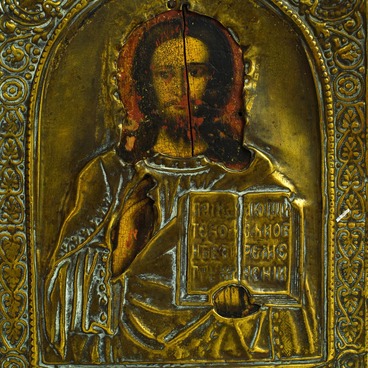
An icon is an image of a saint who is addressed by the believer. The earliest icons depicted the Crucifixion, Jesus Christ, the Mother of God and Nicholas the Wonderworker. Initially, the images were painted on wood. In the 11th and 12th centuries, cast icons appeared — they were reduced copies of full-size church images. They were durable, cheap, and convenient to carry. Among the cast icons were those that were worn on the body; they are called pectoral icons.
There are several versions as to how such pectoral icons came to be. One says that they were secretly worn on the chests of the first Christians, who were persecuted by the Jews and Romans. Another suggests that initially they belonged to those who traveled a lot: wanderers, pilgrims, and warriors. The third one is that the icons made of precious metals were worn by the nobles of Byzantium as jewelry. There are many more hypotheses.
The Museum Complex of Kuybyshev houses an icon cast from copper — “St. Nicholas the Wonderworker of Myra”. This half-length image of the saint with a closed Gospel in his left hand is among the most common in Byzantine and Russian art.
Saint Nicholas lived in the 3rd–4th century in Lycia, in Asia Minor and was an archbishop in the city of Myra — therefore he is called Nicholas of Myra. Saint Nicholas has always been revered as an intercessor in sorrows and a helper in misfortunes. He is considered the patron saint of travelers and conqueror of demons. In almost every Russian house during the heyday of Orthodox Christianity, one could see an icon of St. Nicholas the Wonderworker. People turned to him more often than to other saints, praying “for intercession from all kinds of troubles and misfortunes.” Russian navigators also tried to bring a copper icon of the saint with them on the way to pray to him for help on the road or on the water.
At the same time, Nicholas the Wonderworker entered church history as a strict defender of the dogmas of the Christian faith and a ruthless persecutor and exterminator of heresies.
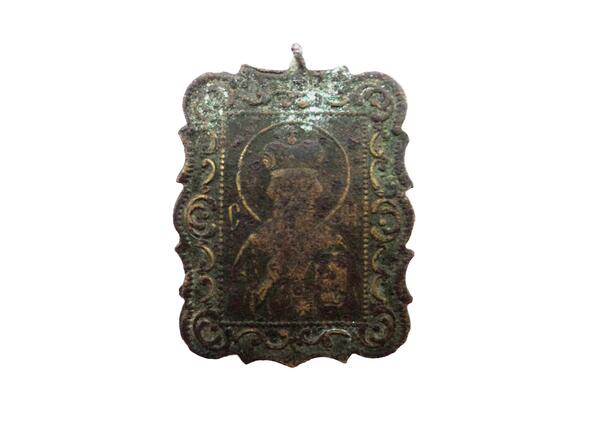
The displayed icon is a thin cast plate made of copper alloy. The edges of the icon are wavy and patterned. In the center of the upper part is a loop for a lace or chain. On the front side, in the central part of the icon, is a relief half-length image of the elder in episcopal vestments. On the head of the Saint is a miter headdress surrounded by a halo. The right hand of the Holy Elder is raised in a blessing gesture, and he holds a closed Gospel in his left hand.
The inner and outer edges of the frame are made in the form of a relief ornament of dots. There is a pattern of curls on the margins of the frame. The icon’s relief is flat, with fine details and a clear casting.
There are several versions as to how such pectoral icons came to be. One says that they were secretly worn on the chests of the first Christians, who were persecuted by the Jews and Romans. Another suggests that initially they belonged to those who traveled a lot: wanderers, pilgrims, and warriors. The third one is that the icons made of precious metals were worn by the nobles of Byzantium as jewelry. There are many more hypotheses.
The Museum Complex of Kuybyshev houses an icon cast from copper — “St. Nicholas the Wonderworker of Myra”. This half-length image of the saint with a closed Gospel in his left hand is among the most common in Byzantine and Russian art.
Saint Nicholas lived in the 3rd–4th century in Lycia, in Asia Minor and was an archbishop in the city of Myra — therefore he is called Nicholas of Myra. Saint Nicholas has always been revered as an intercessor in sorrows and a helper in misfortunes. He is considered the patron saint of travelers and conqueror of demons. In almost every Russian house during the heyday of Orthodox Christianity, one could see an icon of St. Nicholas the Wonderworker. People turned to him more often than to other saints, praying “for intercession from all kinds of troubles and misfortunes.” Russian navigators also tried to bring a copper icon of the saint with them on the way to pray to him for help on the road or on the water.
At the same time, Nicholas the Wonderworker entered church history as a strict defender of the dogmas of the Christian faith and a ruthless persecutor and exterminator of heresies.
The displayed icon is a thin cast plate made of copper alloy. The edges of the icon are wavy and patterned. In the center of the upper part is a loop for a lace or chain. On the front side, in the central part of the icon, is a relief half-length image of the elder in episcopal vestments. On the head of the Saint is a miter headdress surrounded by a halo. The right hand of the Holy Elder is raised in a blessing gesture, and he holds a closed Gospel in his left hand.
The inner and outer edges of the frame are made in the form of a relief ornament of dots. There is a pattern of curls on the margins of the frame. The icon’s relief is flat, with fine details and a clear casting.