Icons created at monasteries or specialized art centers were based on Byzantine canons, the observance of which was mandatory. For example, the use of reverse perspective was obligatory; there were no halftones or light sources in the images, as there are no shadows in the Kingdom of God. The saints were depicted with their characteristic attributes. The vestments of the martyrs and miracle workers were regulated, and the colors of the clothes corresponded to their status and historical realities.
However, the creation of such “professional” icons required a lot of time and resources. They were expensive and were not available to every Orthodox family.
Therefore, in the late 19th century, the printing industry offered its help to the believers. Factories began to produce quite economical icons in terms of execution: in order to create such an icon, the masters painted only the face and hands on the board. The rest of the wooden board either remained untouched or was covered with paint of the same tone. A tin, stamped revetment was attached on top of the board, on which the rest of the image of the saint was printed.
Icons with a tin revetment were produced much quicker, in huge quantities and were in great demand among the common people.
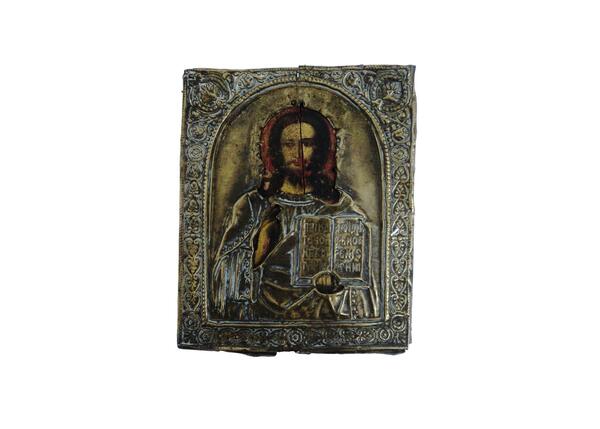
One of these icons is the “Christ Pantocrator” from the collection of the Museum Complex of Kuybyshev. This half-length image of Jesus Christ with the Gospel in His left hand and His right hand blessing the whole world belongs to the main type of iconographic depictions of the Son of God.
The face and hair of Christ are painted in oil on the board quite simply. The remaining details of the image of the Savior are printed on the revetment, which is made of a metal sheet by stamping. On the central part with a semicircular upper half are slots through which the hands and face is visible. In the center is the figure of the Savior in a chiton and a himation. Above the left hand is an open Gospel with a text. The revetment is attached to the board with nails along the edges. Previously, a presently-lost crown was nailed on top of the revetment over the head of the Savior.
However, the creation of such “professional” icons required a lot of time and resources. They were expensive and were not available to every Orthodox family.
Therefore, in the late 19th century, the printing industry offered its help to the believers. Factories began to produce quite economical icons in terms of execution: in order to create such an icon, the masters painted only the face and hands on the board. The rest of the wooden board either remained untouched or was covered with paint of the same tone. A tin, stamped revetment was attached on top of the board, on which the rest of the image of the saint was printed.
Icons with a tin revetment were produced much quicker, in huge quantities and were in great demand among the common people.
One of these icons is the “Christ Pantocrator” from the collection of the Museum Complex of Kuybyshev. This half-length image of Jesus Christ with the Gospel in His left hand and His right hand blessing the whole world belongs to the main type of iconographic depictions of the Son of God.
The face and hair of Christ are painted in oil on the board quite simply. The remaining details of the image of the Savior are printed on the revetment, which is made of a metal sheet by stamping. On the central part with a semicircular upper half are slots through which the hands and face is visible. In the center is the figure of the Savior in a chiton and a himation. Above the left hand is an open Gospel with a text. The revetment is attached to the board with nails along the edges. Previously, a presently-lost crown was nailed on top of the revetment over the head of the Savior.