


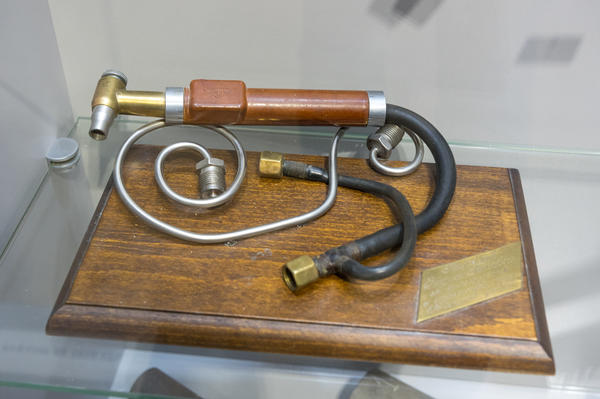
This is a souvenir in the form of a fragment of a welding machine — a gift from colleagues for the 50th anniversary of the eminent welder of the plant, Hero of Socialist Labor Evdokia Pavlovna Nochvina (1926–2012).
Manual welding master Evdokia Nochvina worked at the enterprise from 1944 to 1991. By the mid-1950s, 46 ships were delivered to the fleet, on the production of which she worked directly, including 2 cruisers, more than 30 various civil ships. During these years, the work of Evdokia Nochvina was awarded medals ‘For Labor Valor’ and ‘For Labor Distinction’. When, in the second half of the 1950s, the plant began building the first Soviet missile carriers — Project 611 diesel-electric submarines and its modifications, it was Evdokia Nochvina who was entrusted with welding rocket racks on these boats. Academician Sergei Korolev himself especially noted the accuracy and responsibility of the welder.
By the decree of the Presidium of the Supreme Soviet of the USSR of April 28, 1963, Evdokia Nochvina was awarded the title of Hero of Socialist Labor for her great services in the creation and production of new types of missile weapons, as well as nuclear-powered submarines and surface ships equipped with these weapons, and the rearmament of ships of the Navy.
The work on the construction of the lead submarine missile carrier of Project 667 A became especially memorable for the welder. This nuclear-powered ship opened an account for the largest series of nuclear-powered submarines in the domestic shipbuilding industry. In total, 59 ships of this type were built at Sevmash in 1963–1990. During the construction of the ship, Evdokia Nochvina was entrusted with the most important welding work. When the order was finish in the factory, no one was surprised that it was Evdokia Pavlovna who became the ‘godmother’ of the ship. She smashed a bottle of champagne on the side of the nuclear-powered ship and handed the symbolic key to the ship to its first commander and ‘godfather’ Vadim Leonidovich Berezovsky. After that Evdokia Pavlovna, contrary to all the traditions of ‘not letting in women, ” was always a welcome guest on the ship.
Manual welding master Evdokia Nochvina worked at the enterprise from 1944 to 1991. By the mid-1950s, 46 ships were delivered to the fleet, on the production of which she worked directly, including 2 cruisers, more than 30 various civil ships. During these years, the work of Evdokia Nochvina was awarded medals ‘For Labor Valor’ and ‘For Labor Distinction’. When, in the second half of the 1950s, the plant began building the first Soviet missile carriers — Project 611 diesel-electric submarines and its modifications, it was Evdokia Nochvina who was entrusted with welding rocket racks on these boats. Academician Sergei Korolev himself especially noted the accuracy and responsibility of the welder.
By the decree of the Presidium of the Supreme Soviet of the USSR of April 28, 1963, Evdokia Nochvina was awarded the title of Hero of Socialist Labor for her great services in the creation and production of new types of missile weapons, as well as nuclear-powered submarines and surface ships equipped with these weapons, and the rearmament of ships of the Navy.
The work on the construction of the lead submarine missile carrier of Project 667 A became especially memorable for the welder. This nuclear-powered ship opened an account for the largest series of nuclear-powered submarines in the domestic shipbuilding industry. In total, 59 ships of this type were built at Sevmash in 1963–1990. During the construction of the ship, Evdokia Nochvina was entrusted with the most important welding work. When the order was finish in the factory, no one was surprised that it was Evdokia Pavlovna who became the ‘godmother’ of the ship. She smashed a bottle of champagne on the side of the nuclear-powered ship and handed the symbolic key to the ship to its first commander and ‘godfather’ Vadim Leonidovich Berezovsky. After that Evdokia Pavlovna, contrary to all the traditions of ‘not letting in women, ” was always a welcome guest on the ship.


