During the Great Patriotic War, boots were practically not available for sale. The country’s shoe factories specialized in sewing boots for the army. Mostly demobilized officers wore chrome shoes. During the war years, the shoe shop of an artel of disabled people mastered the manufacture of canvas boots with wooden soles, several specialists were engaged in shoe repair. The queue for repairs dragged on for months, there was a huge lack of shoemakers. In families where there were men and teenagers, they repaired shoes.
The solution to the ‘shoe’ problem was even discussed at the meetings of the City Party Committee. The Molotovsk city newspaper (as Severodvinsk was then called) reported on the sale of felt boots, rubber and felt women’s boots. However, a few days later it published feuilletons about how unscrupulous sellers sold shoes “from under the counter.”
Given the shortage, a young teacher at school No. 7, Zinaida Vasilievna Veshnyakova, had no chance of getting new shoes. When Zinaida Vasilievna arrived in the city after graduating from the pedagogical school, she had neither boots, nor felt boots. One could only dream of buying shoes in a store. A compassionate school technician, with whom a cobbler relative lived in Minsk, took pity on the teacher. She helped Zinaida Vasilyevna to have these boots sewn without queuing in Minsk. Then the leg measurements were sent by letter to Minsk, and a few months later a parcel with boots arrived in Molotovsk.
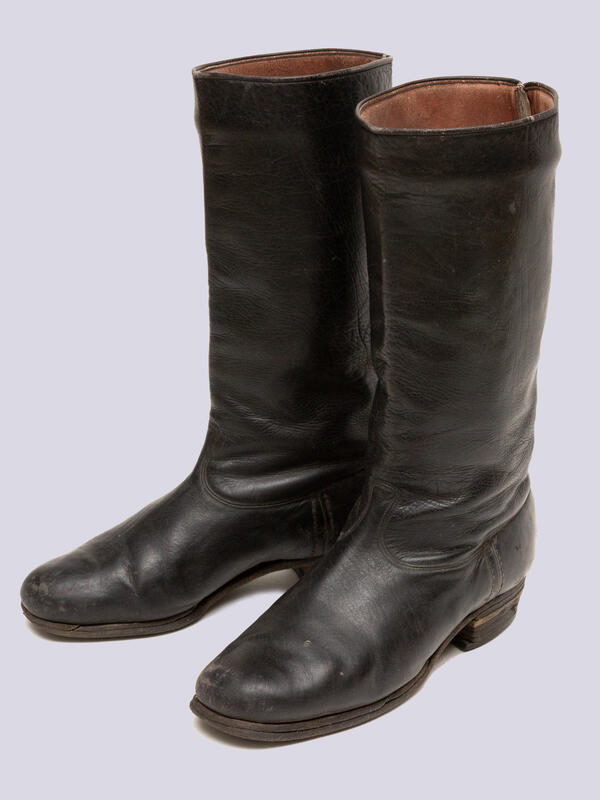
The teacher treated the new thing with care. She never walked in the new boots on the muddy marshy streets, preferring to wear them in the winter around school as a second pair of shoes. We can see that the heels of the boots are almost not worn out. When it became easier with the shoe supply, and other shoes appeared in the wardrobe, the boots were still kept in the family, as a memory of the difficult post-war years. In 2012, on the eve of her death, Zinaida Vasilievna donated the boots to the museum, along with a whole collection of shoes from later years.
The solution to the ‘shoe’ problem was even discussed at the meetings of the City Party Committee. The Molotovsk city newspaper (as Severodvinsk was then called) reported on the sale of felt boots, rubber and felt women’s boots. However, a few days later it published feuilletons about how unscrupulous sellers sold shoes “from under the counter.”
Given the shortage, a young teacher at school No. 7, Zinaida Vasilievna Veshnyakova, had no chance of getting new shoes. When Zinaida Vasilievna arrived in the city after graduating from the pedagogical school, she had neither boots, nor felt boots. One could only dream of buying shoes in a store. A compassionate school technician, with whom a cobbler relative lived in Minsk, took pity on the teacher. She helped Zinaida Vasilyevna to have these boots sewn without queuing in Minsk. Then the leg measurements were sent by letter to Minsk, and a few months later a parcel with boots arrived in Molotovsk.
The teacher treated the new thing with care. She never walked in the new boots on the muddy marshy streets, preferring to wear them in the winter around school as a second pair of shoes. We can see that the heels of the boots are almost not worn out. When it became easier with the shoe supply, and other shoes appeared in the wardrobe, the boots were still kept in the family, as a memory of the difficult post-war years. In 2012, on the eve of her death, Zinaida Vasilievna donated the boots to the museum, along with a whole collection of shoes from later years.