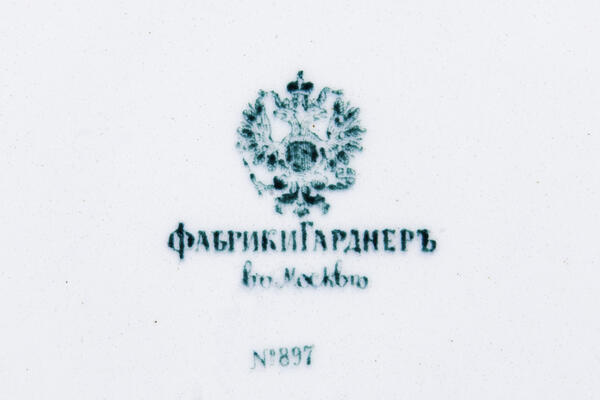
The soup bowl with a lid from a faience dinnerware set was produced at a factory in the village of Verbilki, Dmitrov Uyezd, not far from Moscow. Known earlier as the Gardner Manufactory, it was acquired by the major industrialist Matvey Kuznetsov in 1891. Later, this factory along with other ceramics enterprises became part of the Matvey Kuznetsov Partnership for the Production of Porcelain, Earthenware and Majolica Products.
Matvey Kuznetsov’s great-grandfather founded porcelain production in the Gzhel District in 1812. His father owned the Riga Porcelain and Faience Factory. Matvey Kuznetsov inherited these enterprises and acquired other factories.
In its heyday, the Partnership included eight factories, which manufactured two-thirds of Russia’s porcelain. The Kuznetsovs developed a wide range of products: from luxury dinner sets for members of the imperial family to mass-market tavern tableware. There were products to suit any taste and wallet.
The porcelain and faience products of the Matvey Kuznetsov Partnership were of very high quality and received numerous awards at industrial and art exhibitions of both nationwide and international levels. Matvey Kuznetsov was awarded the title of Supplier of the Court of His Imperial Majesty. The Partnership implemented the latest technological innovations and used the best local and imported raw materials.
Along with the purchase of the Gardner Manufactory, the new owner received the right to use the Gardner stamp, as well as images of the awards, which the famous manufactory had received before the deal. Kuznetsov also made active use of the Gardner Manufactory’s designs. The soup bowl from the museum’s collection is an example of such products. It was made in the Rococo Revival style.
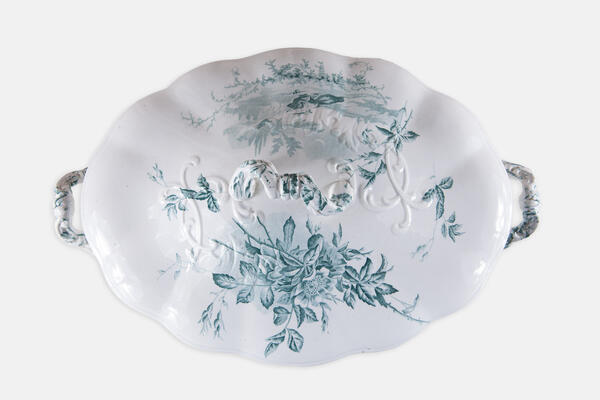
The base of the oval soup bowl is shaped like a shell, which is typical of the Rococo style. Its wavy walls and lid are decorated with a relief pattern. The handles are shaped like scrolls. The monochrome images of rosehip bouquets are also in harmony with the overall decoration style. They were created using the technique of underglaze printing.
Matvey Kuznetsov’s great-grandfather founded porcelain production in the Gzhel District in 1812. His father owned the Riga Porcelain and Faience Factory. Matvey Kuznetsov inherited these enterprises and acquired other factories.
In its heyday, the Partnership included eight factories, which manufactured two-thirds of Russia’s porcelain. The Kuznetsovs developed a wide range of products: from luxury dinner sets for members of the imperial family to mass-market tavern tableware. There were products to suit any taste and wallet.
The porcelain and faience products of the Matvey Kuznetsov Partnership were of very high quality and received numerous awards at industrial and art exhibitions of both nationwide and international levels. Matvey Kuznetsov was awarded the title of Supplier of the Court of His Imperial Majesty. The Partnership implemented the latest technological innovations and used the best local and imported raw materials.
Along with the purchase of the Gardner Manufactory, the new owner received the right to use the Gardner stamp, as well as images of the awards, which the famous manufactory had received before the deal. Kuznetsov also made active use of the Gardner Manufactory’s designs. The soup bowl from the museum’s collection is an example of such products. It was made in the Rococo Revival style.
The base of the oval soup bowl is shaped like a shell, which is typical of the Rococo style. Its wavy walls and lid are decorated with a relief pattern. The handles are shaped like scrolls. The monochrome images of rosehip bouquets are also in harmony with the overall decoration style. They were created using the technique of underglaze printing.