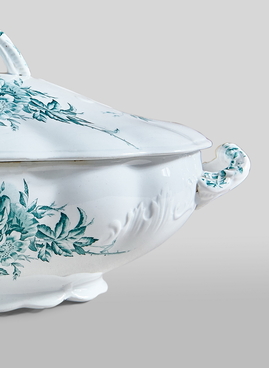
The dinnerware set from the museum’s collection was produced at the famous manufactory Villeroy & Boch in the city of Mettlach, Germany. This enterprise became one of the first large ceramics monopolies in Europe.
The factory’s history dates back to the mid-18th century when François Boch set up a small faience workshop with his three sons. During that time, porcelain dinnerware was expensive, while faience, although similar in appearance, was much cheaper to produce and therefore more affordable for customers.
In the early 19th century, Nicolas Villeroy founded a ceramics manufactory near Jean-François Boch’s factory. The two successful entrepreneurs got acquainted. Soon they became friends and eventually business partners, merging their companies in 1836.
The components of the dinnerware set — the plate, soup bowl, cutting board, and two gravy boats on non-detachable stands — were made in the Rococo Revival style. Its name comes from the word “rocaille”, which refers to a specific style of decoration, with an abundance of curves resembling the letter “C”. Rocaille decoration included such motifs as seashells and scrolls, often combined with cascades of vines and shoots.
The style’s influence can be observed mainly in the shapes of the pieces. The oval soup bowl’s base has a wavy edge, as do the plate, and stands of saucers with their uneven surfaces.
Floral scrolls are the dominant motif in the relief pattern around the handles and at the bases of pieces. The handles are also shaped like scrolls and decorated with gilding.
One of the most popular motifs of Rococo painting was flowers. This dinnerware set is decorated with bouquets of roses and forget-me-nots in a pastel color palette, which was typical of the style. The predominant color is delicate pink.
In contrast to the hand-painted products of the 18th century, the Villeroy & Boch dinnerware set was decorated using the decal technique. It was an inexpensive mechanized process of transferring images that did not require artists to engage in painstaking manual work.
The factory’s history dates back to the mid-18th century when François Boch set up a small faience workshop with his three sons. During that time, porcelain dinnerware was expensive, while faience, although similar in appearance, was much cheaper to produce and therefore more affordable for customers.
In the early 19th century, Nicolas Villeroy founded a ceramics manufactory near Jean-François Boch’s factory. The two successful entrepreneurs got acquainted. Soon they became friends and eventually business partners, merging their companies in 1836.
The components of the dinnerware set — the plate, soup bowl, cutting board, and two gravy boats on non-detachable stands — were made in the Rococo Revival style. Its name comes from the word “rocaille”, which refers to a specific style of decoration, with an abundance of curves resembling the letter “C”. Rocaille decoration included such motifs as seashells and scrolls, often combined with cascades of vines and shoots.
The style’s influence can be observed mainly in the shapes of the pieces. The oval soup bowl’s base has a wavy edge, as do the plate, and stands of saucers with their uneven surfaces.
Floral scrolls are the dominant motif in the relief pattern around the handles and at the bases of pieces. The handles are also shaped like scrolls and decorated with gilding.
One of the most popular motifs of Rococo painting was flowers. This dinnerware set is decorated with bouquets of roses and forget-me-nots in a pastel color palette, which was typical of the style. The predominant color is delicate pink.
In contrast to the hand-painted products of the 18th century, the Villeroy & Boch dinnerware set was decorated using the decal technique. It was an inexpensive mechanized process of transferring images that did not require artists to engage in painstaking manual work.