This elegant cup and saucer set was supposedly made in the 1820s. It is an excellent example of French porcelain in the Empire style that replaced Classicism in the late 18th century. The main objective of the new style was to glorify Napoleon Bonaparte and his rule.
Like Classicism, the Empire style was based on ancient art, with its primary inspiration being the art of Imperial Rome. The military motifs in Empire ornaments, such as weapons, armor, and laurel wreaths were borrowed from that period. The key characteristics of the Empire style are grandeur and formality. A particular splendor was achieved through the extensive use of gilding.
The French porcelain market has always been dominated by the Manufacture nationale de Sèvres. Its predecessor was established in the Château de Vincennes in 1740. Later, the factory was named after the commune of Sèvres, where it moved in 1756. Throughout its history, the Sèvres manufactory was supervised and patronized by the French government, and its products were distinguished by superb quality and impeccable artistic taste.
Other French porcelain producers inevitably had to compete with the famous manufactory. The competition encouraged them to improve the quality of their products. The French inscription on the back of the piece indicates that the cup and saucer set was made at one of such factories. “Guignot” might either refer to the name of the workshop or be the signature of the artist who painted the set.
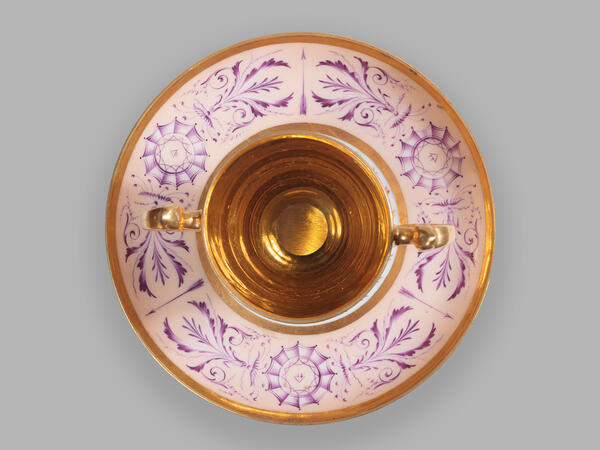
The cup was made in the shape of a krater — an ancient vessel used for mixing wine with water. It has two thin upturned handles with scrolls and is crowned with a tall lid. The round stepped base was designed to match the recess of the saucer. The design of all pieces is symmetrical, which is typical of the Empire style.
The delicate purple arabesque pattern stands out elegantly against the warm pink background. Another exquisite detail is the gilding. The entire inner surface of the cup is gold-plated, and the outside surface is decorated with gilded bands and leaf garlands. The cup’s base, handles, and ball-shaped finial are all coated with gold.
This cup and saucer set is an example of festive chinaware. Such sets were not used every day but were treasured and often passed down from generation to generation as an heirloom.
Like Classicism, the Empire style was based on ancient art, with its primary inspiration being the art of Imperial Rome. The military motifs in Empire ornaments, such as weapons, armor, and laurel wreaths were borrowed from that period. The key characteristics of the Empire style are grandeur and formality. A particular splendor was achieved through the extensive use of gilding.
The French porcelain market has always been dominated by the Manufacture nationale de Sèvres. Its predecessor was established in the Château de Vincennes in 1740. Later, the factory was named after the commune of Sèvres, where it moved in 1756. Throughout its history, the Sèvres manufactory was supervised and patronized by the French government, and its products were distinguished by superb quality and impeccable artistic taste.
Other French porcelain producers inevitably had to compete with the famous manufactory. The competition encouraged them to improve the quality of their products. The French inscription on the back of the piece indicates that the cup and saucer set was made at one of such factories. “Guignot” might either refer to the name of the workshop or be the signature of the artist who painted the set.
The cup was made in the shape of a krater — an ancient vessel used for mixing wine with water. It has two thin upturned handles with scrolls and is crowned with a tall lid. The round stepped base was designed to match the recess of the saucer. The design of all pieces is symmetrical, which is typical of the Empire style.
The delicate purple arabesque pattern stands out elegantly against the warm pink background. Another exquisite detail is the gilding. The entire inner surface of the cup is gold-plated, and the outside surface is decorated with gilded bands and leaf garlands. The cup’s base, handles, and ball-shaped finial are all coated with gold.
This cup and saucer set is an example of festive chinaware. Such sets were not used every day but were treasured and often passed down from generation to generation as an heirloom.