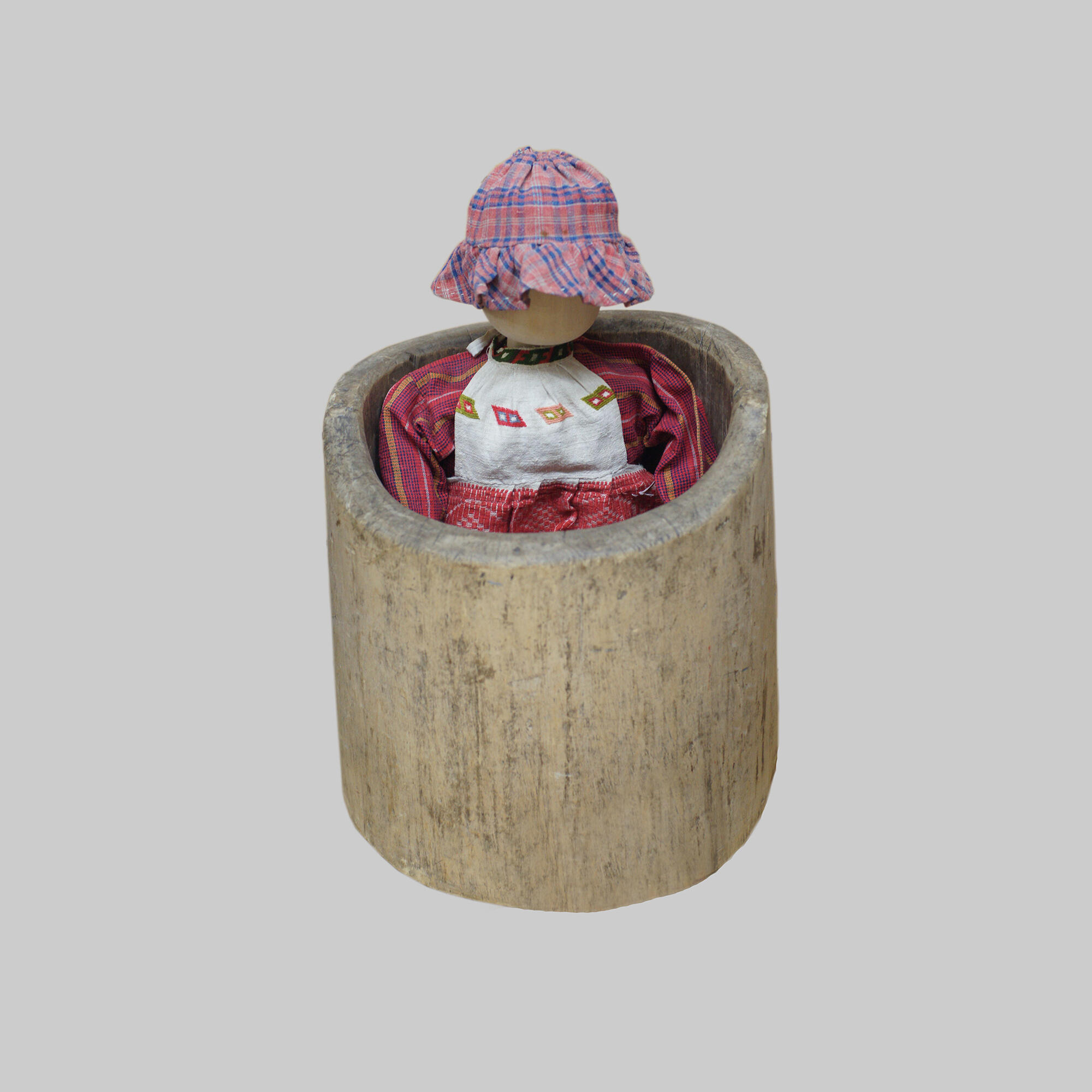


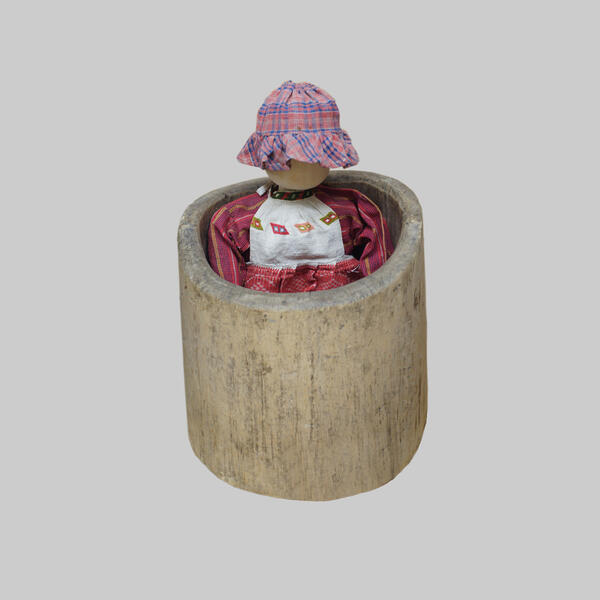
Every Udmurt household had a special chair for small children. Mothers used it to sit down their babies who just learned to sit and crawl. Before sitting down to work at the loom, a woman would place the chair next to her, put her child in it, give it a rattling toy, and then proceed to work on the loom. This massive oaken construction kept the active and inquisitive baby in place allowing the mother to carry on with her chores. The chair was often placed near a bench with all sorts of toys laid out on it: birch bark and wooden rattles, twist dolls, etc. This kept the child occupied and kept them from crying. The manufacturing process for this chair is quite simple. The trunk of the tree was sawed into several parts. Then a hole was carved into one of the round parts (and that’s where the chair’s name comes from: “gyrk” means “a hollow place in the trunk” in Udmurt) The chair is a complete bottomless cylinder. Inside, in the lower part, a thick rectangular crossbar for sitting is inserted into the grooves in cylinder walls. The chair was common in the countryside among Russians and Udmurts.
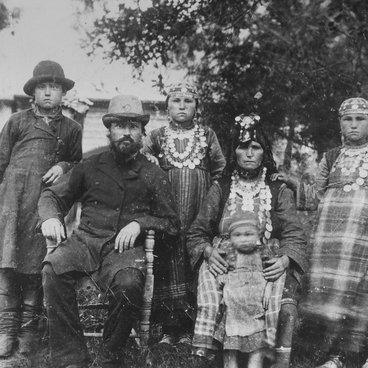
Udmurt peasants took special care of their children. Udmurt writer, ethnographer, and clergyman Grigory Vereshchagin wrote that the Udmurts “believe that children is what brings happiness into people”s lives, especially sons; they believe that it”s the parents of children who can truly call themselves happy and satisfied with their fate.”
Due to the fact that only male population was counted in the communities for the purposes of land allotment, families always rejoiced at the birth of boys, but the Udmurts, unlike some other ethnic groups, never had a pronounced preference for the birth of a boy to the birth of a girl; they always asked the gods to grave their families with boys and girls alike.
The Udmurts called their children “nylpios” — meaning literally “girls-boys”. The believed that the more children a family has, the more it is favored by the gods. The people firmly believed that one child is does not count as having children at all, having two children is a half-measure, and the true parenthood starts at the third child.
It was women of who were in charge of raising a child during their infancy. When a woman went out to the field for work, she would take the child with her. Next to her worksite, she would set up a tripod and hang the cradle slung behind her back onto that tripod while she worked. If there were older children in the family, mothers would delegate the care for the infants to them. Fathers did not distance themselves completely from raising children, but they took on a more proactive role when the children grew up a little.
Wooden walkers with wheels were also used. Holding the top bar, the child pushed the walker along and learned to walk. It was recommended to treat children with attention and affection: “You cannot teach a child with beatings and yelling.” Children were required to treat their parents with respect. “Parents won”t give you a poor advice and won”t talk poorly of you, ” said the folk wisdom.
Udmurt peasants took special care of their children. Udmurt writer, ethnographer, and clergyman Grigory Vereshchagin wrote that the Udmurts “believe that children is what brings happiness into people”s lives, especially sons; they believe that it”s the parents of children who can truly call themselves happy and satisfied with their fate.”
Due to the fact that only male population was counted in the communities for the purposes of land allotment, families always rejoiced at the birth of boys, but the Udmurts, unlike some other ethnic groups, never had a pronounced preference for the birth of a boy to the birth of a girl; they always asked the gods to grave their families with boys and girls alike.
The Udmurts called their children “nylpios” — meaning literally “girls-boys”. The believed that the more children a family has, the more it is favored by the gods. The people firmly believed that one child is does not count as having children at all, having two children is a half-measure, and the true parenthood starts at the third child.
It was women of who were in charge of raising a child during their infancy. When a woman went out to the field for work, she would take the child with her. Next to her worksite, she would set up a tripod and hang the cradle slung behind her back onto that tripod while she worked. If there were older children in the family, mothers would delegate the care for the infants to them. Fathers did not distance themselves completely from raising children, but they took on a more proactive role when the children grew up a little.
Wooden walkers with wheels were also used. Holding the top bar, the child pushed the walker along and learned to walk. It was recommended to treat children with attention and affection: “You cannot teach a child with beatings and yelling.” Children were required to treat their parents with respect. “Parents won”t give you a poor advice and won”t talk poorly of you, ” said the folk wisdom.