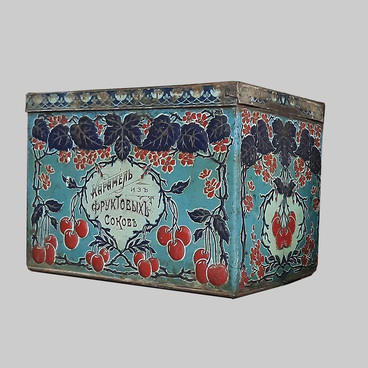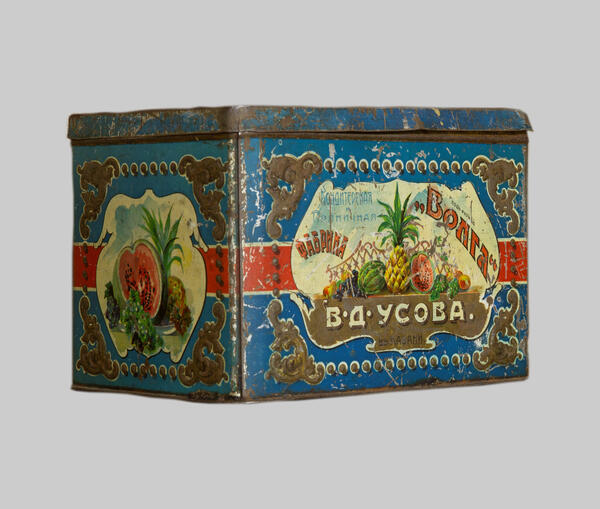
The exhibition showcases a blue tin box with a hinged lid. There is an inscription on its side: ‘Confectionery and Gingerbread Factory of the Volga company owned by V. D. Usov in Kazan.’ Fruits: grape, a pineapple, peaches, and a water-melon are depicted in the center. Residents of the Vyatka Governorate could seldom buy these fruits. These boxes were called bonbonnieres. Manufacturers used these boxes to pack drops with various fruit flavors. They were sold in bulk in stores. Candies called Montpensier were sold in tin boxes as well. These were small, colorful drops with a pronounced flavor. They were cheaper than chocolate sweets. So they were more popular.
The first chocolate confectioneries appeared in Russia in the middle of the 19th century. Their number exceeded 100 by the beginning of the 20th century. The confectionery industry began as handicraftsmanship and developed into manufacture in the second half of the 19th century. The invented steam engines and electricity contributed greatly to the development of the confectionery industry.
There were numerous types of confectionery: different kinds of sweets, chocolate products, cocoa, fruit jelly, pastila, gingerbreads, biscuits, and boiled sweets. Small businesses, bakeries, and baker’s shops manufactured flour confectionery. They produced gingerbreads, ginger goods, rusks, and other goods. In the early 20th century, confectionery was mainly produced in large cities: St. Petersburg, Moscow, Kharkiv, and Odessa.
Confectionery was also produced in Sarapul city in the Vyatka Governorate. Wilhelm Friedrich Wolf from Germany opened a confectionery shop in Troitskaya street in 1886.
He was born in Saxony in 1866. Later he moved to St. Petersburg and became a confectioner. For a long time, he lived in Sarapul, where he opened a confectionery, several confectionery and baker’s shops. He manufactured cakes, honey gingerbreads, pastry and rolls, which were very popular among buyers.
The confectionery also produced custom-made cakes and pastry for birthdays and solemn occasions. The store was extremely popular among Sarapul residents for a long time.
The first chocolate confectioneries appeared in Russia in the middle of the 19th century. Their number exceeded 100 by the beginning of the 20th century. The confectionery industry began as handicraftsmanship and developed into manufacture in the second half of the 19th century. The invented steam engines and electricity contributed greatly to the development of the confectionery industry.
There were numerous types of confectionery: different kinds of sweets, chocolate products, cocoa, fruit jelly, pastila, gingerbreads, biscuits, and boiled sweets. Small businesses, bakeries, and baker’s shops manufactured flour confectionery. They produced gingerbreads, ginger goods, rusks, and other goods. In the early 20th century, confectionery was mainly produced in large cities: St. Petersburg, Moscow, Kharkiv, and Odessa.
Confectionery was also produced in Sarapul city in the Vyatka Governorate. Wilhelm Friedrich Wolf from Germany opened a confectionery shop in Troitskaya street in 1886.
He was born in Saxony in 1866. Later he moved to St. Petersburg and became a confectioner. For a long time, he lived in Sarapul, where he opened a confectionery, several confectionery and baker’s shops. He manufactured cakes, honey gingerbreads, pastry and rolls, which were very popular among buyers.
The confectionery also produced custom-made cakes and pastry for birthdays and solemn occasions. The store was extremely popular among Sarapul residents for a long time.