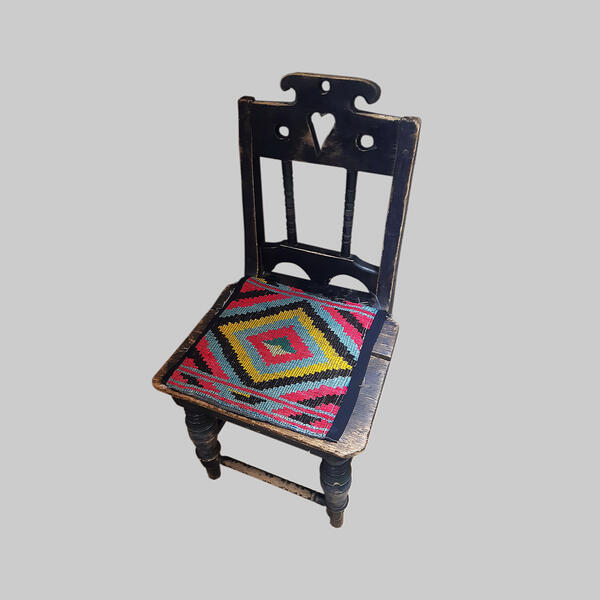
The chair appeared in the peasant households in the mid-19th century, complementing the benches. A table with a massive base and carved table legs was put into the front corner. Next to it was the only chair in the house—pukon. This was the chair for the head of the household or his esteemed guest. Women, especially daughters-in-law, had no right to sit on a chair and sat only on benches. The head of the household sat on his chair during dinners and when guests visited and the food was served to them. A black chair with round legs, a square seat, and a high carved back is displayed in the exhibition.
The dwelling of the Udmurts was a log hut with a gable roof, uninsulated entrance halls, an adobe Russian stove, benches along the walls, bunks and bunk beds with a wooden headboard.
The stove was a sacred place in the Udmurt household. It was the source of heat, it was used to cook food, and created familial comfort. Space above the stove was reserved for children and the elderly. The stove was typically placed in the corner between the back and side walls, or close to either of these walls. Later on the stove ‘moved away’ from the walls: passages behind the stove started appearing in some houses. Small shelves were constructed over that space to store kitchen utensils, dishes, etc.
The corner across the stove was considered the ‘red corner’, same as in a Russian hut. This was the cleanest place of the house. Udmurts call it tor sereg or mudor sereg. Broad benches were placed along all walls, encircling the house. There were benches for men and for women. Above the windows and along the walls, shelves were installed, enclosing the space of the room from the top.
In the interior of the hut, a table, a chair, and a front corner were places of great import. The table was the symbol of the family itself, because families gathered around it. A matitsa — the ceiling beam, which the Udmurts called ‘mumykor’ in their language — had a special place in the worldview of Udmurt people. The word they called that beam consists of two words. First word is ‘mumy, ’ which means ‘mother’; the second is ‘kor, ’ meaning ‘log.’ Praying was only permitted in the space between the matitsa and the ‘red corner’ within the house. When a man was recruited into military service or went to war, he nailed a silver coin with a silk ribbon to the matitsa so it would protect him. When he returned, taking off that ribbon was an important part of the celebration of his return. The man thanked the deity Inmar and ‘mumykor’ for his safe return.
During the construction of the house, the Udmurts performed the rite of raising the matitsa. They prepared a place for it: a wad of wool and a silver coin was placed under either end. Wool was supposed to ‘comfort’ the matitsa as it upheld the great weight of the ceiling boards, ceiling beams, the roof, and the ground in the ceiling. This is how they gave thanks to the matitsa for its hard work. Having built the house, a few days later they carried out a housewarming celebration - ‘korka pyron.’ All relatives were invited, and if the village was small, all its residents were welcome. The guests arrived and greeted the house owners with the phrase: ‘Let this new house be ever prosperous and happy! ’.
The dwelling of the Udmurts was a log hut with a gable roof, uninsulated entrance halls, an adobe Russian stove, benches along the walls, bunks and bunk beds with a wooden headboard.
The stove was a sacred place in the Udmurt household. It was the source of heat, it was used to cook food, and created familial comfort. Space above the stove was reserved for children and the elderly. The stove was typically placed in the corner between the back and side walls, or close to either of these walls. Later on the stove ‘moved away’ from the walls: passages behind the stove started appearing in some houses. Small shelves were constructed over that space to store kitchen utensils, dishes, etc.
The corner across the stove was considered the ‘red corner’, same as in a Russian hut. This was the cleanest place of the house. Udmurts call it tor sereg or mudor sereg. Broad benches were placed along all walls, encircling the house. There were benches for men and for women. Above the windows and along the walls, shelves were installed, enclosing the space of the room from the top.
In the interior of the hut, a table, a chair, and a front corner were places of great import. The table was the symbol of the family itself, because families gathered around it. A matitsa — the ceiling beam, which the Udmurts called ‘mumykor’ in their language — had a special place in the worldview of Udmurt people. The word they called that beam consists of two words. First word is ‘mumy, ’ which means ‘mother’; the second is ‘kor, ’ meaning ‘log.’ Praying was only permitted in the space between the matitsa and the ‘red corner’ within the house. When a man was recruited into military service or went to war, he nailed a silver coin with a silk ribbon to the matitsa so it would protect him. When he returned, taking off that ribbon was an important part of the celebration of his return. The man thanked the deity Inmar and ‘mumykor’ for his safe return.
During the construction of the house, the Udmurts performed the rite of raising the matitsa. They prepared a place for it: a wad of wool and a silver coin was placed under either end. Wool was supposed to ‘comfort’ the matitsa as it upheld the great weight of the ceiling boards, ceiling beams, the roof, and the ground in the ceiling. This is how they gave thanks to the matitsa for its hard work. Having built the house, a few days later they carried out a housewarming celebration - ‘korka pyron.’ All relatives were invited, and if the village was small, all its residents were welcome. The guests arrived and greeted the house owners with the phrase: ‘Let this new house be ever prosperous and happy! ’.