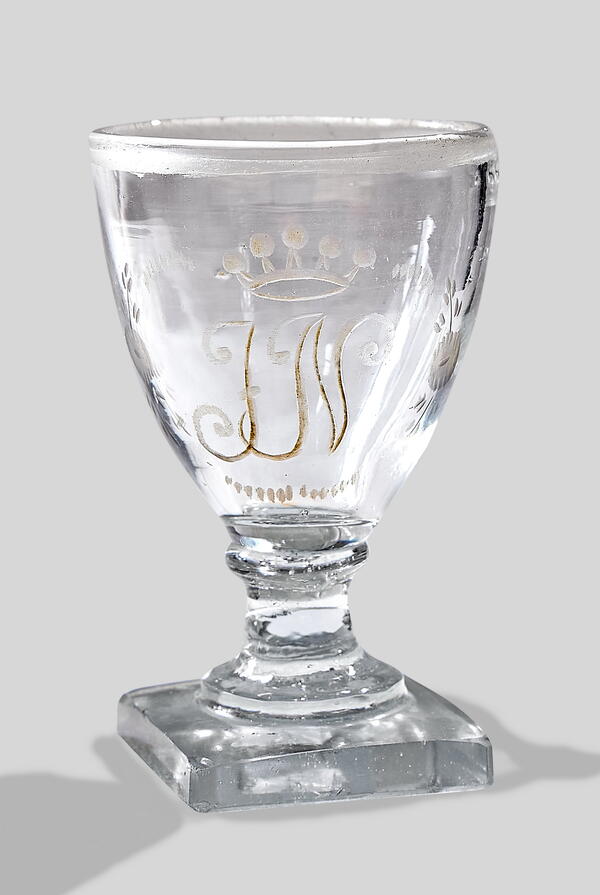
Small, engraved goblet shot glasses entered the collection from the Linen Factory Estate Museum in 1946. Most likely, they once belonged to the Goncharov family.
During the Great Patriotic War, the Big House of the Goncharovs at the Linen Factory was destroyed. After the war, it was rebuilt. Some of the belongings were saved, and many of them entered the museum’s collection.
The glasses date back to the late 18th century. They were most likely produced at the Milyatino (formerly Nemchinov) Glass Factory in the Kaluga Governorate. The enterprise was founded by the merchant Yakov Nemchinov in the wasteland near the village of Bogorodsky (Bogoroditsky), Mosalsky Uyezd. After a large fire in 1798, the new owner, Count Fyodor Orlov, moved production to the village of Milyatino. It was then that the plant received its new name.
By the end of the 18th century, about 80 glass factories operated in the Russian Empire. The leader among them was the factory in St. Petersburg. In 1792, it received the honorary title of the Imperial Factory.
Among private factories, the most prominent were the Gus Factory in the Vladimir Governorate and Dyatkovo Factory in the Oryol Governorate. They belonged to the Maltsov family. Another famous enterprise was the Nikolskaya Factory of the Bakhmetyevs in the Penza Governorate. The Milyatino Factory was also among the country’s leading glass enterprises.
The goblet shot glass with a low frustoconical stem and a square base was created using the glassblowing technique. The front side of the glass is decorated with the initials FN. Some of the surviving glasses feature additional images above the monogram, created using the mat cut technique. One depicts a flying bird, and another one — a crown.
The initials are framed with flowers. The edges of the glasses are decorated with mat-cut bands. At first glance, these glasses may seem modest — one of them is imperfectly shaped, the stem deviates from the vertical axis, and air bubbles can be seen in the glass. Nevertheless, such items are of great historical and artistic value as a rather rare example of the production of Russian private glass factories in the late 18th century.
During the Great Patriotic War, the Big House of the Goncharovs at the Linen Factory was destroyed. After the war, it was rebuilt. Some of the belongings were saved, and many of them entered the museum’s collection.
The glasses date back to the late 18th century. They were most likely produced at the Milyatino (formerly Nemchinov) Glass Factory in the Kaluga Governorate. The enterprise was founded by the merchant Yakov Nemchinov in the wasteland near the village of Bogorodsky (Bogoroditsky), Mosalsky Uyezd. After a large fire in 1798, the new owner, Count Fyodor Orlov, moved production to the village of Milyatino. It was then that the plant received its new name.
By the end of the 18th century, about 80 glass factories operated in the Russian Empire. The leader among them was the factory in St. Petersburg. In 1792, it received the honorary title of the Imperial Factory.
Among private factories, the most prominent were the Gus Factory in the Vladimir Governorate and Dyatkovo Factory in the Oryol Governorate. They belonged to the Maltsov family. Another famous enterprise was the Nikolskaya Factory of the Bakhmetyevs in the Penza Governorate. The Milyatino Factory was also among the country’s leading glass enterprises.
The goblet shot glass with a low frustoconical stem and a square base was created using the glassblowing technique. The front side of the glass is decorated with the initials FN. Some of the surviving glasses feature additional images above the monogram, created using the mat cut technique. One depicts a flying bird, and another one — a crown.
The initials are framed with flowers. The edges of the glasses are decorated with mat-cut bands. At first glance, these glasses may seem modest — one of them is imperfectly shaped, the stem deviates from the vertical axis, and air bubbles can be seen in the glass. Nevertheless, such items are of great historical and artistic value as a rather rare example of the production of Russian private glass factories in the late 18th century.