The Archaeology Institute of the Russian Academy of Sciences carried out research in the historical part of Gorokhovets between 2015 and 2017. The scientists discovered many glass objects, with bracelets being a prevalent type.
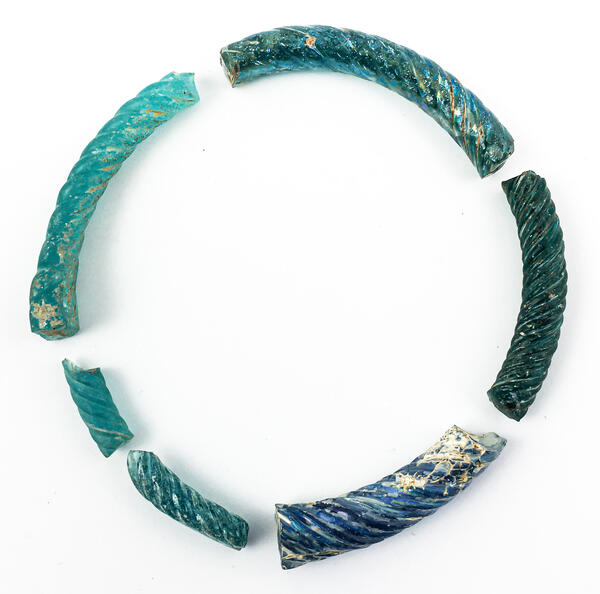
It has long been established that such finds are firmly connected to the 12th–13th centuries, at the same time, their most extensive distribution dates to the pre-Mongolian period. Most of the items were twisted bracelets. They were made by forming a ribbed blank rod, which was then twisted and bent into a ring.
The second largest group is smooth bracelets. They were made from an elongated round blank rod and bent into a ring. Another group is spiral bracelets. There were not many of them in Gorokhovets, as is usually the case in ancient Russian towns.
Spiral bracelets were made by twisting two, four, or five thin rods, which were all welded together and bent. The ratio of twisted to smooth bracelets is important for establishing the timeline of these pieces of jewelry.
The study of bracelets from the city of Novgorod showed that the predominance of twisted bracelets over smooth ones was typical of the pre-Mongolian period. The deposits of the mid-13th century demonstrated an equal ratio between these two groups. Then, from the end of the 13th century, smooth bracelets started to significantly prevail over twisted ones.
Research in the Gorokhovets district proved that the finds date to the period between the second half of the 12th century and the first half of the 13th century. More than half of the bracelets were discovered in small fragments, which makes it impossible to determine their inner diameter.
The color range of the bracelets is very diverse: there were beige, turquoise, yellow-green, yellow, brown, red-brown, olive, gray-blue, blue-green, and blue-violet items. Most often, the ornaments were performed in dark hues of brown, olive, and beige; somewhat less often yellow-green and yellow were used; occasionally there were shades of blue and turquoise, but never purple.
It has long been established that such finds are firmly connected to the 12th–13th centuries, at the same time, their most extensive distribution dates to the pre-Mongolian period. Most of the items were twisted bracelets. They were made by forming a ribbed blank rod, which was then twisted and bent into a ring.
The second largest group is smooth bracelets. They were made from an elongated round blank rod and bent into a ring. Another group is spiral bracelets. There were not many of them in Gorokhovets, as is usually the case in ancient Russian towns.
Spiral bracelets were made by twisting two, four, or five thin rods, which were all welded together and bent. The ratio of twisted to smooth bracelets is important for establishing the timeline of these pieces of jewelry.
The study of bracelets from the city of Novgorod showed that the predominance of twisted bracelets over smooth ones was typical of the pre-Mongolian period. The deposits of the mid-13th century demonstrated an equal ratio between these two groups. Then, from the end of the 13th century, smooth bracelets started to significantly prevail over twisted ones.
Research in the Gorokhovets district proved that the finds date to the period between the second half of the 12th century and the first half of the 13th century. More than half of the bracelets were discovered in small fragments, which makes it impossible to determine their inner diameter.
The color range of the bracelets is very diverse: there were beige, turquoise, yellow-green, yellow, brown, red-brown, olive, gray-blue, blue-green, and blue-violet items. Most often, the ornaments were performed in dark hues of brown, olive, and beige; somewhat less often yellow-green and yellow were used; occasionally there were shades of blue and turquoise, but never purple.