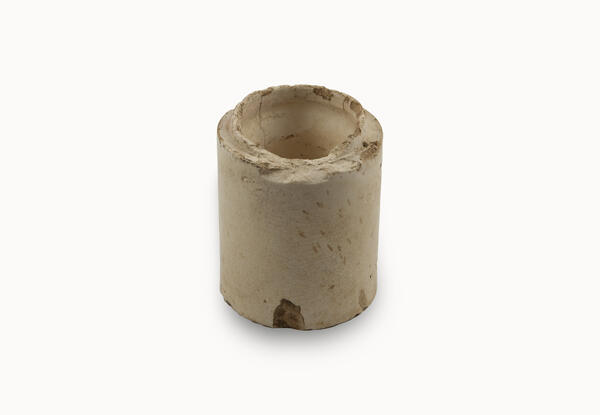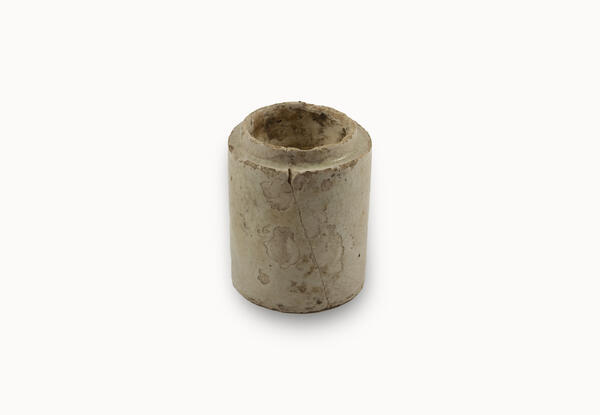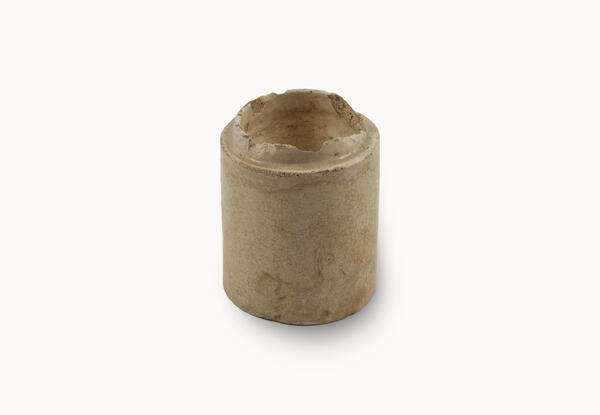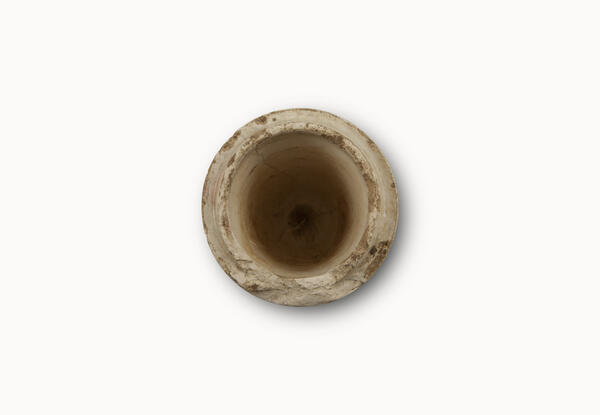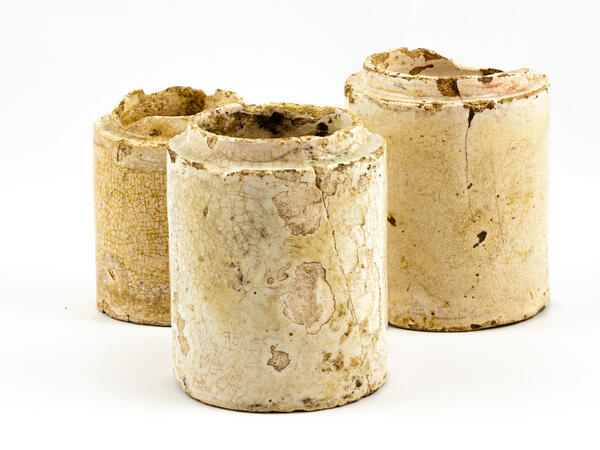
Archaeologists often find small ceramic containers in the recent cultural deposits of Russian cities. Similar objects were also found on the territory of Gorokhovets. Experts call these artifacts apothecary, cosmetic, or pomade jars.
Pomade jars were made of clay and covered with an opaque layer of glaze. The jar was always white inside, while on the outside it could be of different colors: from blue to dark blue, purple, cherry-colored, white, or yellow. All pomade jars that archaeologists managed to find had a similar shape: a cylindrical body and a small rim with a groove under it.
Clay apothecary jars were used to store whitewash, rouge, pomade, and other cosmetics that could have different colors. A scarlet shade was obtained from barberry, green from scallions or nettle leaves, yellow from dock, alder bark and saffron, and crimson from young apple leaves.
Cosmetic jars had thick walls and a massive bottom, and their internal volume was much smaller than the external one. The bottom of such containers was deliberately made massive and rounded so that it was more convenient to take out cream or balm with a wooden spatula or fingers.
Due to their steadiness and good quality of ceramics and glaze, pomade jars were often reused. In particular, Alexander Pushkin’s neighbor Yekaterina Ivanovna Osipova recalled that, while staying in the village of Mikhailovskoye between 1824 and 1826, the poet lived quite modestly and even used a cosmetic jar instead of an inkwell.
Such artifacts allowed scientists to better understand the lifestyle of Gorokhovets residents starting from the 16th century. Cosmetic jars were recovered during archaeological excavations at 7 Lenina Street. Dutch, as well as Turkish, smoking pipes were also found there. Researchers dated the objects from the exposition to the period of the 18th century — the first half of the 19th century.
Pomade jars were made of clay and covered with an opaque layer of glaze. The jar was always white inside, while on the outside it could be of different colors: from blue to dark blue, purple, cherry-colored, white, or yellow. All pomade jars that archaeologists managed to find had a similar shape: a cylindrical body and a small rim with a groove under it.
Clay apothecary jars were used to store whitewash, rouge, pomade, and other cosmetics that could have different colors. A scarlet shade was obtained from barberry, green from scallions or nettle leaves, yellow from dock, alder bark and saffron, and crimson from young apple leaves.
Cosmetic jars had thick walls and a massive bottom, and their internal volume was much smaller than the external one. The bottom of such containers was deliberately made massive and rounded so that it was more convenient to take out cream or balm with a wooden spatula or fingers.
Due to their steadiness and good quality of ceramics and glaze, pomade jars were often reused. In particular, Alexander Pushkin’s neighbor Yekaterina Ivanovna Osipova recalled that, while staying in the village of Mikhailovskoye between 1824 and 1826, the poet lived quite modestly and even used a cosmetic jar instead of an inkwell.
Such artifacts allowed scientists to better understand the lifestyle of Gorokhovets residents starting from the 16th century. Cosmetic jars were recovered during archaeological excavations at 7 Lenina Street. Dutch, as well as Turkish, smoking pipes were also found there. Researchers dated the objects from the exposition to the period of the 18th century — the first half of the 19th century.