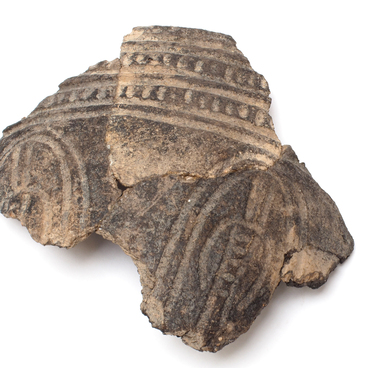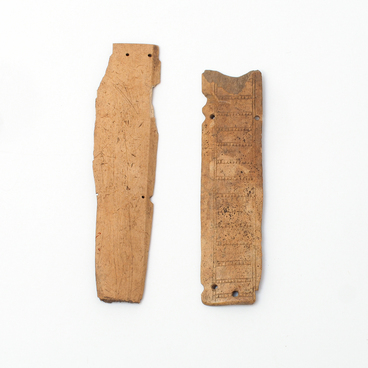
The Samus archaeological culture is considered one of the most original indigenous cultures of Northern Eurasia, which existed during the early Bronze Age — the first half of the 2nd millennium BC. It was characterized by ceramic vessels with complex ideographic compositions — drawings that denoted whole ideas and images.
There are not many Samus ceramic vessels with complex symbolic compositions that have been found. Settlement Samus IV is located within the modern village of Samus of the closed administrative-territorial formation of Seversk.
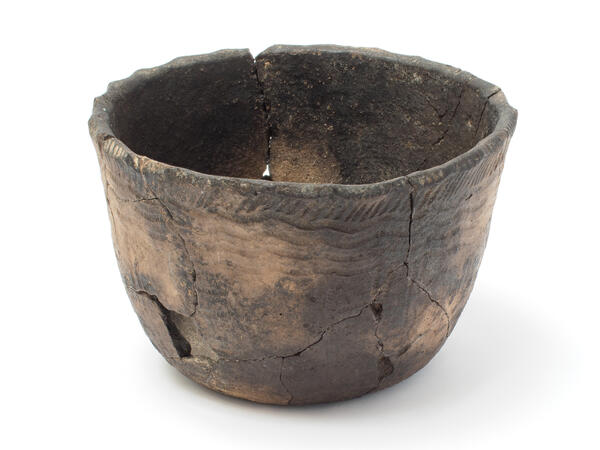
The ceramic vessel from the museum was discovered in 1996 at the bottom of a wide, but shallow pit, which had been dug intentionally in ancient times. The vessel was assembled from several large fragments. The archaeologists could not confirm whether the vessel was shattered deliberately during the ritual, or it was destroyed by time and soil. The finding was restored: the shape and ancient ornament were repaired.
The ceramic vessel is a wide reservoir with a flat bottom and an open mouth — the widest upper part. To make it, an ancient potter used the traditional technology of clay coling: the vessel was wrapped in a circle with clay coils; these coils were fastened together by fingers. With a special spatula, the master applied the symbolic pattern to the entire surface.
On the walls of the vessel the master depicted hills and masks, and on the bottom — concentric circles, symbolizing the solar disc.
The masks depicted on the vessel belong to human-like images. However, the master designed them in such a way that only a specialist, involved in Samus symbolism can identify human faces. The image of a mountain or a hill represents the world mountain. This is the axis of the universe that connects the sky, the earth and the chthonic depths.
The vessels with symbolic images in the Samus culture greatly differ from household ceramics. Archaeologists distinguish them as a category of a cult. Such vessels were used during special rituals for the protection of people and their well-being. These rituals were also necessary to ensure success in various fields of activity, including metalworking and agriculture. Sacred ceramics also preserved the memory of real and imaginary ancestors, with its help the valuable information was transmitted in the ancient society from one generation to the other.
There are not many Samus ceramic vessels with complex symbolic compositions that have been found. Settlement Samus IV is located within the modern village of Samus of the closed administrative-territorial formation of Seversk.
The ceramic vessel from the museum was discovered in 1996 at the bottom of a wide, but shallow pit, which had been dug intentionally in ancient times. The vessel was assembled from several large fragments. The archaeologists could not confirm whether the vessel was shattered deliberately during the ritual, or it was destroyed by time and soil. The finding was restored: the shape and ancient ornament were repaired.
The ceramic vessel is a wide reservoir with a flat bottom and an open mouth — the widest upper part. To make it, an ancient potter used the traditional technology of clay coling: the vessel was wrapped in a circle with clay coils; these coils were fastened together by fingers. With a special spatula, the master applied the symbolic pattern to the entire surface.
On the walls of the vessel the master depicted hills and masks, and on the bottom — concentric circles, symbolizing the solar disc.
The masks depicted on the vessel belong to human-like images. However, the master designed them in such a way that only a specialist, involved in Samus symbolism can identify human faces. The image of a mountain or a hill represents the world mountain. This is the axis of the universe that connects the sky, the earth and the chthonic depths.
The vessels with symbolic images in the Samus culture greatly differ from household ceramics. Archaeologists distinguish them as a category of a cult. Such vessels were used during special rituals for the protection of people and their well-being. These rituals were also necessary to ensure success in various fields of activity, including metalworking and agriculture. Sacred ceramics also preserved the memory of real and imaginary ancestors, with its help the valuable information was transmitted in the ancient society from one generation to the other.