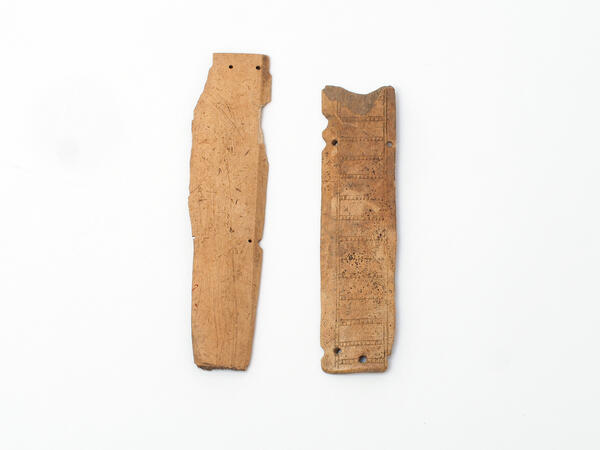
A bone armor plate was found in the cultural layer of the Chekist settlement. It is located on the bank of the Bolshaya Kirgizka River, not far from the place where it joins the Tom River. The exhibit belongs to the Irmen archaeological culture and dates back to the first centuries of the first millennium BC.
The object is a narrow rectangular plate with holes; this plate was a part of the military armor. Such armor was called lamellar or plate: they consisted of many bone or horn plates that were tightly placed to each other. A special groove on one side and a pointed edge on the other provided a tight fit of the armor elements. The fragment was made from the rib bone of a large mammal.
The full armor consisted of several dozen, and sometimes hundreds of plates. They were placed in rows and fastened with straps or tendon threads.
Similar armor appeared in Western Siberia in the Late Bronze Age, in the 12th-7th centuries BC. It was a period of active migrations and military clashes. In the southern regions, large fortresses with complex defensive structures were built. Early chiefdoms appeared: the culture became militarized, a special role was assigned to the leader, property and social stratification appeared. Metal consumption was growing. Masters began to make special offensive weapons from ‘ruthless’ bronze: three-bladed arrowheads, daggers and even swords. At this time, protective armor was also improved, the main type of which was a lamellar plate armor.
The exhibit from the museum is considered rare: the craftsman applied an ornament to it. He decorated the plate with a geometric composition resembling a ladder and then polished its outer surface. The drawing consists of thin and straight engraved lines. Researchers claim that the decorated armor plate was a part of the ceremonial armor. Such armors were expensive and valuable; they could only belong to a representative of the military elite.
The bone armor was designed to protect against the main weapon of the Bronze Age — arrows. If the bow was powerful, the arrow could pierce through a person’s body. However, the lamellar armor distributed the impact force along the plate, so it was quite difficult to pierce it through. The effectiveness of bone armor is also confirmed by experiments and ethnographic descriptions.
The object is a narrow rectangular plate with holes; this plate was a part of the military armor. Such armor was called lamellar or plate: they consisted of many bone or horn plates that were tightly placed to each other. A special groove on one side and a pointed edge on the other provided a tight fit of the armor elements. The fragment was made from the rib bone of a large mammal.
The full armor consisted of several dozen, and sometimes hundreds of plates. They were placed in rows and fastened with straps or tendon threads.
Similar armor appeared in Western Siberia in the Late Bronze Age, in the 12th-7th centuries BC. It was a period of active migrations and military clashes. In the southern regions, large fortresses with complex defensive structures were built. Early chiefdoms appeared: the culture became militarized, a special role was assigned to the leader, property and social stratification appeared. Metal consumption was growing. Masters began to make special offensive weapons from ‘ruthless’ bronze: three-bladed arrowheads, daggers and even swords. At this time, protective armor was also improved, the main type of which was a lamellar plate armor.
The exhibit from the museum is considered rare: the craftsman applied an ornament to it. He decorated the plate with a geometric composition resembling a ladder and then polished its outer surface. The drawing consists of thin and straight engraved lines. Researchers claim that the decorated armor plate was a part of the ceremonial armor. Such armors were expensive and valuable; they could only belong to a representative of the military elite.
The bone armor was designed to protect against the main weapon of the Bronze Age — arrows. If the bow was powerful, the arrow could pierce through a person’s body. However, the lamellar armor distributed the impact force along the plate, so it was quite difficult to pierce it through. The effectiveness of bone armor is also confirmed by experiments and ethnographic descriptions.