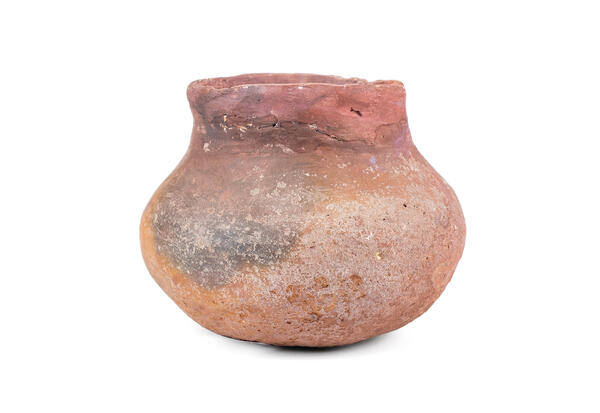
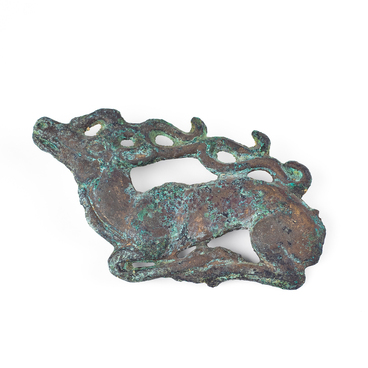
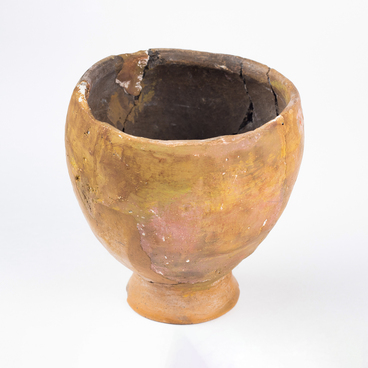
This jug-shaped miniature vessel with a high neck, rounded shoulders, a spherical body and a flattened bottom was made of light clay. The craftsman made a through hole under the rim. The vessel was included in the burial equipment of Tagar burial mounds. The burial ground, which was discovered in the city of Sayanogorsk in the Republic of Khakassia, was dated to the period from the 4th to the 3rd century BCE.
During the construction of the Sayanogorsk Aluminum Smelter, scientists were contacted to carry out rescue archaeological work. The research was carried out by the Beya Archaeological expedition of the Institute of the History of Material Culture of the Russian Academy of Sciences. The excavations took place from 2004 to 2007, the research was headed by Margarita Nikolaevna Pshenitsyna.
The pottery of the early Bain stage of the Tagar culture consisted mainly of jar-like vessels with a flattened bottom. This form of pots prevailed throughout the development of the Tagar archaeological culture. Over time, only the patterns changed, and some peculiar shapes of vessels for various purposes appeared.
The pottery of the next Podgornov stage was distinguished by the fact that the mouth of the vessel received a characteristic thickening along the bevel with a sharp edge below. Besides, the objects began to be decorated with groove patterns. This type of vessel was most widespread in the steppes of the Khakass-Minusinsk Basin.
Among the items of the Saragashen stage of the Tagar culture, to which this artifact belongs, researchers often found vessels in the form of a vase or a cauldron on a conical foot. Jar-shaped vessels, as a rule, without ornament, differed from similar housewares of the previous stage by a characteristic straight or oblique cut of the rim.
Russian archaeologists
have also encountered other jug-shaped vessels similar to this item from the
collection, both with and without decorative patterns. Small vessels of various
shapes were also characteristic of this period. The ways such items were used
have been little studied. It is believed that miniature bronze vessels were
used as earrings.